
Infant Sleep Regression at 4 Months: What's Really Going On
The 4 month sleep regression isn't a setback — it's the sleep cycle growing up. Why babies wake every 40 minutes, how long it lasts, and what really helps.

Mama Ai Team
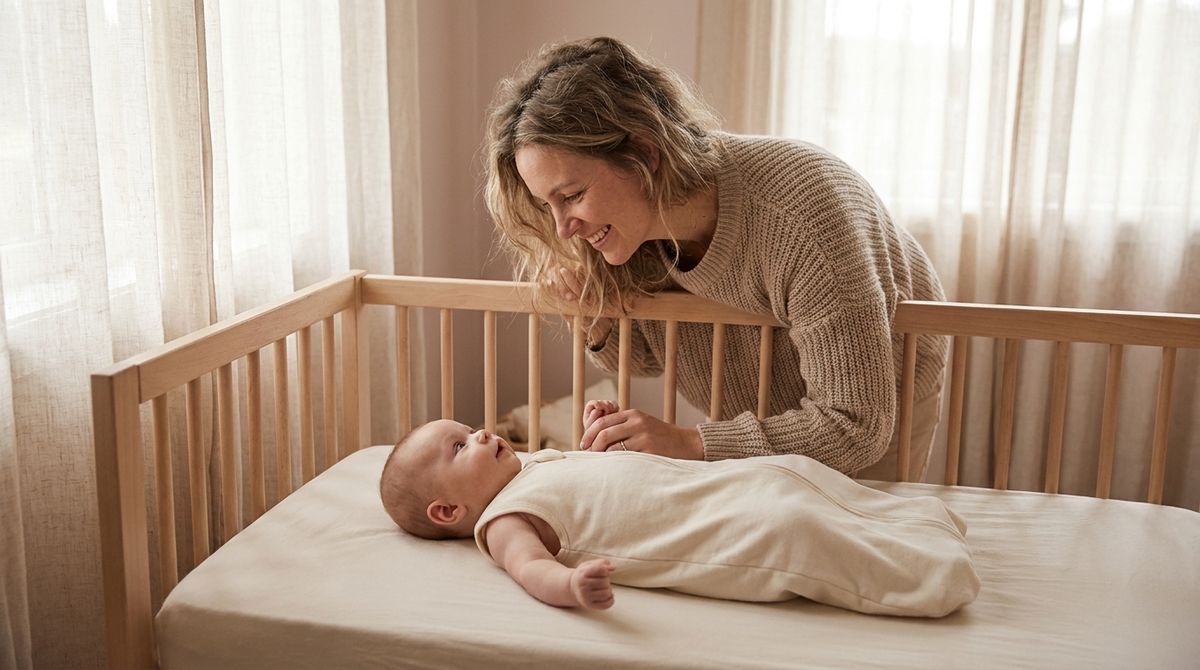
Your baby was sleeping. Maybe not perfectly, but sleeping: three hours in a row, sometimes four, and once — a whole five, and you almost let yourself believe the worst was behind you. And then someone flipped a switch. Now they wake every forty minutes. Breast, arms, rocking, pacifier, breast again — all the way to sunrise. And you lie there in the dark thinking the same thought over and over: what did I do wrong?
Nothing. Nothing at all. What's happening to your baby usually gets called sleep regression — possibly the worst word in the entire parenting dictionary. Because there is no regression. There's growing up, and it just looks terrible from the outside — especially at four in the morning.
Infant sleep regression: what it is and why nothing is broken
Here's the headline, and it's the reason to keep reading: infant sleep regression is not a step backwards. It's a step forward that you, unfortunately, feel in your own spine.
"Sleep regression" is a folk term, not a diagnosis. It doesn't appear in any medical classification. Parents invented the word to describe something very real: a baby who was sleeping suddenly stops. But the word itself paints the wrong picture — as if your baby "forgot how," as if something broke and needs fixing. What's actually happening in their head is exactly the opposite.
The classic baby sleep regression signs are hard to miss: sleep stretches that shrink to forty minutes, catnaps that used to be long naps, a baby who fights bedtime they used to accept, and night wakings that need you every single time. All of it points at one thing — a brain that's rebuilding sleep from the ground up.
How baby sleep cycles work — and what changes at 4 months
A newborn's sleep is beautifully simple. They only have two states: active sleep (twitching, grunting, eyes moving under the lids) and quiet sleep. No complicated transitions, no in-between stages. That's exactly why newborns can fall asleep anywhere, through any noise, in anyone's arms, and sleep like someone pulled the plug.
Somewhere between three and five months, your baby's brain goes through a serious reorganisation. Sleep rebuilds itself from two simple states into full adult architecture — several stages, deep sleep alternating with light sleep. A real sleep cycle forms, roughly 40–50 minutes long, and at the end of every cycle there's a phase of very light sleep.
And here's the key thing almost nobody says out loud: this is permanent. Your baby's sleep has changed for good. It isn't going to "go back" to how it was at two months — not in a week, not in a month. What does change from here is your baby's ability to move from one cycle into the next without fully waking up.
Why your baby wakes every 40–50 minutes like clockwork
Because they're surfacing. At the end of each sleep cycle your baby rises almost to the surface — and takes a split second to check the surroundings. That's not a glitch, that's normal. You do the same thing every night: you surface, roll to your other side, pull the blanket back up, and remember none of it in the morning.
The difference is that an adult knows how to dive back down. A four-month-old doesn't yet. And a very simple logic kicks in: a baby wakes up where they fell asleep. If they drifted off at your breast, in warm arms, being gently rocked — and surfaced forty minutes later alone, in silence, in a crib — that's alarming. The world changed while they slept. So they call you, to bring back the conditions they fell asleep in.
You haven't spoiled them. You haven't created a "bad habit." They're simply looking for what they remember.
When it starts and how long does sleep regression last
The real, physiological sleep regression lands at roughly 3–5 months. For some babies it starts at 3.5 months, for others closer to five — and it has nothing to do with whether you have a "good" baby. This is about brain maturation, and brains mature on their own schedule.
How long does it last? The honest answer: for most families the acute phase runs two to six weeks. But it isn't a switch with a date on it. The rebuild of the sleep cycle happens once and for good; learning to link one cycle to the next is a process that stretches over weeks and months. Most parents describe it less as "it ended" and more as "it gradually got easier."
Are the 8–10, 12 and 18 month regressions real?
Yes and no. Let's be honest here: there's almost no evidence behind a fixed "regression calendar." It's folk classification, not science.
But stretches of unsettled sleep really do happen around those months — the mechanism is just different:
- 8–10 months. Your baby is learning to crawl, sit, pull to stand. At night the brain rehearses the new skill, and your baby literally wakes up to "have a stand in the crib." Object permanence is also forming — the understanding that mum still exists even when she's out of sight. Hence separation anxiety.
- 12 months. First steps, first words, and often the shift to one nap a day.
- 18 months. A language leap, teeth, personality, and a will that has fully arrived.
These are developmental leaps, not repeats of the four-month rebuild. The four-month sleep regression is the only one with concrete, universal physiology behind it.
How much should a 4 month old actually sleep?
A huge share of parental suffering at this stage isn't about your baby's sleep at all — it's about a false benchmark. A friend mentioned her baby "sleeps through the night." Social media showed you that a normal four-month-old sleeps twelve hours without stirring. Against that picture, your reality looks like failure.
So here's what normal sleep actually looks like:
- Across 24 hours at this age, babies sleep roughly 12–16 hours, naps included.
- Night wakings at 4 months are normal — practically the rule. The overwhelming majority of babies have them.
- Most importantly: in research, "sleeping through the night" very often means an unbroken stretch of 5–6 hours — midnight to five, say. Not twelve. Five.
Read that last point again. Your baby may already be "sleeping through the night" by the standards of science — just not by your neighbour's.
And one more thing: night feeds at four months are still normal for many babies. The stomach is small, growth is fast, and night-time milk production in breastfeeding mothers is physiologically higher. Waking to eat at this age isn't fussiness. If you're breastfeeding and want to work through latch and volume, you may find our guide on how to get breastfeeding off to a good start useful.
What actually helps — honestly, no promises
There's no magic button, and anyone selling you one is selling you something else. But there are things that genuinely tip the scales.
A boring, predictable bedtime routine
A routine isn't about magic, it's about predictability. The same short sequence every evening, in the same order: bath, fresh clothes, dim light, feed, a song or a couple of phrases, crib. Fifteen to twenty minutes. "Boring" is a compliment here. Your baby's brain learns: sleep always comes after this chain.

Drowsy but awake
This is the single most useful idea in the whole article — and simultaneously the most infuriating, because it sounds simple and is anything but. Since a baby wakes up where they fell asleep, try putting yours down drowsy but awake: relaxed, heavy-lidded, but still conscious. Then, when they surface forty minutes later, they'll find exactly the setting they fell asleep in — and they get a chance to dive back down on their own.
It won't work the first time. Or the tenth. It's a skill, and skills take practice.
Wake windows and tired signs
At 4 months most babies are comfortably awake for about 1.5–2.5 hours between sleeps. But watch your baby, not the clock: the stare that goes glassy, eye rubbing, yawns, losing interest in a toy. An overtired baby falls asleep worse, not better — a tired brain gets wired, and then surfaces even more often.
Darkness, white noise, and the art of the pause
A dark room — genuinely dark; you don't need a night light. White noise helps smooth over household sounds right at the light phase: keep it quiet (about the volume of a calm conversation) and not right next to the crib. During the day, aim for full feeds rather than endless three-minute snacks, so your baby isn't topping up calories at night.
And separately — the pause. Babies are noisy between cycles: they grunt, sigh, whimper, shuffle, sometimes cry out — all without waking up. If you fly into the room at the first sound, you'll regularly wake a baby who was about to fall back asleep on their own. Count to thirty. Sometimes that's all it takes.
Swaddling and rolling: the moment you can't miss
This is the most important paragraph in the article, and it's about safety.
The moment your baby shows any sign of learning to roll — tipping onto their side, twisting their torso, pushing off with their legs — swaddling has to stop. Completely. Not "with one arm out," not "just one more week." Done.
The reason is simple and serious: a swaddled baby who rolls onto their stomach can't push up on their arms and lift their head. You've taken away the one tool they had to save themselves. And the cruel irony is that learning to roll falls in exactly the same 3–5 months as the sleep rebuild — right when you least want to touch the one thing that was "sort of working."
The replacement is a sleep sack with arms free. Yes, the first few nights will probably be worse. It's worth it.

Sleep training: what the research shows
The topic parent group chats go to war over. Let's try it without moralising in either direction.
What the data does show: behavioural methods — graduated extinction (where a parent returns at gradually increasing intervals; it's also called "controlled comforting") and bedtime fading — do improve settling and reduce night wakings in some babies in clinical trials. Long-term follow-up, including a five-year follow-up of participants in a randomised trial, found no harm to attachment, emotional wellbeing, or the child's stress levels.
What the data doesn't show: that it's mandatory, that it works for everyone, or that without it a baby won't learn to sleep. Most methods aren't even considered before 4–6 months.
And most importantly: it's a choice, not an obligation. Plenty of families simply live through this period — responsively soothing, rocking, feeding at night — and arrive at the same place by a different road. That's every bit as normal. The right option is the one your family can actually sustain.
Safety: what not to miss
The safe sleep rules never change
Whatever is happening with sleep cycles, these rules stay exactly the same:
- On the back — for every sleep, day and night. If your baby already rolls confidently both ways on their own, you don't need to roll them back at night — but still put them down on their back.
- Alone, in their own crib — in the parents' room for at least the first 6 months.
- A flat, firm mattress with a fitted sheet.
- An empty crib: no pillows, blankets, bumpers, positioners, toys, or nests.
And separately — about four in the morning, when you're barely human. Never fall asleep with your baby on a sofa or in an armchair. It's one of the most dangerous scenarios there is: a baby can slide into the gap between the cushions or end up face-down in soft upholstery. If you feel yourself going under during a feed, it's safer to plan ahead and feed in bed with pillows and blankets moved well away than to black out in an armchair.
When it isn't a regression — and when to call the doctor
Sleep regression is about a baby who wakes but is otherwise cheerful, feeding, gaining weight, and comfortable. It's worth seeing a doctor if you notice:
- Snoring, mouth breathing during sleep, pauses in breathing — this can point to sleep apnoea in your baby and needs a doctor's assessment.
- Signs of illness: fever, cough, runny nose, lethargy.
- An ear infection — the pain often gets worse lying flat, which is why a baby screams specifically at bedtime.
- Reflux: heavy spit-ups, arching the back, crying right after a feed.
- Poor weight gain or noticeably fewer wet nappies.
- Inconsolable crying, rather than just waking. Colic usually peaks at 6–8 weeks and settles by 3–4 months — so at four months it's most likely not that; we wrote about how to tell the difference and what helps in our article on colic in babies.
Trust yourself. If something inside you is ringing that this isn't about sleep — that's a reason to see a doctor, not a sign of anxiety.
You're a person too: surviving these weeks
Let's call it what it is: sleep deprivation on this scale is brutal. You forget words, you cry over spilled tea, you get angry at your baby and then hate yourself for the anger. That's not a character flaw and it's not evidence you're a bad parent. It's physiology — exactly the same kind that's rebuilding your baby's sleep.
What genuinely helps:
- Split the night into shifts. One adult takes the first half, the other takes the second. Four unbroken hours restore you incomparably better than eight shredded ones.
- Lower the bar. The dust can wait. Dinner can be takeaway. This is temporary.
- Accept help — and ask for it specifically: "take him out for an hour while I sleep."
- Nap during the day when you get the chance, instead of "finally getting everything done."
And this matters. Tiredness lifts after sleep. But if the heaviness doesn't lift even on the good days, if the joy is gone, if there's constant anxiety, a sense that you're not coping or that your baby would be better off without you — that's no longer about lost sleep. It may be postpartum depression, and it's treatable. We've gone through how to tell postpartum depression from ordinary exhaustion in detail. Asking for help isn't weakness — it's caring for your baby too.
Key takeaways
- The 4 month sleep regression isn't a regression. It's a permanent rebuild of sleep architecture: the sleep cycle becomes adult, around 40–50 minutes, with a light phase at the end of each one.
- You didn't cause it. Not teeth, not habits, not "spoiling." Your baby surfaces between cycles and looks for the setting they fell asleep in.
- It won't go back — it gets easier going forward, once your baby learns to link cycles. For most families the acute phase lasts two to six weeks.
- Night wakings and night feeds at 4 months are normal. "Sleeping through the night" in research often means a 5–6 hour stretch, not twelve.
- What helps: a boring routine, putting your baby down drowsy but awake, wake windows, darkness, white noise, and the ability to hold a pause at the first sounds.
- Stop swaddling at the first signs of rolling — swap to a sleep sack with arms free.
- Sleep training is a choice, not a duty. The evidence doesn't support harm to attachment — and babies learn to sleep perfectly well without it too.
- Red flags: snoring and pauses in breathing, fever, poor weight gain, inconsolable crying — see a doctor.
- Safe sleep doesn't change: on the back, alone, in their own crib, empty. And never fall asleep with your baby on a sofa or in an armchair.
Tonight will probably be hard. But your baby isn't broken — they grew. And you, for the record, are doing better than you think at four in the morning.
This article is general information and doesn't replace personalised medical advice. If you're worried about your baby's sleep, breathing, behaviour, or weight gain, talk to your pediatrician.
Sources
- AAP / HealthyChildren.org — Getting Your Baby to Sleep
- AAP / HealthyChildren.org — Swaddling: Is it Safe?
- NICHD — Safe to Sleep
- Price AM et al. Five-Year Follow-up of Harms and Benefits of Behavioral Infant Sleep Intervention. Pediatrics, 2012
- Mindell JA et al. Behavioral Treatment of Bedtime Problems and Night Wakings in Infants and Young Children. Sleep, 2006
Created with AI and reviewed by the Mama Ai team. Educational information — not a substitute for professional medical advice.
We’re with you every week of the way
Download on the App Store