
Newborn Jaundice: Bilirubin Levels and When to Treat
Why a newborn turns yellow, what a bilirubin number actually means, how physiological jaundice differs from pathological, when phototherapy is needed, and the warning signs that call for a doctor today.

Mama Ai Team
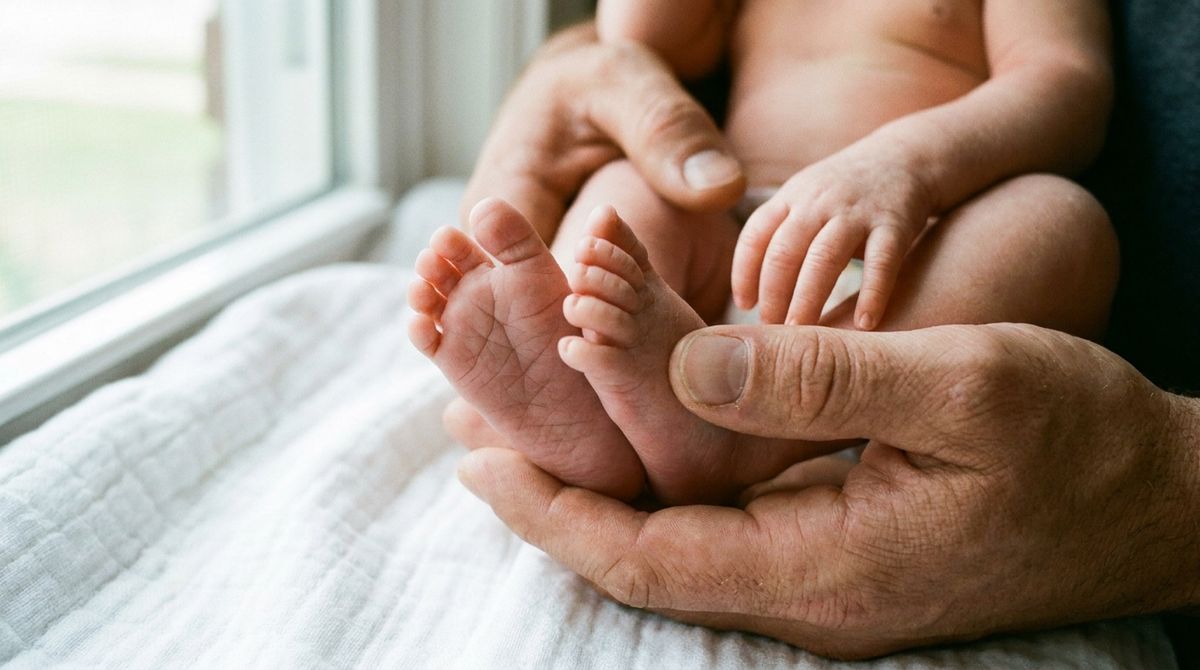
On day three after birth you look at your baby in daylight and notice it: the skin on their face isn't pink anymore, it has a warm yellow cast. Or a nurse says calmly, "A little jaundiced — let's check the bilirubin." And everything inside you tightens.
The good news: newborn jaundice is one of the most common conditions of the first week of life, and in the vast majority of cases it is harmless and resolves on its own. Visible yellowing occurs in roughly 60% of full-term and 80% of preterm babies. But there is a small group of situations where jaundice is a signal rather than a normal phase, and those are the ones worth recognizing. Let's go through it step by step: why babies turn yellow, what a bilirubin number means, how physiological jaundice differs from pathological jaundice, when phototherapy is needed, and when you should be seen today rather than "at the checkup next week."
Why newborns turn yellow: where bilirubin comes from
Bilirubin is a pigment produced when hemoglobin — the protein inside red blood cells — breaks down. It has one very noticeable side effect: it's yellow. When enough of it builds up in the blood, it tints the skin and the whites of the eyes.
In a newborn, two things happen at once:
- A surplus of red blood cells. In the womb your baby ran on fetal hemoglobin and a large volume of red cells — that's how oxygen came across the placenta. After birth they breathe on their own, that reserve is no longer needed, and the extra cells break down in bulk. The breakdown product is bilirubin.
- An immature liver. It's the liver that neutralizes bilirubin: it binds (conjugates) it with glucuronic acid, after which it leaves the body in bile and stool. In a newborn the enzyme that does this is still working at half speed and only reaches full capacity over the first weeks of life.
So the arithmetic is simple: a lot of bilirubin is made, and it clears slowly. Hence the other name for this kind of jaundice — conjugation jaundice: the problem isn't disease, it's the pace at which enzymes mature. This is a normal step in adapting to life outside the womb, not a malfunction.
One more detail explains a lot about treatment: some of the bilirubin that has already reached the gut can be reabsorbed back into the bloodstream. The less often a baby feeds and the less often they stool, the more bilirubin comes back. That's why feeding isn't a "supportive measure" — it's part of the clearance mechanism itself.
Physiological jaundice: what it looks like and when it's normal
Physiological (normal) jaundice follows a very recognizable script:
- It appears after 24 hours of life — usually on day two or three.
- It peaks on days 3–5 in full-term babies and on days 5–7 in preterm babies.
- It fades gradually — by 1–2 weeks in a full-term baby, by 2–3 weeks in a preterm one.
- It moves head to toe: the whites of the eyes and the face yellow first, then the chest and belly. It clears in reverse order — the legs lighten before the face does.
- The baby behaves normally: they wake for feeds, suck well, wet their diapers, and have normal-colored stool.
The easiest way to spot yellowing is in daylight by a window — warm bulbs and evening lighting distort skin tone badly. A useful home check: gently press a finger on the skin of the forehead or nose and let go. If the spot flashes yellow rather than white for a second, jaundice is present. You can't judge how severe it is this way — the eye, including a clinician's eye, is systematically unreliable — but you can track the trend at home.

Normal bilirubin levels in newborns: why there is no single number
This is the question parents ask most in the first days: "Bilirubin of 11 mg/dL (190 µmol/L) — is that normal or not?" The honest answer: you can't tell from one number, and that's not a dodge — it's the essence of the modern approach.
The threshold at which treatment is needed depends on at least three things:
- The exact age in hours, not in days. A bilirubin of 8.8 mg/dL (150 µmol/L) at 18 hours of life and the same 8.8 mg/dL at 96 hours are two fundamentally different situations.
- Gestational age. For a baby born at 35 weeks the threshold is noticeably lower than for one born at 40 weeks.
- Risk factors: hemolysis (red cell destruction), significant weight loss and dehydration, G6PD deficiency, sepsis, low albumin.
That's why clinicians don't check the result against a single "normal value" — they plot it on an hour-specific nomogram: a chart with hours of life along the bottom and bilirubin up the side, with threshold lines drawn for phototherapy and for more intensive treatment. The updated American Academy of Pediatrics guideline (AAP, 2022) includes a whole set of these curves — separate ones for each week of gestation and for babies with and without risk factors.
mg/dL and µmol/L: how to convert
US labs usually report bilirubin in mg/dL, while many labs elsewhere in the world use µmol/L. The conversion is simple: 1 mg/dL ≈ 17.1 µmol/L. So 12 mg/dL is about 205 µmol/L, and 20 mg/dL is roughly 342 µmol/L.
Ballpark figures — for orientation only
So the numbers on the discharge paperwork stop being a black box, here are rough reference points (to be clear: these are not thresholds for making your own decisions):
- Jaundice usually becomes visible to the eye once bilirubin passes roughly 5 mg/dL (85 µmol/L).
- In a healthy full-term baby, the peak of physiological jaundice most often falls in the range of about 5–12 mg/dL (85–205 µmol/L) on days 3–5.
- For a full-term baby with no risk factors, the phototherapy threshold at around 72 hours of age sits near 20–21 mg/dL (340–360 µmol/L), and in the first 24 hours it is substantially lower.
- For a baby born at 35–36 weeks or with hemolysis, the thresholds are a few mg/dL (several tens of µmol/L) lower.
Direct (conjugated) bilirubin is measured separately. In ordinary physiological jaundice the indirect fraction is elevated while the direct one stays low. A rise in direct bilirubin is an entirely different story and always calls for a workup.
Finally, there are two ways to measure. A transcutaneous bilirubinometer is a device held against the forehead or chest: fast, painless, ideal for screening. But at high values, after phototherapy has started, and in babies with darker skin, the reading is confirmed with a blood test, which is the one that counts.
Pathological jaundice: red flags you can't miss
Pathological jaundice is far less common than the physiological kind, but it's the whole reason screening exists. Contact your doctor urgently (not "whenever you get a chance") if:
- Jaundice appears in the first 24 hours of life. This always warrants immediate evaluation — physiological jaundice doesn't start that early.
- The yellowing is increasing quickly — your baby is noticeably more yellow than they were a day ago.
- The yellow has spread below the navel, reaching the palms and soles.
- Stool becomes pale, chalky white or clay-colored, and urine is dark — and it stays that way. That combination can point to obstructed bile flow, including biliary atresia (blocked bile ducts). It's a rare condition, but timing is critical: surgery works best in the first 6–8 weeks of life, so this needs to be checked immediately, not "watched for a week."
- Jaundice persists beyond 2 weeks in a full-term baby (beyond 3 weeks in a preterm baby). "The jaundice still hasn't gone after a month" is not unusual and often turns out to be harmless, but it does require testing that includes direct bilirubin.
- There are neurological signs: the baby is floppy and hard to wake, feeds poorly, has a high-pitched cry, arches their back, throws their head back, or runs a fever. These are signs of acute bilirubin encephalopathy — a rare but dangerous complication that, untreated, can lead to kernicterus with lasting neurological consequences. Preventing exactly this scenario is why thresholds and phototherapy exist.
What's most often behind pathological jaundice
- Rh or ABO blood group incompatibility. Maternal antibodies destroy the baby's red cells, and bilirubin rises fast and early. We covered this mechanism and how it's prevented in our article on Rh incompatibility in pregnancy.
- Other forms of hemolysis, including hereditary spherocytosis and G6PD deficiency — an enzyme disorder more common in people of Mediterranean, Middle Eastern, African and Southeast Asian ancestry.
- A cephalohematoma or extensive bruising from birth: blood pooled under the periosteum breaks down, adding another load of bilirubin.
- Infection — anything from a urinary tract infection to sepsis.
- Hypothyroidism (an underactive thyroid) — one of the common causes of prolonged jaundice, which is part of why newborn screening matters.
- Liver and bile duct disease, including biliary atresia and choledochal cyst.
- Rare inherited disorders of bilirubin metabolism (Crigler–Najjar syndrome, for example).
Jaundice and breastfeeding: two different things that get confused
This is probably the most useful part of the article — because this is where bad advice is handed out most often.
Breastfeeding jaundice (early)
It shows up on days 2–5. The cause isn't the milk, it's not getting enough of it: the baby takes in little, loses weight, stools infrequently, so bilirubin isn't cleared and some of it is reabsorbed from the gut. Essentially it's a jaundice of underfeeding and dehydration.
The fix is more feeds, not fewer. Aim for 8–12 feeds in 24 hours, including overnight, with a good latch and attention to whether the baby is actually swallowing. If your supply is still low or the baby is sleepy, your doctor may recommend pumping and supplementing. We walked through the practical steps in our guide on getting breastfeeding started in the first days.
Important: giving water or glucose solution is useless and harmful. Water doesn't flush out bilirubin, but it does fill a tiny stomach and crowd out milk, so the baby eats even less — and the jaundice gets worse.
Breast milk jaundice (late)
This is a different condition. It starts later — around the end of the first week — lasts longer, and can linger for 8–12 weeks, fading gradually. Meanwhile the baby feeds well, gains weight well, is alert, and has normal-colored stool. Certain components of breast milk are thought to slow bilirubin processing in the liver.
This kind of jaundice is benign and does not require stopping breastfeeding. There's no need to interrupt nursing "to clear the jaundice." But it's a diagnosis of exclusion: before attributing prolonged jaundice to milk, your doctor should confirm that direct bilirubin is normal, that thyroid screening was done, and that the stool isn't pale.

Treatment: how phototherapy works
Phototherapy is the main treatment, and a very effective one. The baby is placed under a lamp or on an illuminated pad (a fiber-optic "blanket") emitting blue-green light at a wavelength of about 460–490 nm. That light penetrates the skin and changes the structure of bilirubin molecules: they turn into water-soluble forms that leave the body in urine and bile without needing the liver's immature enzymes. In other words, the light does exactly the job the liver hasn't grown into yet.
What usually happens in practice:
- The baby lies undressed as much as possible so the light reaches a large area of skin; the eyes are covered with a soft mask or goggles.
- Feeding continues. The current approach is not to interrupt breastfeeding; the baby is taken out from under the lamp for feeds, and at high levels there are setups that allow feeding during treatment.
- Body temperature and adequate intake are monitored, and bilirubin is rechecked regularly.
- Possible side effects are usually mild and temporary: more frequent, looser stools, a mild rash, slight dehydration. Phototherapy has been used for decades and is considered safe.
- One to three days is typically enough; after it's stopped, bilirubin sometimes rebounds a little, so a follow-up test is ordered.
If bilirubin is very high or keeps climbing, intensive phototherapy is added (several light sources at once). In hemolytic disease, where maternal antibodies are the cause, intravenous immunoglobulin (IVIG) is sometimes used. In rare, most severe cases an exchange transfusion is performed — the baby's blood is replaced in small portions with donor blood, rapidly removing excess bilirubin and antibodies. This is not often needed, and it's timely phototherapy that keeps such cases rare.
What doesn't help — and what can hurt
- "Some sunlight by the window." Glass blocks a significant part of the useful spectrum, the light dose can't be controlled, and the risks are real: overheating, chilling an undressed baby, and sunburn on very thin skin. Direct sunbathing is not recommended for newborns. An ordinary walk in the shade is good for you both, but it isn't treatment for jaundice.
- Water, tea or glucose "to flush it out." They don't lower bilirubin and they reduce how much milk the baby takes.
- Herbal blends, homeopathy, "liver support" supplements. Their effectiveness isn't proven, and for a newborn any unnecessary product is a potential risk.
- Stopping breastfeeding "for a couple of days." In the vast majority of cases it isn't needed and it undermines your supply. Discuss any change to the feeding plan with your doctor.
- Waiting for it to "pass on its own" when there are red flags. Jaundice in the first 24 hours, pale stool or a lethargic baby are not things to watch at home.
How long it lasts and what to do at home
In most full-term babies the yellowing fades noticeably by the end of the first week and is gone by two weeks. With breastfeeding a faint yellow tint can persist longer — a common and usually harmless pattern, as long as the baby is feeding well and gaining.
What is genuinely in your hands:
- Feed often. Eight to twelve times a day, on demand, and wake a sleepy newborn if they've gone more than 3–4 hours straight in the first days.
- Count diapers. After days 4–5, aim for at least 6 wet diapers and 3–4 stools a day.
- Watch the color of the stool. It should go from black meconium to greenish and then yellow — not lighten toward white.
- Don't skip the follow-up visit. A baby discharged from the hospital is usually seen within 1–3 days at home; if bilirubin was near the upper limit, a repeat check is needed.
- Take care of yourself. The first week postpartum is when anxiety is amplified by exhaustion and hormonal swings; there are reference points for your own recovery in our article on postpartum bleeding and warning signs. And if your baby is unsettled in the evenings and you suspect it isn't the jaundice, take a look at our guide to colic in babies.
Key takeaways
- Newborn jaundice happens because surplus red blood cells break down while the liver is still immature; visible yellowing occurs in roughly 60% of full-term and 80% of preterm babies.
- Physiological jaundice appears after 24 hours, peaks on days 3–5 and fades by 1–2 weeks.
- There is no single "normal bilirubin level for a newborn": the threshold depends on age in hours, gestational age and risk factors, and is read off an hour-specific nomogram. Unit conversion: 1 mg/dL ≈ 17.1 µmol/L.
- See a doctor urgently for: jaundice in the first 24 hours, a rapid rise, yellow below the navel and on the palms and soles, pale stool with dark urine, jaundice lasting more than 2–3 weeks, lethargy, poor feeding, a high-pitched cry, arching, or fever.
- Pale stool together with jaundice needs immediate evaluation — biliary atresia is treated far more successfully the earlier it's found.
- Early breastfeeding jaundice is treated with more frequent feeds, not water and not glucose; late breast milk jaundice is benign and does not require giving up nursing.
- Phototherapy is safe and effective, and feeding continues during it. "Sunlight through a window" is not treatment and isn't safe.
This article is general information and does not replace personalized medical advice. If you notice any of the warning signs in your baby, or you're unsure about their skin tone, contact your pediatrician or neonatologist — it's always better to check than to wait.
Sources
Created with AI and reviewed by the Mama Ai team. Educational information — not a substitute for professional medical advice.
We’re with you every week of the way
Download on the App Store