C-Section: Indications, Procedure & Recovery
A c-section isn't scary. A reassuring guide to planned vs. emergency cesarean, the indications, anesthesia, how the surgery works, and recovery.

Mama Ai Team

A cesarean section is an operation in which your baby is born through an incision in the abdomen and uterus rather than through the birth canal. Today, roughly one in four or five babies is born this way, and for many families it's a safe, calm way to meet their newborn. Whether you have a planned c-section ahead or you simply want to be ready for any scenario, this article will help you understand what to expect: the indications, how the surgery goes, anesthesia, recovery, and your next pregnancy.
First, the most important thing: the way your baby is born doesn't make you "more" or "less" of a mom. A c-section often protects the health of both mother and baby, and it deserves the same calm, informed approach as a vaginal birth.
What is a c-section
During a cesarean section (often shortened to "c-section" or "C/S"), the doctor makes an incision in the lower abdomen and then in the uterus, and gently lifts the baby out. Most often the incision is horizontal — along the lower crease of the belly, on the "bikini line." This kind of c-section scar is barely visible and heals more strongly. In rare emergencies a vertical incision may be needed.
The whole operation usually takes 30–60 minutes, but the baby is actually delivered in the first 5–10 minutes — the rest of the time goes to carefully stitching the tissues back together, layer by layer. Most women are awake during a c-section: only the lower body is numbed, so you'll be able to hear that first cry and see your baby almost right away.
Planned vs. emergency c-section
A c-section can be planned or an emergency, and these two situations feel quite different.
Planned c-section
A planned c-section is scheduled in advance — when it's already clear during pregnancy that a vaginal birth would carry an increased risk. The date is usually chosen close to term (typically after 39 weeks) so the baby has time to fully mature. You have time to prepare calmly: discuss anesthesia with your doctor, get your lab work done, and pack your hospital bag ahead of time. The night before, you'll be asked not to eat or drink for several hours before the surgery.
Emergency c-section
An emergency c-section is done when something doesn't go to plan — late in pregnancy or during labor itself. Sometimes the decision is made once contractions have already started: if you're not sure how to tell that labor has begun and what happens next, it's worth reading up in advance. An emergency operation goes faster, but the principles are the same; when time is critically short, general anesthesia may be used. It's important to know: "emergency" doesn't mean "something terrible" — more often it's simply a sensible safeguard.
Indications for a c-section
The decision to have a c-section is always made by your doctor together with you, based on your specific situation. Among the most common indications for a cesarean section:
- Baby's position. A breech or transverse lie, when the baby is in an awkward position for a vaginal birth.
- Placenta previa. The placenta is covering the opening of the uterus.
- Pregnancy complications. For example, severe preeclampsia or poorly controlled gestational diabetes, where continuing the pregnancy or labor would be risky.
- Multiple pregnancy. Twins or triplets, especially if the babies are positioned unfavorably.
- Stalled labor. The cervix isn't dilating or the baby isn't moving down despite strong contractions.
- Baby's condition. Signs that the baby isn't getting enough oxygen and the birth needs to be completed quickly.
- A uterine scar. Previous surgery on the uterus or certain previous c-sections.
Sometimes the indications only become clear during labor — so even if you're set on a vaginal birth, it helps to understand how a c-section works.
How the surgery and anesthesia work
For planned and many emergency c-sections, regional anesthesia — spinal or epidural — is used most often. A thin needle delivers medication into your back that "switches off" sensation below the waist. You stay awake: you feel touch and pressure, but not pain. This lets you meet your baby right after birth.
Here's roughly how the operation goes:
- An IV line and a urinary catheter are placed, and your skin is cleaned.
- A low screen is set up between you and the surgical field so you don't see the procedure itself.
- In many hospitals your partner can be nearby — check whether this is possible ahead of time.
- The doctor makes the incision, and within a few minutes the baby is born; you hear that first cry.
- If the baby is doing well, early skin-to-skin contact is often done right in the operating room.
- Then the doctor closes the incision layer by layer — this takes up most of the time.
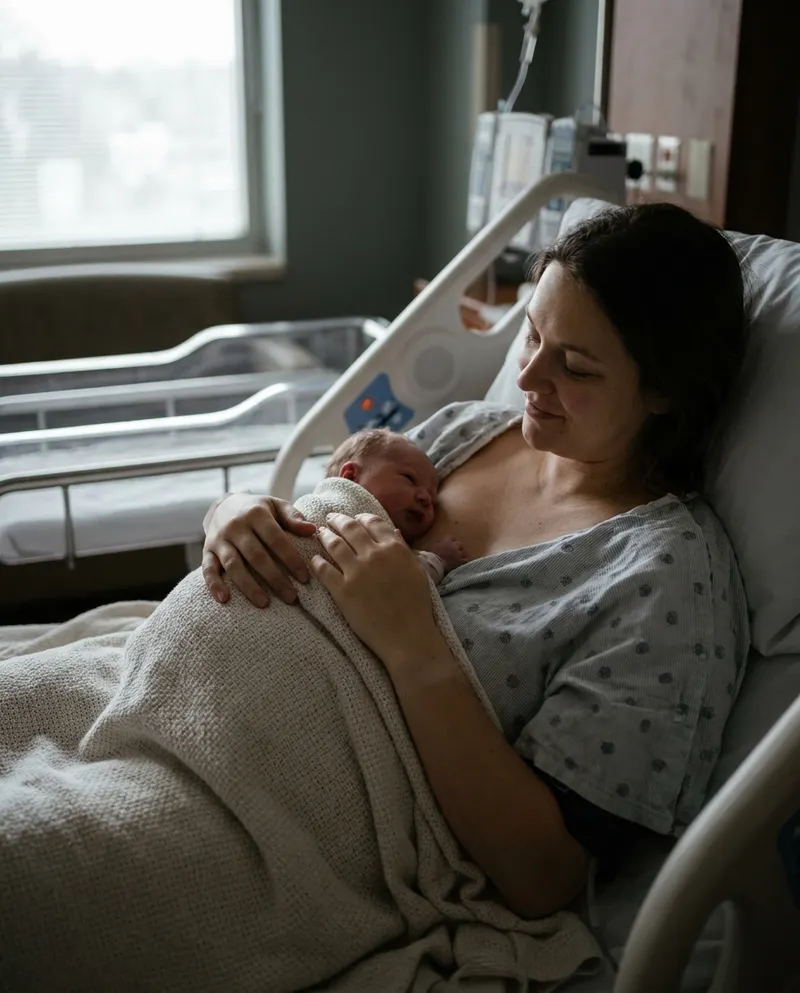
After the operation you'll be moved to a room for monitoring. The anesthesia wears off gradually over a few hours, and during that time the team will start arranging pain relief that's safe while breastfeeding.
How long c-section recovery takes
Recovery after a cesarean section takes longer than after a vaginal birth: it is, after all, abdominal surgery. But with a calm, gradual approach, most women confidently return to their usual life. Here are the rough stages.
The first days in the hospital
You'll usually stay in the hospital for 3–4 days. Within a few hours you'll be asked to get up and walk a little — early activity lowers the risk of blood clots and helps your bowels "wake up." The first day is the most tender: it hurts to cough, laugh, and turn over. This is normal, and the pain is managed with medication. The discharge (lochia) after a c-section is the same as after a vaginal birth, and lasts several weeks.
Caring for the incision and scar
Keep the incision clean and dry, and wear loose clothing that doesn't rub. Mild pulling, numbness, or itching around the scar in the first weeks is completely normal. A c-section scar looks bright red and firm at first, but over 6–12 months it fades and becomes softer and thinner. Once the scar has fully healed, your doctor may suggest gentle massage or silicone sheets.
When you can lift, drive, and exercise
The main rule for the first 6 weeks: don't lift anything heavier than your baby. Returning to activities is gradual:
- Driving: usually after 2–4 weeks — once you can brake sharply and turn without pain.
- Heavy lifting and intense exercise: as a rule, not before 6–8 weeks and after your doctor's okay.
- Walking: you can and should start almost right away — short walks at a comfortable pace.
- Intimacy: once the discharge has stopped and you feel ready, usually after your follow-up checkup.
Listen to your body: more pain or bleeding is a signal to slow down.
Warning signs — when to seek urgent care
Get medical help if you have:
- a temperature above 38 °C, or chills;
- redness, swelling, increasing pain or discharge from the incision, or the edges of the wound separating;
- heavy bleeding (soaking a pad within an hour) or large clots, or foul-smelling discharge;
- pain, swelling, or redness in your calf — a possible sign of a blood clot;
- a severe headache, difficulty breathing, or chest pain;
- burning and pain when urinating.

VBAC and your next pregnancy
One c-section doesn't mean all your future births will have to be surgical. Many women with a single horizontal uterine scar can have a vaginal birth after cesarean (VBAC); by various estimates, it's successful in roughly 60–80% of those who are offered it. Whether this option is right for you depends on the reason for your first c-section, the type of scar, and how your new pregnancy goes — it's decided individually.
When planning your next baby, doctors usually advise waiting at least 18 months between births so the uterine scar has time to strengthen. This lowers the risks in your next pregnancy. Be sure to tell your doctor about your previous c-section — it affects how your pregnancy is managed and where you give birth.
Key takeaways
- A c-section is a safe and often necessary operation; the way you give birth doesn't define your worth as a mom.
- A planned c-section is arranged in advance, while an emergency one is done when the situation changes; "emergency" is about a safeguard, not a catastrophe.
- Spinal or epidural anesthesia is used most often: you stay awake and meet your baby almost right away.
- You'll stay in the hospital 3–4 days; basic recovery takes about 6 weeks, sometimes longer.
- For 6 weeks, don't lift anything heavier than your baby; driving comes after 2–4 weeks, and exercise after 6–8 weeks and your doctor's approval.
- Know the warning signs (fever, problems with the incision, bleeding, signs of a clot) and don't hesitate to contact your doctor.
- A vaginal birth (VBAC) is often possible after a c-section; it's best to plan your next pregnancy after about 18 months.
This article is for general information only and is not a substitute for personalized medical advice. Your situation is unique, so always follow the guidance of your own doctor and obstetric team.
Sources
Created with AI and reviewed by the Mama Ai team. Educational information — not a substitute for professional medical advice.
We’re with you every week of the way
Download on the App Store