
Hospital Bag Checklist: What to Pack for Mom and Baby
A complete hospital bag checklist by category: documents, labor and delivery, postpartum, baby, and going home. When to pack your bag and what not to bring.

Mama Ai Team

As the end of pregnancy approaches, a sweet but slightly nerve-wracking task appears: packing your hospital bag. A ready-made checklist helps you stay calm once contractions start — your bag is already by the door, and you can head to the hospital without scrambling. In this article you'll find a detailed hospital bag checklist organized into clear categories: documents, things for labor and delivery, items for the postpartum room, baby essentials, and what to bring for going home. We'll also cover when to pack your hospital bag and what you don't need to bring.
Keep in mind: exact requirements vary from one hospital to another and from country to country. Some facilities provide a lot on site, while others ask you to bring everything yourself. So think of this packing list as a universal starting point, and confirm the final details with your own hospital ahead of time.
When to pack your hospital bag
Most experts recommend having your bag ready by around 35–36 weeks. A pregnancy is considered full term from 37 weeks, but labor can start earlier, so it's best to be prepared in good time. If you're expecting twins or your doctor has mentioned the possibility of an early delivery, pack even sooner — around 32–34 weeks.
To know when it's time to go, it helps to tell real contractions from practice ones. Read up on how to tell that labor has started and how Braxton Hicks contractions differ from true labor. Another sign that labor is near is losing your mucus plug; we've covered what the mucus plug looks like and when it comes away separately. And to estimate your due date, see our article on how long a pregnancy lasts.
It's handy to pack not one big bag but several bags or compartments: one for labor, one for the postpartum room, and one for going home. That way your partner or family can bring the right items at the right moment. Many hospitals ask that things come in plastic bags rather than a suitcase or leather bag — check this in advance.
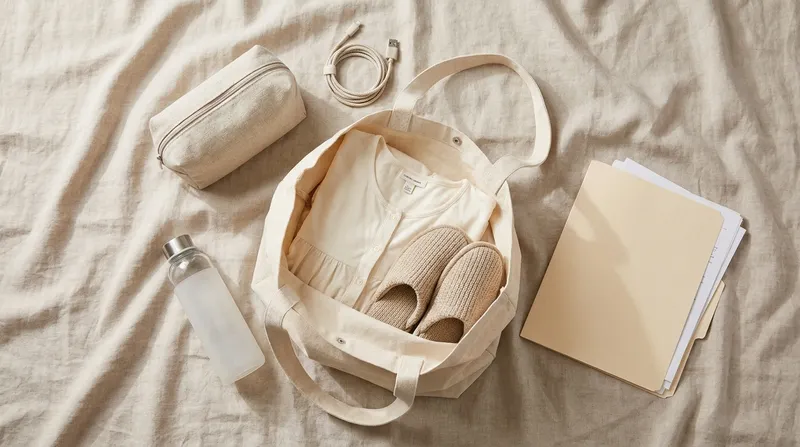
Hospital bag checklist by category
Let's break everything into clear groups. That way nothing gets forgotten, and you can label each bag.
1. Documents and paperwork
This is the most important part — without your documents, the hospital may not be able to admit you. Put them in a separate folder or sleeve and place it on top so you can grab it first.
- Photo ID (passport) and a copy.
- Your pregnancy maternity record with all test results and ultrasound reports.
- Health insurance card or documents showing you're registered with the facility.
- Birth certificate voucher / referral, if such a document is used in your country.
- Your birth contract or agreement, if you're paying privately or have a chosen doctor.
- Recent test results that aren't already in your maternity record.
- A little cash and a bank card.
2. Items for mom during labor
These come in handy in the delivery room. The priority here is comfort and anything that helps you get through contractions more easily.
- A washable nightgown or a comfortable loose T-shirt you don't mind giving birth in (many hospitals provide their own gown — check first).
- Rubber slippers that are easy to wash.
- Warm socks — feet often get cold during labor.
- Still water and a light snack to keep your energy up (if your hospital allows it).
- Lip balm — your lips dry out from frequent breathing.
- A hair tie to keep your hair back.
- Phone and charger with a long cord, plus headphones with your favorite music.
- A small handheld fan or facial mist to freshen up.
3. Items for mom after birth (postpartum room)
You'll spend anywhere from one to several days in the postpartum room. Here, recovery, hygiene, and easy nursing matter most.
- Postpartum pads (special, high-absorbency ones) — you'll need quite a few for the first days.
- Disposable or comfortable cotton underwear — several pairs.
- 2–3 nightgowns with easy nursing access, or a robe that buttons up the front.
- A nursing bra and breast pads.
- Toiletries: toothbrush and toothpaste, gentle soap or body wash, shampoo, comb, deodorant, wet wipes, toilet paper.
- A towel for yourself.
- A postpartum support belt, if your doctor recommends one (especially after a C-section).
- Tableware: a mug, spoon, and plate (you often need your own).
- A breast pump, if you plan to use one (not necessarily right away).
- Lanolin nipple cream and a cream for cracked skin.
4. Items for baby
The minimum kit for a newborn. Choose clothes in soft cotton, in newborn sizes (for 50–56 cm / about 20–22 in). Wash and iron everything in advance.
- Newborn diapers (size 1) — a small pack.
- Wet wipes without alcohol or fragrance.
- 2–3 undershirts or bodysuits and 2–3 pairs of pants or a few footed sleepers.
- Thin cotton hats and socks, plus scratch mittens.
- 2–3 thin swaddle blankets and 1–2 warmer ones — even if you don't swaddle, they always come in handy.
- A diaper rash cream and gentle baby soap.
- A blanket or throw appropriate for the season.
Check with your hospital what's provided on site: some fully supply swaddle blankets, diapers, and clothing for the baby, so you only need to bring a going-home outfit.

5. Going-home items
This bag is usually brought in on discharge day — it can wait at home and your partner can bring it.
- A going-home outfit for baby suited to the season: a bodysuit/sleeper, hat, socks, and a bunting or a dressier going-home set.
- A car seat (infant carrier), group 0+ — the safest way to bring a newborn home by car.
- Clothes and shoes for mom that are comfortable for the ride home. Keep in mind your belly won't disappear right away — bring loose clothing, roughly what you wore around 5–6 months pregnant.
- A small makeup bag with a few essentials, if you'd like nice photos.
6. For your partner and for comfort (optional)
If your partner will be there for the birth, or you'd like to make your stay cozier, add these optional but nice-to-have extras.
- For your partner: a change of clothes, slippers, water, and a snack, plus any health certificate the hospital requires.
- Your own pillow in a pillowcase (a colored one, say, so it doesn't get mixed up with hospital ones).
- Earplugs and a sleep mask — the room can be noisy and bright.
- A power bank — an outlet isn't always within reach.
- A book, your favorite tea bags, a small night light.
What NOT to bring to the hospital
Extra things just weigh your bag down and often go against hospital rules. It's usually best to leave behind:
- Expensive jewelry and large amounts of cash — keep it to a minimum.
- Strong-smelling makeup and perfume — sharp scents bother your baby and the other moms in your room.
- "Just in case" medications — any drugs are prescribed and supervised by your doctor. Bring only what you take regularly, and clear it with the medical staff.
- Perishable food and anything with a strong smell.
- Lots of clothes and "backup" items — your family can always bring anything missing.
- A suitcase instead of bags, if your hospital asks for items in plastic bags for hygiene reasons.
How to make sure you don't forget anything
A few simple tricks make packing stress-free:
- Label each bag: "Documents," "Labor," "Postpartum," "Baby," "Going home."
- Print out this list and check off what you've already packed.
- Tell your partner where the bag is and which bag is for what.
- Save the hospital's address, the admissions desk contact, and your route in your phone.
- Confirm the official list with your own hospital — that's the one that counts, and ours is a handy starting point.
Key takeaways
- Have your hospital bag ready by 35–36 weeks — labor can start earlier than expected.
- It helps to sort items by category: documents, labor, postpartum, baby, going home, and comfort.
- Documents come first: ID, maternity record, insurance card.
- Don't bring extras: valuables, perfume, medications without a prescription, and perishable food.
- Always confirm your hospital's exact packing list with your facility — requirements vary.
This article is for general information only and isn't a substitute for personalized medical advice. For questions about preparing for birth and about your health, talk to your doctor or midwife.
Sources
Created with AI and reviewed by the Mama Ai team. Educational information — not a substitute for professional medical advice.
We’re with you every week of the way
Download on the App Store