
When to Take a Pregnancy Test for Accuracy
When to take a pregnancy test for an accurate result — what day, what time of day, how hCG works, and why a faint line or false negative can happen.

Mama Ai Team

If you're trying to conceive or suspect you might be pregnant, the main question is almost always the same: when to take a pregnancy test so the result is accurate? Test too early and you can get a false negative even though you really are pregnant. Wait just a couple of days and the test becomes far more reliable. In this article we'll walk calmly through how a home pregnancy test works, the best time to take it, what time of day, and why that second line is sometimes so faint.
How a pregnancy test works: it's all about hCG
A home pregnancy test detects a hormone in your urine called hCG (human chorionic gonadotropin). This hormone is produced by the developing placental tissue after a fertilized egg attaches to the wall of the uterus — an event known as implantation.
Before implantation there's virtually no hCG in your body, so no test — not even the most sensitive one — will show anything. After implantation the hormone level starts to climb quickly: in the first weeks it roughly doubles every 48–72 hours. That's exactly why each extra day of waiting noticeably improves your chances of a reliable result.
Implantation usually happens around 6–12 days after ovulation. If you'd like a clearer sense of which day of your cycle you ovulated, this guide on how to recognize the signs of ovulation and your fertile window can help — counting from ovulation makes it easy to know when a test is actually worth doing.
What day to take a pregnancy test
The test gives its most reliable answer on the first day of a missed period and later. By that point, most women already have an hCG level high enough for an ordinary home test to detect with confidence.
Translated into cycle days: with a standard 28-day cycle, ovulation falls around day 14, implantation around days 20–26, and the first day of an expected period is roughly day 28. So the guideline "test from the first day of a missed period" works for most people, but the exact date depends on the length of your particular cycle and your day of ovulation.
Can you test before a missed period?
Yes, taking a pregnancy test before a missed period is possible, but with caveats. There are sensitive tests the manufacturer clears for use 4–5 days before your expected period. However, the earlier you test, the higher the risk of a false negative: hCG may still be too low.
Approximate reliability by day looks like this:
- 4–5 days before your missed period: a positive result can be caught, but at this stage the test still "misses" many pregnancies.
- On the day of your missed period: accuracy is noticeably higher, though a few cases can still slip through.
- A week after your missed period: the result is most reliable — by now hCG is usually already high.
So the golden rule is simple: if you can be patient, wait for the day of your missed period. And an early negative test when your period still hasn't arrived is worth repeating in 2–3 days.
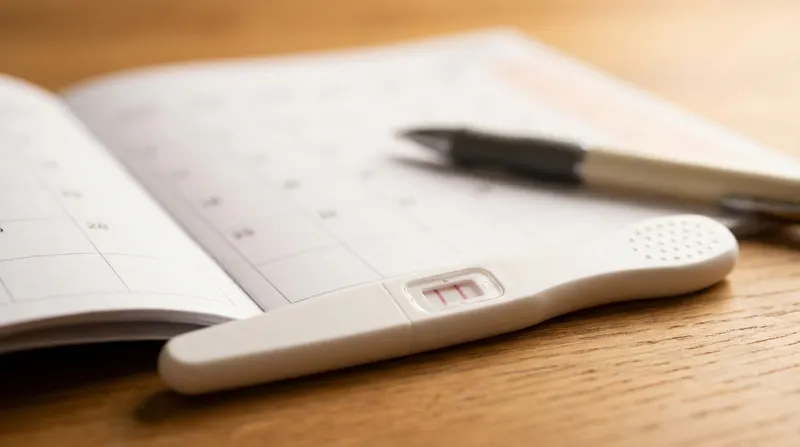
What time of day to take the test
The best time is the morning, right after you wake up, using your first urine of the day. Overnight your urine becomes more concentrated, and the hCG level in it is higher. This matters especially in early pregnancy, when there's still little hormone and every bit of concentration counts.
If you're testing after a missed period, the time of day matters less — by then hCG is usually high enough for the test to work during the day too. But when testing early, stick with morning urine and don't drink a lot of fluids beforehand: diluted urine is a common cause of a false "no."
How to read the result correctly
Read the instructions for your specific test carefully — different manufacturers have different wait times and result-window layouts. A few general rules will help you avoid mistakes.
A faint second line on the test
A faint second line on a test is almost always a positive result. If the line appeared within the expected time (usually within 3–5 minutes) and sits in the result zone, even a pale line means hCG was detected. It tends to be faint when it's still very early and there isn't much hormone. After a couple of days, a repeat test usually shows a brighter line.
What an evaporation line is
If you look at the test after the allotted time (an hour later, for example), a colorless or grayish line may appear in the window — this is an "evaporation line." It shows up because the urine is drying out, not because of hCG, and it doesn't mean pregnancy. So read the result strictly within the interval given in the instructions, and don't trust lines that emerge much later.
False negative and false positive tests
Understanding the reasons behind "misleading" results is important so you don't panic or jump to conclusions.
A false negative pregnancy test
A false negative pregnancy test is a "no" when you actually are pregnant. It's far more common than a false positive. The main causes:
- Testing too early — the hCG level is still below the test's sensitivity.
- Diluted urine — lots of fluids, or daytime testing instead of morning.
- Not following the instructions — too little wait time, or an expired/damaged test.
- Late ovulation — you ovulated later than you thought, so the pregnancy is "younger" than the assumed date.
If your period doesn't arrive and the test is negative, repeat it in 2–3 days in the morning. If you're not sure of your ovulation day, pay attention to how you feel: the early pregnancy symptoms before a missed period can help, though symptoms on their own don't make a diagnosis.
A false positive test
A false positive test — a "yes" when there's no pregnancy — is rare. Possible causes include taking medications that contain hCG (some fertility treatments), a very early biochemical pregnancy that ended almost immediately, recent childbirth or pregnancy loss, and certain rare medical conditions. If a result is in doubt, the most reliable way to confirm it is a blood test with your doctor.
Bleeding but the test is negative: how not to get confused
Sometimes light spotting a few days before an expected period is mistaken for the period starting — so people don't take a test. In reality it may be implantation bleeding, after which hCG is only just starting to rise. How to tell the two apart is covered in detail in our article on implantation bleeding vs. your period. If you're unsure, take a test in the morning, and with conflicting results, see your doctor.
When to see a doctor
It's worth consulting a professional if:
- your period is late but tests keep coming back negative;
- the test is positive — to confirm it, date the pregnancy, and begin care;
- results are contradictory, or you got a positive and then a negative test;
- you have severe lower-abdominal pain, heavy bleeding, or sudden dizziness — this is a reason to seek help without delay.
Your doctor may order a blood test for hCG: it detects the hormone earlier and more precisely than a home test, and tracked over time (a repeat after 48 hours) it helps assess how the pregnancy is developing.
Key takeaways
- The test detects the hormone hCG, which appears only after implantation — about 6–12 days after ovulation.
- The most reliable result comes from the first day of a missed period, and even more accurately a week after it.
- Testing before a missed period is possible but more often gives a false negative; an early negative test is worth repeating in 2–3 days.
- Take the test in the morning with your first urine and don't drink a lot of fluids beforehand.
- A faint second line that appears on time is usually a positive result; lines that show up after the allotted time don't count.
- If in doubt or with a positive result, see your doctor — a blood test for hCG is the most accurate.
This article is general information only and is not a substitute for personalized medical advice. For questions about your health and pregnancy, please consult your own healthcare provider.
Created with AI and reviewed by the Mama Ai team. Educational information — not a substitute for professional medical advice.
We’re with you every week of the way
Download on the App Store