
Signs of Ovulation: How to Find Your Fertile Window
How to recognize ovulation and pinpoint your fertile window: cervical mucus, basal body temperature, ovulation tests, and the best time to conceive.

Mama Ai Team

When you're trying to conceive, only a few days each month really count. These days are called your fertile window — a short stretch around ovulation when conception is most likely. The good news is that your body gives off some fairly noticeable signals. Once you learn to read them, you can pinpoint ovulation more accurately and choose the best time to conceive without turning it into a source of anxiety. In this article, we'll walk through the main signs of ovulation, how to track it, and answer common questions — including whether you can get pregnant during your period.
What ovulation and the fertile window are
Ovulation is the release of a mature egg from the ovary. It usually happens about 14 days before your next period starts — not strictly on day 14 of your cycle, as many people assume. If your cycle is longer or shorter than 28 days, the day of ovulation shifts accordingly. That's why relying on the "middle of the cycle" alone isn't always reliable.
Once released, the egg only survives a short time — about 12 to 24 hours. Sperm, on the other hand, can stay capable of fertilization in the female reproductive tract for up to 5 days. Because of this difference, the fertile window lasts about six days: roughly the five days leading up to ovulation plus the day of ovulation itself. The highest odds of conceiving are in the one to two days before ovulation and on the day it occurs.
It helps to think of the cycle in two phases. The first, the follicular phase, runs from the start of your period to ovulation and can vary in length. The second — the luteal phase — comes after ovulation and is usually fairly stable, around 12 to 14 days. It's this relative consistency that lets you "count backward" from your expected period to estimate the day of ovulation.
The main signs of ovulation
Your body changes throughout the cycle under the influence of hormones. Here are the signals many women use to tell that ovulation is approaching or has arrived.
Cervical mucus (ovulation discharge)
This is one of the most reliable natural signs. As ovulation approaches, discharge becomes more abundant, clear, slippery, and stretchy — it's often compared to raw egg white. This consistency helps sperm travel toward the egg. After ovulation, under the influence of progesterone, the mucus thickens again, turning whiter and scantier. Watching the changes in your discharge is a simple, free way to notice when your fertile days arrive.
Basal body temperature
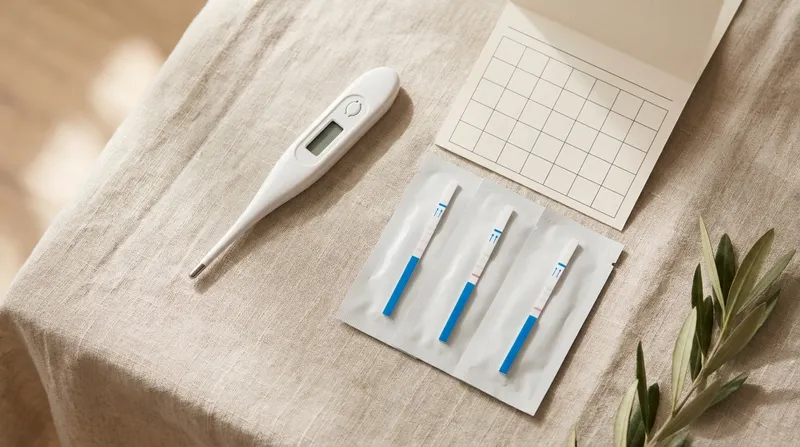
Basal body temperature (BBT) is your temperature at complete rest, measured first thing in the morning before you even get out of bed. After ovulation, progesterone raises your BBT slightly — usually by 0.3 to 0.5 °C (about 0.5 to 1 °F). It's important to understand that the rise in temperature tells you ovulation has already happened, not that it's about to. So BBT isn't great for predicting this cycle, but it's useful for confirming that ovulation occurred and for understanding the overall picture of your cycle over several months.
Mid-cycle pain (mittelschmerz)
Some women feel a mild pulling pain or discomfort low in the abdomen on one side around the time of ovulation. This is called mittelschmerz (German for "middle pain"). It's usually harmless and lasts anywhere from a few minutes to a couple of days. If the pain is severe, sharp, or comes with a fever, it's worth seeing a doctor.
Higher libido, breast tenderness, and other signals
As ovulation nears, many people notice a boost in sex drive — a natural mechanism that increases the chance of conceiving. Other, less specific signs are possible too: mild breast tenderness or sensitivity, slight bloating, a heightened sense of smell, small mood shifts. These symptoms vary from person to person and don't prove ovulation on their own, but combined with discharge and BBT they round out the overall picture.
How to track ovulation
The most reliable approach is to combine several methods — that way you cross-check one signal against another.
The calendar method
If your cycle is regular, you can subtract about 14 days from the expected date of your next period — that gives you a rough day of ovulation. The method is simple but the least accurate, especially with an irregular cycle, and works best as a starting point.
Ovulation tests (LH tests)
Ovulation tests (known as OPKs) detect the surge of luteinizing hormone (LH) in your urine, which triggers the release of the egg. A positive result means ovulation will most likely happen within the next 12 to 36 hours — a signal that your most fertile days have arrived. To catch the peak, people usually start testing a few days before expected ovulation and repeat daily, at the same time of day.
Cycle-tracking apps
Apps help you log your period dates, discharge, BBT, and test results in one place and visually show your estimated fertile window. Keep in mind that their predictions are an estimate based on your data, not an exact forecast of the day of ovulation, so it's helpful to pair them with paying attention to your body.
How to calculate your fertile window and choose the best time to conceive
To improve your chances of conceiving, focus on the days before ovulation and the day of ovulation. Since sperm can live up to five days, intimacy on these days "meets" the released egg right on time.
In practice, a simple approach works for most couples: intimacy every 1 to 2 days throughout the fertile window. This takes the pressure off hitting "day X" exactly while still covering the most likely days for conception. For most men, daily or near-daily contact during the fertile window doesn't harm sperm quality and may even be preferable.
A few cues that help narrow the window:
- Egg-white discharge — you're probably in your fertile days right now.
- A positive LH test — ovulation is expected within the next 1 to 1.5 days; the next two days are the most favorable.
- A rise in basal body temperature — ovulation has already happened; this cycle's fertile window is closing.
After intimacy during your fertile days comes the waiting period. If conception has happened, in the first weeks you may notice early pregnancy symptoms before a missed period — but only a test and a doctor's exam can confirm it reliably, so early "symptoms" shouldn't be taken as a guarantee.
Can you get pregnant during your period
This is one of the most common questions — and the short answer is: yes, though it's less likely. Menstruation itself isn't a fertile time, but you can get pregnant "during your period" for two reasons. First, with a short cycle (say, 21 to 24 days), ovulation comes early, and the fertile window may partly overlap with the end of your period. Second, sperm live up to five days: if intimacy happened in the last days of bleeding, they can "wait" for early ovulation.
So if pregnancy isn't wanted right now, don't treat the days of your period as completely "safe." And if you're trying to conceive, look not to the absence of bleeding but to the signs of your fertile window — discharge, LH tests, and the pattern of your cycle.
When to see a doctor
Watching for signs of ovulation is helpful in itself, but in some situations it makes sense to consult a specialist without delay. Talk to your doctor if:
- your cycle is irregular, very short (under 21 days) or long (over 35 days), or your periods stop;
- you don't notice signs of ovulation over several cycles (for example, no BBT rise and consistently negative LH tests);
- you're under 35 and haven't conceived after 12 months of regular tries;
- you're 35 or older and haven't conceived after 6 months;
- you have very painful or heavy periods, pain during intimacy, or known conditions (such as PCOS, endometriosis, or thyroid problems).
Not ovulating (anovulation) is a common and often treatable cause of trouble conceiving. A doctor can help identify the cause and suggest appropriate testing or treatment.
Key takeaways
- Ovulation usually happens about 14 days before your next period — not strictly on day 14 of your cycle.
- The fertile window lasts about 6 days — the days before ovulation plus the day of ovulation; the egg lives 12 to 24 hours, sperm up to 5 days.
- Key signs of ovulation: egg-white discharge, a rise in basal body temperature, mid-cycle pain, and higher libido.
- The most reliable methods combine cervical mucus, LH tests, and BBT; the calendar and apps give only a rough forecast.
- The best time to conceive is the days before ovulation and the day of ovulation; a convenient routine is intimacy every 1 to 2 days during the fertile window.
- You can get pregnant during your period, especially with a short cycle.
- See a doctor if your cycle is irregular, you see no signs of ovulation, or you haven't conceived after 12 months (or 6 months if you're over 35).
This article is for general information only and isn't a substitute for personalized medical advice. For questions about your cycle, fertility, and planning a pregnancy, talk to your own doctor.
Sources
Created with AI and reviewed by the Mama Ai team. Educational information — not a substitute for professional medical advice.
We’re with you every week of the way
Download on the App Store