
Baby Led Weaning & Starting Solids: A Month-by-Month Guide
When to start solids according to WHO and AAP, readiness signs, a month-by-month baby food chart, purées vs baby led weaning, allergens, and what to avoid before age one.

Mama Ai Team

Somewhere between four and six months, almost every parent starts googling "when to start solids" and "baby led weaning vs purées." The topic is full of contradictions: grandma swears by juice at three months, a neighbour started cereal at four, and the internet argues endlessly about spoons versus finger foods. Here we've gathered what the WHO, the American Academy of Pediatrics (AAP) and ESPGHAN actually agree on: when to begin, how to read your baby's readiness, which first foods for baby to offer, how much that is in grams, and what's off the table in the first year.
The one idea that takes away half the anxiety: until 12 months, breast milk or formula stays the foundation of nutrition, and solid food is a supplement and a learning process. In the first months, your baby isn't so much filling up as getting to know flavours, textures and the whole business of eating.
When to start solids: what the WHO and AAP say
The WHO recommends exclusive breastfeeding to around 6 months, then introducing complementary foods while continuing to breastfeed to 2 years and beyond. The AAP and ESPGHAN put it a little more flexibly: start solids around 6 months, but not before 4 months (17 weeks) and not later than 6–7 months (26 weeks).
Why not before 4 months: until then most babies still have an active tongue-thrust reflex, immature kidneys and gut, and haven't yet coordinated the "take it — chew it — swallow it" sequence. Why not much after 6 months: by then the iron stores built up in the womb are running low, and milk alone no longer covers a growing baby's need for iron and zinc. On top of that, meeting thicker textures and allergenic foods too late is linked to a higher chance of texture refusal and food allergy.
The timing is the same for breastfed and formula-fed babies. For babies born preterm, age is usually counted as corrected age — that's worth discussing with your pediatrician separately.
Signs your baby is ready for solids
The calendar is only half the answer. Look at the baby in front of you. A baby is usually ready when they:
- hold their head steadily and can sit with support (in a highchair, without tipping to one side);
- have lost the tongue-thrust reflex — they no longer automatically push the spoon and food back out;
- show interest in food: they watch your plate, reach for food, open their mouth when a spoon comes close;
- can show you they've had enough — turning away, closing their mouth, leaning back;
- can pick something up and bring it to their mouth (especially important for self-feeding).
And here's what is not a readiness sign, even though it's widely believed: waking more often at night, seeming "not full enough," drooling, or chewing on a fist. Drool and everything-in-the-mouth is more often about teething, and night waking at four months is usually a reorganisation of sleep rather than hunger — there's more on that in our article about the 4-month sleep regression. Adding cereal before bed, unfortunately, doesn't improve sleep: studies haven't confirmed that link.
Can you start solids at 4 months?
"Starting solids at 4 months" is a very common search, so let's answer it directly. The 4–6 month window is considered acceptable, but it isn't the default recommendation: an earlier start is worth discussing with your pediatrician in specific situations (slow weight gain, iron deficiency, certain medical reasons). If your baby is healthy, growing well and showing no readiness signs, there's no rush — and turning four months is definitely not a reason to begin "because it's time." If your baby was born at term and at 4.5 months sits confidently with support, brings food to their mouth and is clearly interested, you can start before six months — carefully, and never as a replacement for milk.
Starting solids at 3 months (another popular search) isn't supported by current guidance in any form — not with juice, not with cereal.
Purées or baby led weaning: two approaches
Both approaches work, and you don't have to pick one "forever" — most families end up combining them.
Spoon-feeding purées (the traditional route)
The classic plan: smooth single-ingredient purées and cereals from a spoon, gradually getting thicker, coarser, and lumpier. Upsides: it's easy to keep track of how much went in, simpler to watch the reaction to a specific food, and convenient when weight gain or iron is a concern. Downsides: if you stay on smooth textures past 9–10 months, your baby may later refuse lumps, and mealtimes easily turn into "just one more spoonful."
One rule applies whichever route you take: by 8–10 months textures need to move on — fork-mashed food, soft pieces, and by the first birthday an adapted version of the family meal (no salt, no sugar, no risky shapes).
Baby led weaning (BLW)
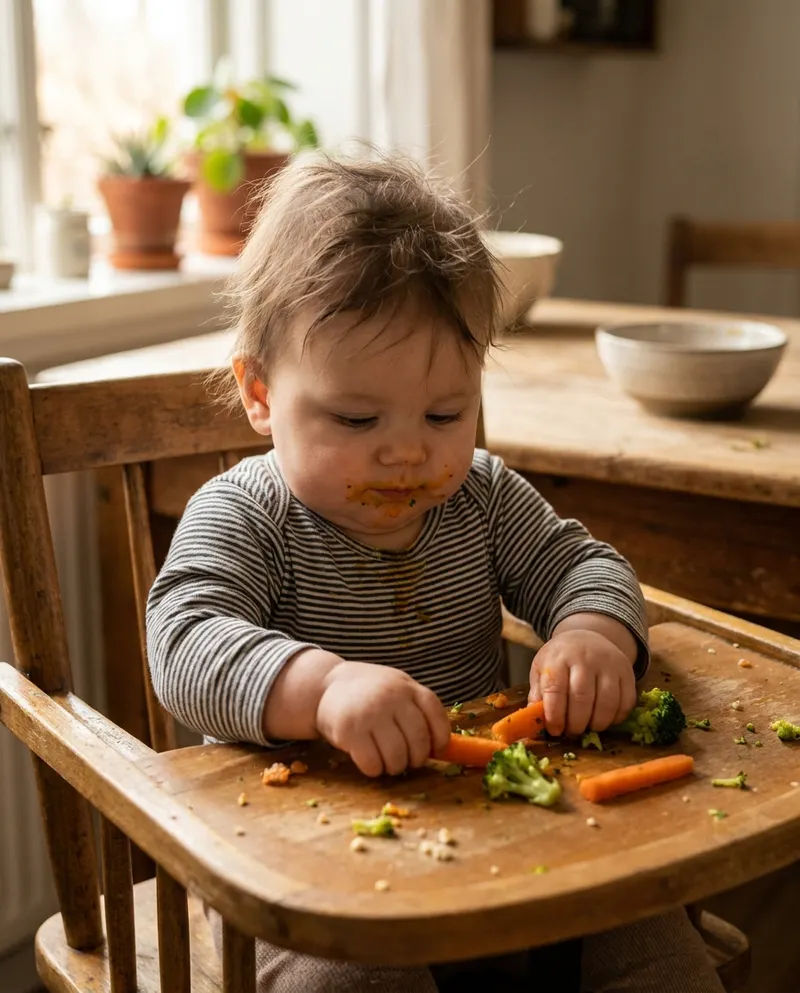
With baby led weaning, your baby eats soft, appropriately shaped foods with their hands from the very start, sitting at the table with everyone else. Upsides: it builds fine motor skills and chewing, introduces textures early, lets the baby regulate how much they eat, and creates fewer battles around food. Downsides: it's harder to count what actually got eaten, it's messier, and in the first weeks a baby takes in very little — which is exactly why iron-rich baby food matters so much here.
Safe shapes for BLW: strips about the size of an adult finger that squash easily between your fingers — cooked carrot, zucchini, sweet potato, broccoli "trees," soft pear or peach, strips of omelette, pieces of soft meat or meatballs, a slice of avocado, a strip of unsalted bread. From 9–10 months, once the pincer grasp appears, you move to pea-sized pieces.
Gagging vs choking: how to tell them apart
This is the thing that scares parents off baby led weaning most — and the thing rarely explained clearly. Gagging is a normal protective reflex; in babies it's triggered closer to the middle of the tongue and happens often. It looks and sounds alarming: your baby goes red, coughs, sticks their tongue out, sometimes retches — but they are breathing and making noise. In that moment, the best thing is not to panic, not to slap their back and not to put fingers in their mouth: the baby is handling it, and interfering can push the piece deeper.
Choking (a blocked airway) looks different and is almost always silent: the baby can't cough, breathe or make a sound, panics, and the lips and face turn blue. That is an emergency — it needs first aid and a call for emergency help. Parents starting solids benefit enormously from taking a short infant choking first-aid course ahead of time.
Safety rules that lower the risk with either approach: your baby eats only sitting upright and only with an adult watching; no food in the car seat, stroller, on the move or during play; never put food into your baby's mouth for them; cut foods safely (grapes and cherry tomatoes lengthwise into quarters, hot dogs never in coins); no hard small foods (see below).
Where to begin: first foods and a month-by-month solids chart
There is no strict "correct order" of foods — neither the WHO nor the AAP requires you to start with zucchini specifically or cereal specifically. The things that matter are iron and variety. A sensible plan: start with vegetables and iron-fortified cereal, add meat early, and don't postpone the allergens.
6 months — getting acquainted
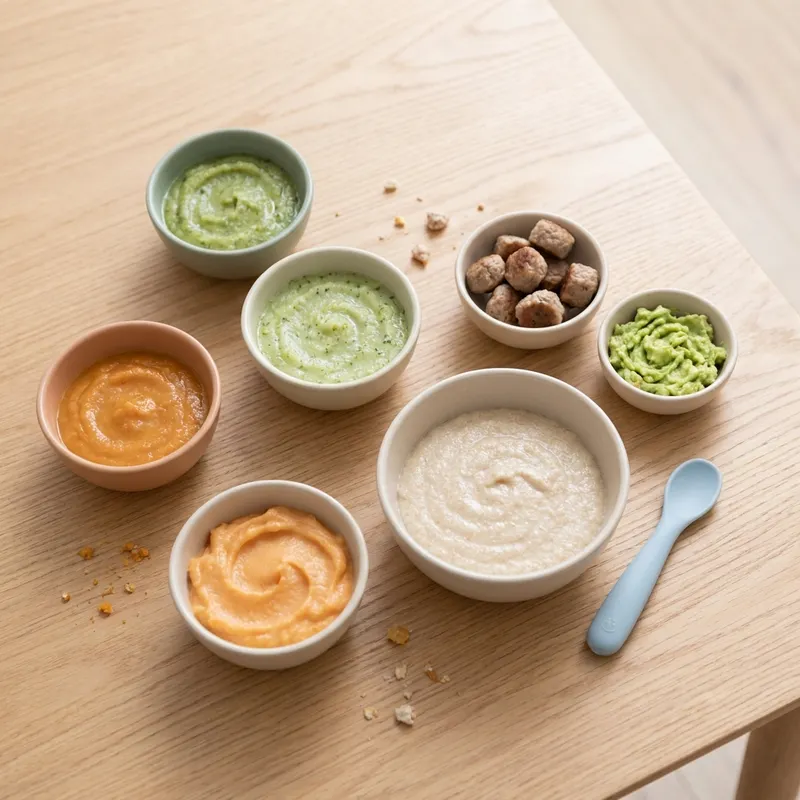
- Vegetables: zucchini, broccoli, cauliflower, pumpkin, sweet potato, carrot (all cooked).
- Cereals with no added sugar or milk: buckwheat, rice, corn; iron-fortified versions are preferable.
- Amounts: begin with 1 teaspoon (about 5 g) once a day and work up to 50–100 g over 3–5 days. Introduce a new food every 2–3 days so you can spot reactions.
- Solid meals: 1–2 a day, always after or between milk/formula feeds.
6–7 months — iron and protein
- Meat: turkey, rabbit, veal, chicken — puréed or as soft meatballs. Start with 5–10 g, building to 30–50 g a day by 8 months.
- Fruit: apple, pear, plum, banana, peach — 50–60 g (fruit comes after vegetables, otherwise vegetables tend to lose the taste contest).
- Vegetable oil and butter — 3–5 g stirred into a dish.
- Allergens: peanut butter (thinned to a smooth consistency), well-cooked egg, dairy, wheat, fish, sesame, soy.
8–9 months — textures and volume
- Plain fermented dairy with no added anything: baby-style cottage cheese up to 50 g, yogurt or kefir up to 100–150 ml (not as a main drink).
- Fish: 30–60 g, once or twice a week, replacing meat that day.
- Egg yolk: starting at ¼, working up to a whole one by twelve months.
- Texture: fork-mashed food, soft pieces, finger foods. A main-dish portion is 100–150 g, across 3 meals a day.
10–12 months — nearly the family table
- Finely chopped pieces, pasta, soft vegetable and meat dishes, unsalted bread, legumes.
- 3 main meals plus 1–2 snacks; portions of 150–200 g.
- Learning to drink from an open cup; bottles gradually take a back seat.
The WHO's guide to frequency: 2–3 meals a day at 6–8 months, and 3–4 meals plus 1–2 snacks to appetite at 9–23 months. Milk or formula continues alongside: roughly 500–700 ml a day by the end of the first year. If you're breastfeeding, starting solids is no reason to cut back on feeds — there's more on building a feeding rhythm in our article on breastfeeding in the first days.
Allergens: introduce early, don't delay
The old advice to "hold off on egg and peanut until age 2 or 3" is out of date. The LEAP trial and the guidance that followed from NIAID, the AAP and ESPGHAN showed the opposite: introducing peanut and egg early, from around 6 months, lowers the risk of developing an allergy to those foods.
- Offer allergens once your baby has already managed a few simple foods — usually in week 2–4 of solids.
- One new allergen at a time, at home, in the first half of the day, starting with a quarter teaspoon.
- Form matters: whole nuts are off-limits until age 4–5; peanut is given only as a paste thinned with water or purée. Egg must be fully cooked, never runny.
- Regularity counts: if a food went down well, keep offering it about twice a week — tolerance is maintained by regular exposure.
- If your baby has moderate to severe eczema or a known food allergy, talk to your doctor about how to introduce peanut before you start — testing is sometimes recommended first.
Mild redness around the mouth from acidic fruit is usually a contact reaction rather than an allergy. What should raise concern is a rash over the body, swelling of the lips or eyelids, vomiting soon after eating, or laboured or wheezy breathing — those symptoms need urgent medical care.
What babies shouldn't have in the first year
- Honey — in any form, including baked goods, before 12 months: the risk is infant botulism.
- Cow's milk as a main drink — not before 12 months. A small amount cooked into a dish, or fermented dairy after 8 months, is fine, but milk doesn't replace formula or breast milk.
- Salt and sugar — don't add them. A baby's kidneys can't handle a salt load, and the AAP recommends avoiding added sugar at least until age 2. The same goes for deli meats, salty cheeses, jarred sauces and "tea-time" biscuits.
- Juice — not recommended before 12 months, and it isn't a necessary food afterwards either. Water from a cup, yes; juice, no.
- Unpasteurised milk and cheeses, raw or undercooked eggs, raw fish and meat.
- Common choking hazards: whole nuts and seeds, whole grapes and cherry tomatoes, chunks of raw carrot or hard apple, popcorn, hard candy and chewy sweets, hot dogs in coins, a thick spoonful of nut butter, large chunks of cheese.
- Chocolate, sweet drinks, tea and coffee, and plant-based "milks" (rice, almond) used as a main source of nutrition.
A separate word about mushrooms, smoked foods and fried food: babies under one don't need them, and they're generally not recommended before age 3.
If your baby refuses solids
This is normal and extremely common. A baby may need 10–15 introductions to a food before accepting it, and that doesn't mean "they don't like broccoli." What helps:
- Offer, don't force. Force-feeding, distraction with cartoons and "one spoon for mummy" reduce appetite over time and sour a child's relationship with food.
- Divide the roles: the adult decides what and when to offer; the baby decides how much to eat, and whether to eat at all.
- Eat together. Babies copy — food gets tried far more willingly at a shared table.
- Don't start solids on days with illness, vaccinations, real discomfort, or during a stretch of colic and tummy pain — wait for a calmer patch.
- Offer food when your baby is alert and a little hungry, but not ravenous — a very hungry baby wants milk, not experiments.
It's worth contacting your pediatrician if: your baby has stopped gaining weight or is losing it; by 7–8 months they take nothing into their mouth and swallow nothing but milk; they gag or cough hard at nearly every meal; blood appears in the stool, or persistent vomiting or diarrhoea follows a new food; or you notice lethargy, paleness and reduced activity. A sudden rash, facial swelling or difficulty breathing after eating is a reason to call emergency services immediately.
Key takeaways
- Start solids around 6 months, going by both age and readiness signs; not before 4 months, and don't push it past 6–7 months.
- Until 12 months, breast milk or formula stays the foundation of nutrition; solid food is a supplement and a learning process.
- First foods for baby are vegetables and iron-fortified cereals, with meat added early: after 6 months, iron is critical.
- Purées and baby led weaning are equally valid and can be combined; by 8–10 months textures must get more complex.
- Gagging is noisy and normal; true choking is silent, with no ability to breathe. Food only while sitting and supervised.
- Allergens (peanut, egg, fish, dairy, wheat) go in early, from around 6 months, and are offered regularly in a safe form.
- Before twelve months, rule out honey, cow's milk as a drink, salt, sugar, juice, unpasteurised foods and anything easy to choke on.
- Portions grow from a teaspoon to 100–150 g per meal by 8–12 months; refusing a new food the first few times is completely normal.
This article is general information and does not replace personalised medical advice. A feeding plan for your own baby — especially with prematurity, allergy, iron deficiency or weight-gain concerns — is worth discussing with your pediatrician.
Sources
Created with AI and reviewed by the Mama Ai team. Educational information — not a substitute for professional medical advice.
We’re with you every week of the way
Download on the App Store