Baby Milestones: When Babies Sit Up, Crawl and Walk
A month-by-month map of baby milestones in the first year: when babies sit up, crawl, stand and walk, the real age ranges behind the charts, and when to check in with your pediatrician.

Mama Ai Team
Almost every parent has caught themselves doing this arithmetic. The neighbour's baby is sitting up confidently at six months, someone in the group chat says their little one started crawling at five, and yours is still working on rolling over. And quietly, somewhere in your chest, the worry switches on: are we behind?
Almost always, no. The question "when do babies sit up, crawl and walk" has no single right answer, and that isn't medicine being vague — it's medicine being accurate. Infant development works as a range, not a deadline. Below is a map of the first year month by month: when a newborn starts holding their head up, smiling, cooing, rolling, sitting, crawling and walking, which timings count as typical, what actually helps, and which signs are worth calmly raising with your pediatrician.
The big idea: milestones are ranges, not deadlines
Every developmental milestone chart describes not a "correct age" but a window in which a skill usually shows up. The spread is enormous, and that's normal: two healthy babies can take their first steps at 9 months and at 16 months, and both are squarely within what's expected.
There's one detail here that surprisingly few people know. In 2022, the CDC — together with the American Academy of Pediatrics (AAP) — revised its list of developmental milestones for the first time in two decades and moved from the 50th percentile to the 75th. Previously a milestone meant "half of children can do this by this age" — meaning exactly half of healthy babies were "late" by definition, and parents panicked over a perfectly normal position below the average. Now each milestone is phrased as "most children do this by…". At the same time, the vague "may be able to" wording was removed, so that watchful waiting doesn't turn into an endless "let's give it another month" in cases where a child genuinely needs support.
The practical takeaway is simple: if your baby isn't doing something yet, it's usually not a delay — it's their own pace. What matters isn't a single date but the overall picture and the forward movement: skills keep appearing, keep getting more complex, and don't disappear.
Corrected age for babies born preterm
If your baby arrived early, every timeline should be counted using corrected age: subtract the number of weeks of prematurity from their actual age. A baby who is 7 months old but was born 8 weeks early is assessed like a five-month-old. Corrected age is generally used until around 2 years, by which point the difference has usually evened out. Don't compare a preterm baby with same-birthday peers — it's the single most common source of unnecessary worry.
Baby development month by month: a map of the first year
Each stage below is broken down into four areas: motor skills (gross and fine), speech and sounds, social and emotional development and cognitive development. The months given are a guide, not a timetable.
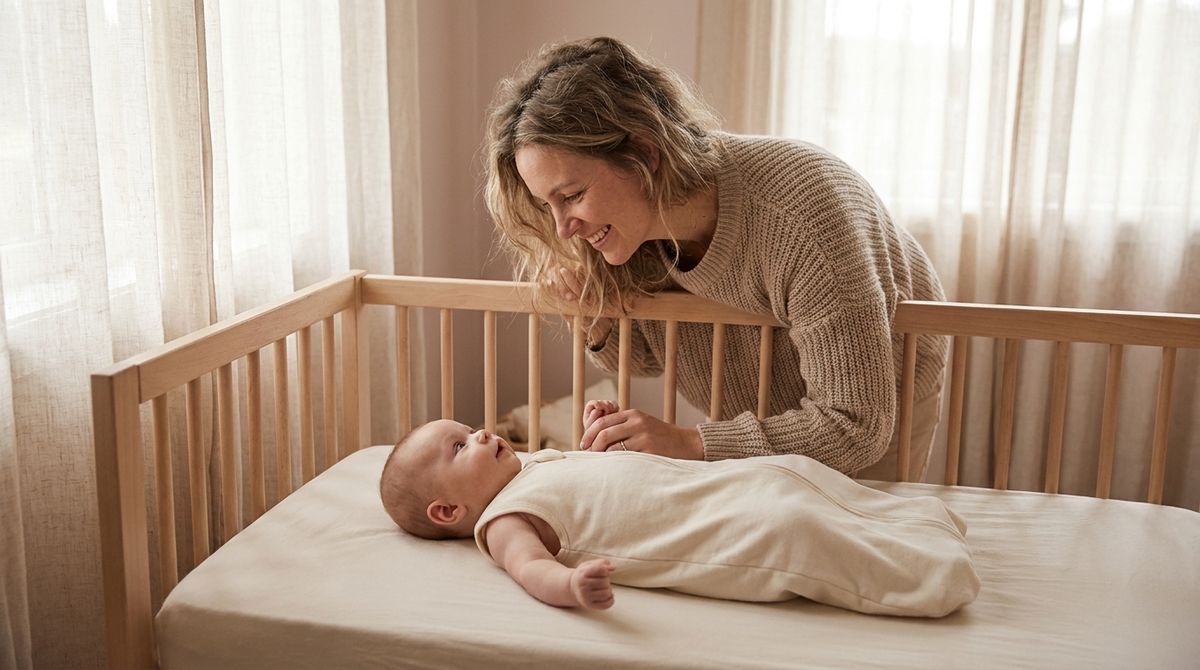
1–2 months: head control, eye contact and the first smile
- Motor: lifts their head briefly during tummy time, and by 2 months holds it up for a few seconds. Arm movements are still random, fists are often clenched, and the innate grasp reflex is at work.
- Speech and sounds: crying takes on different shades, and closer to 2 months the first drawn-out vowels appear — "ahh", "ooh". This is cooing, the very first rehearsal for speech.
- Social and emotional: at around 6–8 weeks comes the first social smile — not in sleep and not "just gas", but a response to your face and your voice. Your baby settles in your arms.
- Cognitive: focuses at roughly 8–12 inches (20–30 cm) — exactly the distance to your face during a feed — follows a face, and turns towards a loud sound.
This is also the peak of evening fussiness, which is why so many questions in the early weeks turn out to be less about development and more about colic in babies and what actually brings relief.
3–4 months: pushing up on the arms and first rolls
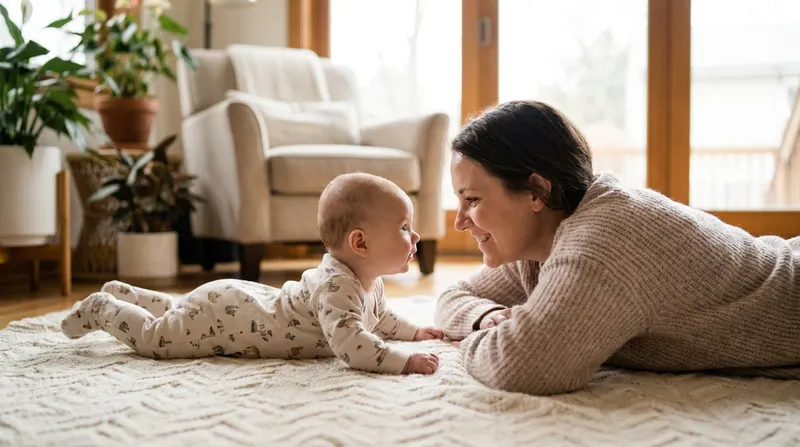
- Motor: holds their head steady upright, and during tummy time props up on the forearms and lifts the chest. Reaches for a toy and brings it straight to the mouth. The first roll from tummy to back often happens around 4 months (the usual range is 4–6 months; back to tummy typically comes later).
- Speech and sounds: cooing becomes sing-song, and your baby "answers" you in turns if you leave a pause. Real out-loud laughter appears.
- Social and emotional: smiles first to get your attention, recognises familiar people, and lights up when you walk in.
- Cognitive: studies their own hands at length, brings them together at the midline, and searches with their eyes for where a sound came from.
This is also when the famous sleep shake-up lands — and it's tied to exactly this developmental leap. More on that in our article on the 4-month sleep regression.
5–6 months: rolling both ways and the first "ba-ba"
- Motor: rolls in both directions and holds tummy time propped on straight arms. Starts sitting with support, and by 6 months many babies sit briefly on their own, leaning on their hands in front of them (the "tripod" position). Passes an object from hand to hand.
- Speech and sounds: babbling with consonants appears — "ba-ba", "da-da", "ma-ma". These syllables don't carry meaning yet; they're articulation practice. Expect plenty of squealing and raspberries.
- Social and emotional: laughs infectiously, tells familiar faces from strangers, and reaches up to be picked up.
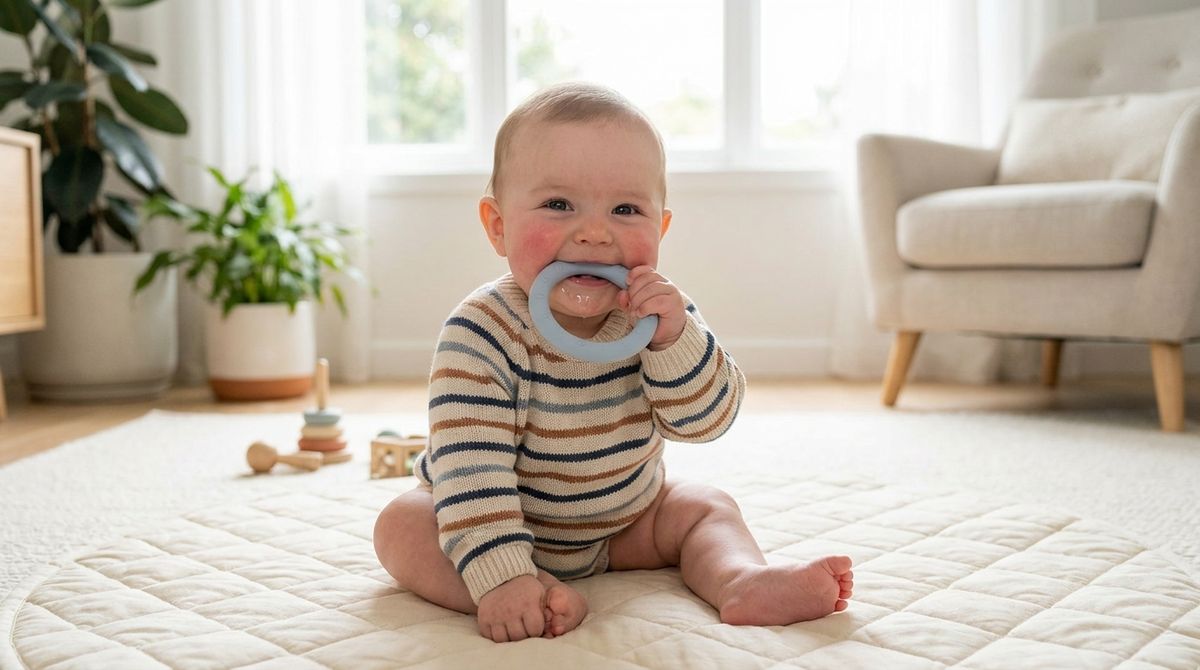
- Cognitive: puts absolutely everything in the mouth — that's the main way of investigating the world, not a bad habit. Follows a dropped toy with their eyes.
Steady head control and sitting with support are among the signs of readiness for solid food, so from roughly this age you may find our month-by-month chart for starting solids useful.
7–9 months: sitting alone, crawling, pulling to stand
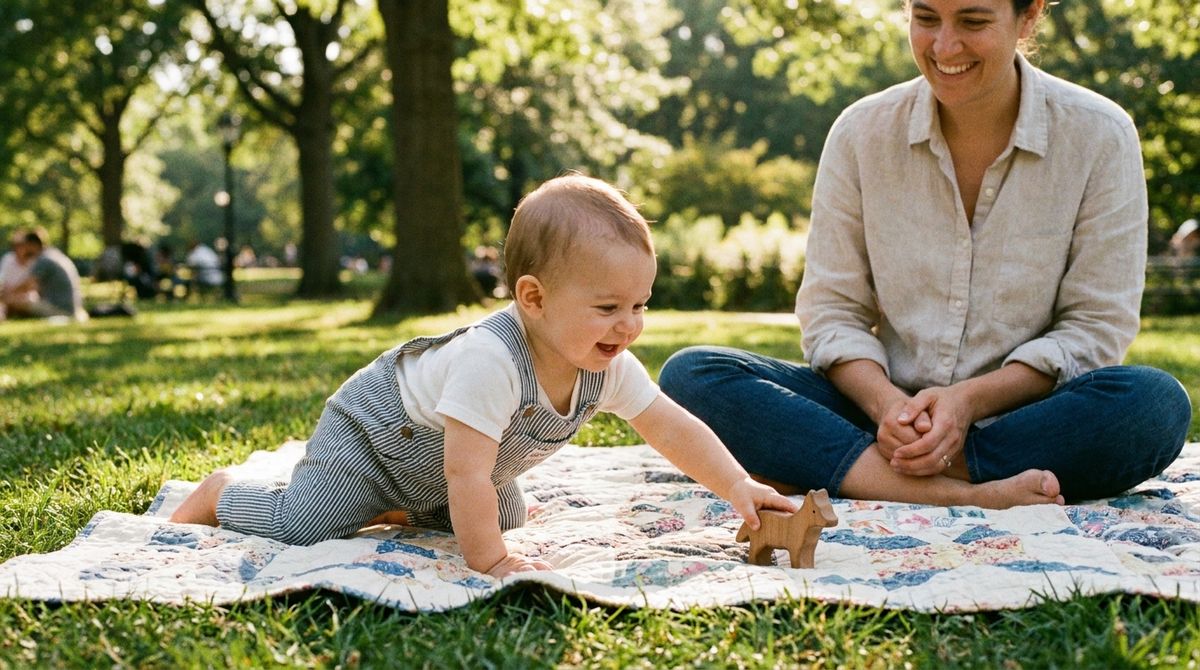
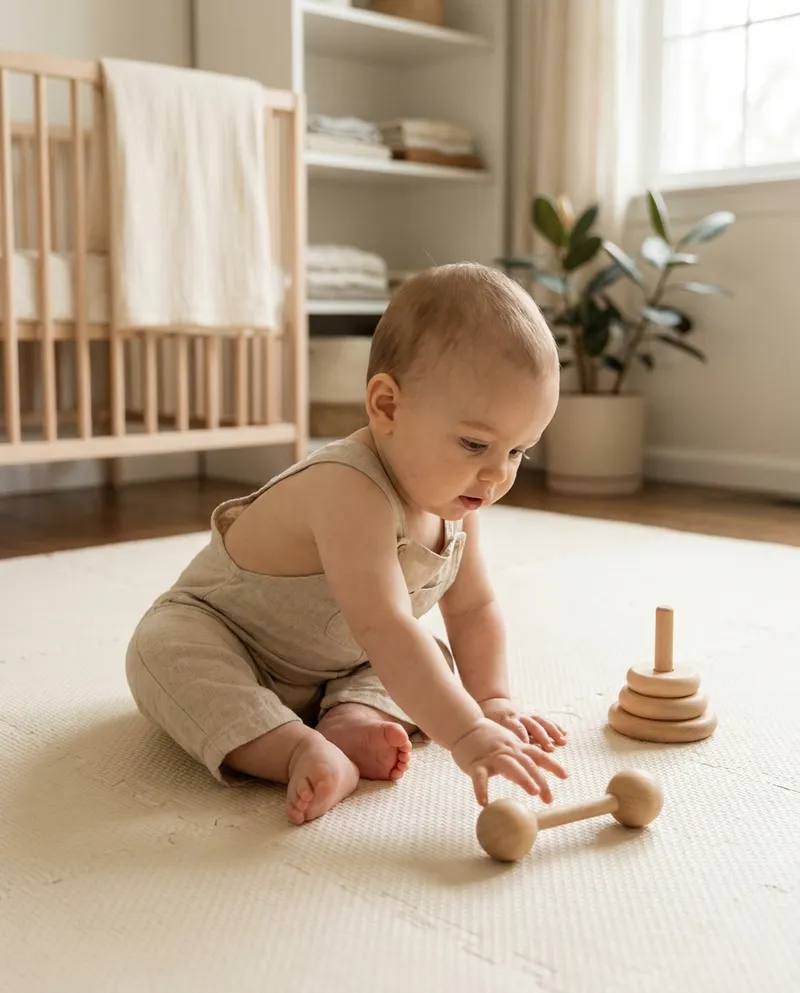
- Motor: sits without support confidently (usually 6–9 months) and gets into sitting from lying down. Starts crawling — commando-style on the belly, on hands and knees, backwards or sideways (usually 7–10 months). Pulls up on furniture to stand (around 8–10 months). The pincer grasp develops — picking up a crumb between thumb and index finger.
- Speech and sounds: babbling stretches into strings of syllables with real intonation. By 9 months a baby usually turns to their own name and understands "no" from your tone of voice.
- Social and emotional: stranger anxiety and protest at separation appear — not a spoiled temperament, but a sign of secure attachment taking shape. Adores peekaboo.
- Cognitive: masters object permanence — looks for a toy hidden under a blanket. Bangs objects together, exploring cause and effect.
Many babies sleep badly and get grouchy around now because of teeth — what's normal and what isn't is covered in our piece on baby teething symptoms and relief.
10–12 months: cruising, gestures and first words
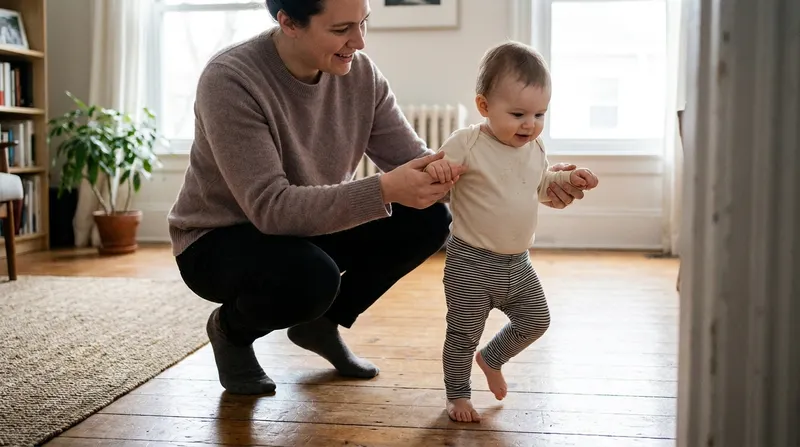
- Motor: moves along the sofa and the wall ("cruising"), stands alone for a few seconds, walks holding both your hands and then just one. First independent steps usually come between 9 and 15 months. Drinks from a cup with help, puts objects into a box and takes them out again.
- Speech and sounds: babble starts to sound like real speech in its intonation. First meaningful words appear at roughly 10–14 months: "mama" and "dada" now have an address. Understands simple requests: "give it to me", "here you go", "come here".
- Social and emotional: waves bye-bye, claps, and points at anything interesting — gestures by 12 months matter every bit as much as words. Plays give-and-take, imitates you.
- Cognitive: uses objects for their purpose (brings a comb to their head, a phone to their ear), looks for something hidden in plain sight, and repeats whatever got a reaction out of you.
When do babies sit up, crawl and walk: the real ranges
The most reliable windows for gross motor skills come from the WHO multicentre study, which followed children in several countries over time. These are the ranges that cover virtually the entire healthy population:
- Holds head up during tummy time — confidently at around 3–4 months.
- Rolls over — about 4–6 months in one direction, both directions usually by 6–7.
- Sits without support — WHO window 3.8–9.2 months, typically 6–9.
- Stands with assistance — 4.8–11.4 months.
- Crawls on hands and knees — 5.2–13.5 months, typically 7–10.
- Walks with assistance — 5.9–13.7 months.
- Stands alone — 6.9–16.9 months.
- Walks alone — 8.2–17.6 months, most often 9–15.
What if my baby never crawls at all?
That's a normal variant too. In that same WHO study, around 4% of children never crawled on hands and knees — they bottom-shuffled, rolled, commando-crawled, or went straight to pulling up and walking, and they started walking right on time. Crawling is the only one of the six milestones the WHO doesn't treat as obligatory. If your baby is getting around actively by any method, reaching, pulling up to stand and picking up new skills, the stage has been skipped, not lost.
Development comes in leaps — and unevenly
Here's another thing that saves parents a lot of nerves: progress isn't linear. Babies develop in bursts, and between bursts there are plateaus where for weeks "nothing happens". These leaps often come with wrecked sleep, extra clinginess and food refusal — and it's temporary.
Something else matters more: a leap in one area almost always puts another on pause. A baby learning to walk often stops adding new words for a month or six weeks — all the brain's resources are going into balance and coordination. A child who suddenly starts speaking in phrases may become temporarily clumsy. That's a normal reallocation of energy, not a step backwards. The genuinely worrying sign isn't a pause but the loss of a skill the child already had — more on that below.
How to support development: what actually works
Good news for tired parents: developmental skills aren't sold in shops. A baby's brain is built out of ordinary, everyday interaction.
Tummy time — from the very first days
Whenever your baby is awake and you're right there, put them on their tummy. Start with 3–5 minutes 2–3 times a day from literally the first week, building up to roughly 15–30 minutes in total per day by 2 months, and after that as much as your baby enjoys. This isn't a fad: tummy time strengthens the neck, back and shoulder muscles — the foundation for rolling, sitting and crawling — and it trains hand-eye coordination too.
The second important effect is head shape. Safe sleep on the back has sharply reduced the risk of sudden infant death syndrome, but it has increased cases of positional plagiocephaly (a flattened spot on the back of the head). Plenty of tummy time while awake, plus varying which way the head is turned during sleep, is the main prevention. If the head looks noticeably asymmetrical, or your baby always turns it to the same side, show your pediatrician — the earlier, the easier it is to help.
More floor, fewer seats
Bouncers, swings, jumpers and the car seat used outside the car all restrict movement. A safe patch of floor with a few simple objects gives your baby more than any "activity centre". There's also no need to prop a baby up in cushions before they can sit on their own — the skill arrives when the back is ready for it.
Baby walkers don't help
Infant walkers are not recommended by pediatric organisations: they don't speed up walking, and by some observations even slightly delay it and alter the movement pattern, while remaining a frequent cause of injury — falls down stairs, tip-overs, burns and poisonings, because they abruptly extend how far a baby can reach. In Canada, selling them has been banned since 2004. If your little one really wants to be upright, a stationary activity centre without wheels, or simply cruising along the sofa, is the better option.
Conversation, not screens
- Narrate whatever you're doing, name objects, echo your baby's sounds back and then pause — that's how they learn turn-taking in a conversation.
- Read board books from as early as 6 months, even if your baby mostly chews them.
- Sing, and use rhymes with hand movements — rhythm and gesture both help speech.
- Respond to your baby's initiative: they point, you name it. That exchange matters more than any flashcards.
- Screens offer no developmental benefit before 18–24 months (video calls with family are the exception). "Educational" videos are no substitute for a live face.
- A bilingual family does not delay speech — that's a myth.
When to see a doctor
This list isn't a diagnosis and it isn't a reason to panic. It's a reason to calmly have your baby seen by a pediatrician and, if needed, get a referral to a neurologist or an early intervention programme. Early support works better the sooner it starts — and most often the doctor simply puts your mind at rest.
- No head control by around 4 months — the head flops and isn't held up during tummy time.
- Not rolling in either direction by 6 months.
- Not sitting even with support by 9 months.
- No babbling and no response to their own name by 9–12 months.
- No gestures by 12 months — no waving bye-bye, no pointing, no reaching up to be held.
- Not bearing weight on the legs when supported by 12 months.
- Persistent asymmetry: using only one hand consistently before 12 months, one side of the body noticeably weaker, the head always turned to the same side. A clear hand preference normally develops after the first birthday.
- No eye contact, no social smile — your baby doesn't look at your face or respond to your voice.
- Muscles that are too stiff or, conversely, too floppy — the baby feels "rigid" or "rag-doll" in your arms.
- Loss of skills already gained, at any age — stopped babbling, no longer sits, stopped smiling or responding to familiar people. A regression of skills is always a reason to see a doctor without waiting, even if the child seems well in every other way.
And separately: if your gut tells you something isn't right, that alone is reason enough to book an appointment. A parent sees their child every single day, and doctors value that observation.
Common questions from parents
Do I need to actively teach my baby to sit, crawl or walk?
Deliberately drilling a skill is neither necessary nor helpful. The grown-up's job is to create the conditions: free, safe floor space, interesting objects just beyond arm's reach, tummy time, and your presence nearby. The body assembles the movement itself once the muscles and nervous system are ready. Massage and physiotherapy prescribed by a doctor are a separate matter, when there's a specific indication for them.
My baby walked at 16 months — is that late?
That's still within the normal spread: independent walking fits into a window extending to roughly 17–18 months. But if by 15 months your baby isn't trying to step while holding on, or by 18 months isn't walking alone, it's worth discussing with your pediatrician. And for what it's worth, when a child starts walking tells you nothing about their future abilities.
Do boys and girls develop differently?
Small statistical differences have been described (girls tend to start talking a little earlier, boys sometimes sit a little later), but they're so small that they change nothing in practice. Individual differences between children of the same sex are far larger than the average differences between the sexes — so go by the general ranges.
Key takeaways
- Milestones are ranges, not deadlines. Since 2022 the CDC has phrased them as "most children do this by…" (the 75th percentile), precisely so that parents don't panic over comparisons with the average.
- As a rough guide: holds head up at ~3–4 months, rolls over at 4–6, sits without support at 6–9, crawls at 7–10, first steps at 9–15, first words at 10–14 months.
- Crawling can be skipped — around 4% of healthy babies never crawl on hands and knees and start walking right on schedule.
- For babies born preterm, use corrected age until around 2 years.
- Development is uneven: a motor leap often puts speech on hold, and vice versa. A pause is normal; losing a skill is not.
- What works: tummy time from the first days, free floor space, talking and reading. Baby walkers aren't recommended and don't speed up walking.
- See a doctor if there's no head control by 4 months, no rolling by 6, no sitting with support by 9, no babbling or response to their name by 9–12, no gestures or weight-bearing on the legs by 12 months, with persistent asymmetry, or with any regression of skills.
This article is general information and does not replace personalized medical advice. If you have any concerns about your child's development, discuss them with your pediatrician — they'll assess your baby as a whole, not by a single line in a chart.
Sources
Created with AI and reviewed by the Mama Ai team. Educational information — not a substitute for professional medical advice.
We’re with you every week of the way
Download on the App Store