Diaper Rash: How to Treat It at Home and When to Worry
Redness under the diaper is almost always diaper rash. Here's why it happens, what to do tonight, how to tell it from a yeast rash, and when to see a doctor.

Mama Ai Team
You open the diaper and see bright red, irritated skin — and the first thought is usually "what am I doing wrong?" Most of the time the answer is: nothing. Diaper rash (its medical name is irritant diaper dermatitis) shows up in most babies at least once during the first year, especially between 9 and 12 months. It's skin irritation, not a report card on your parenting.
Below: why the skin under the diaper turns red, what you can do as early as tonight, how to tell an ordinary diaper rash from a fungal (candidal/yeast) one, from heat rash and other baby rashes, and which signs mean it's time to see a doctor.
Why diaper rash happens: what's actually going on with the skin
A newborn's skin is thinner than an adult's, and its protective barrier is still maturing. Under the diaper, four things act on it at once:
- Moisture. Prolonged contact with urine softens the top layer of skin (maceration): it becomes loose and easier to damage.
- Friction. Damp, softened skin rubs against the diaper — most of all on the raised areas: the buttocks, the pubic area, the inner thighs.
- pH shift. Bacteria in the stool break the urea in urine down into ammonia, and the environment under the diaper becomes more alkaline. In an alkaline environment, stool enzymes — lipase and protease — become active and damage the top layer of skin.
- A broken barrier. Once the barrier is disrupted, irritants penetrate deeper, the skin holds on to moisture less well, and fungi and bacteria colonize it more easily. It becomes a vicious cycle.
This is why diaper rash almost always flares up wherever stool has become frequent or loose: during a gut infection, on a course of antibiotics (whether the baby's or a breastfeeding mom's), and in the first weeks of starting solids, when the makeup and acidity of the stool change noticeably. Heat, a tight diaper, infrequent changes, and rough wiping all add to it.
What diaper rash looks like: from mild to severe
- Mild: pinkish patches or an overall pinkness on the raised areas of skin; the baby behaves normally.
- Moderate: bright redness with clear borders across the diaper area, flaking, skin that looks "glossy"; the baby winces during cleaning.
- Severe: deep red skin, weeping, superficial scrapes or erosions, noticeable soreness, crying at every diaper change.
One important detail we'll come back to below: with ordinary irritant diaper rash the depths of the skin folds usually stay clear — urine and stool simply don't reach in there. If the redness is right inside the folds, that's a different story.
And another thing: newborn skin is generally pretty "noisy." In the first days there can be a yellowish tint to the skin, then flaking, tiny white spots, fleeting mottling. Not everything you see is diaper rash, and not everything needs treatment.
What to do right now: the at-home protocol for the next 24–72 hours
Diaper rash treatment in mild and moderate cases is less about "an ointment" and more about consistent care. The logic is simple: remove the moisture, remove the friction, seal the skin with a barrier, and give it time.
1. Change the diaper more often than usual
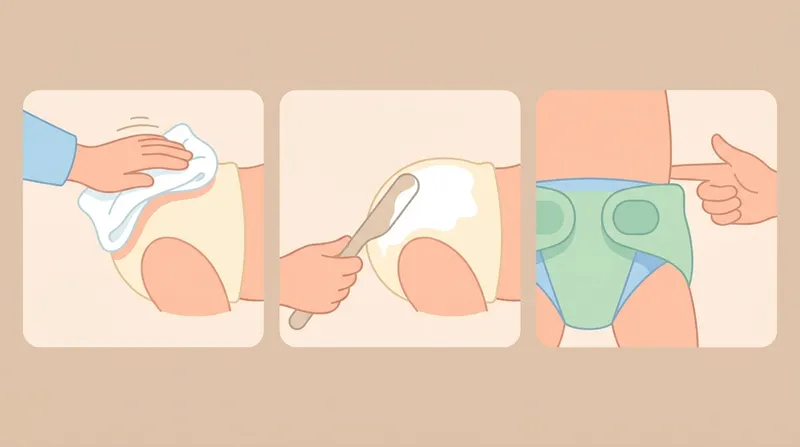
During a flare — roughly every 2 hours during the day for babies in the first months, and right after every stool, even if the diaper seems almost dry. At night, if the baby wakes to feed, it's worth changing the diaper in that window too: night is the longest stretch of skin-to-moisture contact in the whole day. The diaper should sit loosely — you should be able to slip a finger easily under the waistband.
2. Clean gently
- Warm water and a soft cloth or cotton pads are the gentlest option on inflamed skin. You can rinse under running water or use a squeeze bottle so you don't rub at all.
- If you use wipes, choose ones that are alcohol-free and fragrance-free; scented wipes often keep the irritation going.
- Pat, don't rub. Dry thoroughly — especially in the folds.
- Soap and foam on an inflamed area — not every time: plain water is enough, except after a stool.
3. Let the skin breathe
Air time works better than you'd think. Lay down a waterproof pad and leave the baby without a diaper for 10–15 minutes several times a day — for example, after each change. Dryness and no friction are exactly what the skin under a diaper almost never gets.
4. Apply a barrier product in a thick layer
This is the key step, and the one most often done wrong. A barrier paste (usually based on zinc oxide or petroleum jelly/petrolatum) doesn't "heal" the skin chemically — it physically separates it from urine and stool while the barrier repairs itself.
- Apply it thick, like frosting on a cake — don't rub in a thin film. You shouldn't be able to see the skin through the layer.
- Onto dry skin, after air time.
- Don't wipe the paste all the way off at every change. Remove what's soiled and add a fresh layer on top. Scrubbing the paste off injures the skin more than the rash itself.
- If the skin is weeping under the paste, gently pat it dry first — a barrier won't "set" on wet skin.
What's better to avoid
- Talc and powders. Powder clumps in damp folds and can get into the baby's airways if inhaled. Pediatric organizations recommend avoiding it.
- Alcohol solutions, antiseptic dyes (such as gentian violet), and potassium permanganate. These further dry out and damage already-inflamed skin.
- Steroid (hormonal) creams "just in case." The area under the diaper is an occluded zone — absorption there is higher, and prolonged, unsupervised use can thin the skin. These belong only to a doctor's prescription and a short course.
- Antibacterial or "multi-ingredient" ointments without a reason. Extra ingredients mean extra risk of contact allergy.
- A tight diaper and snug waterproof pants over it — they trap heat and moisture.
Looks similar but isn't: telling diaper rash apart from other rashes
If your care routine is right but things aren't improving, the most common reason is that what you're looking at isn't a simple irritant diaper rash. Here are the telltale signs of its symptom look-alikes.
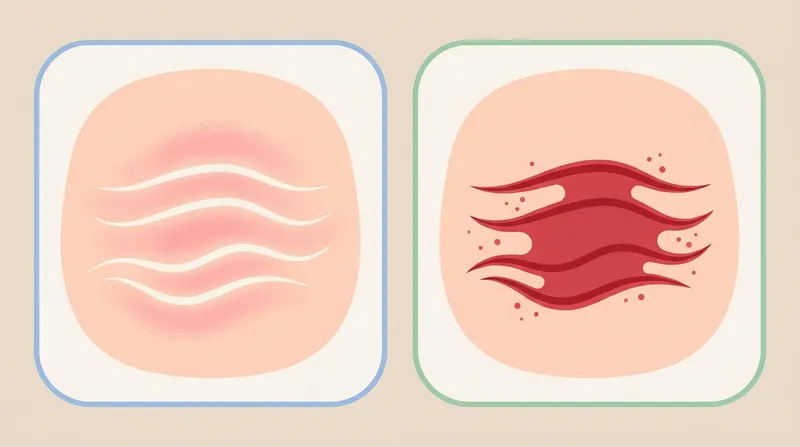
Candidal (yeast) diaper rash
The most common stand-in. The differences from irritant diaper rash are visible to the naked eye:
- The folds aren't spared — they're involved. The redness sits right in the groin and buttock folds, often deep, "beefy red," with a sharp, shiny edge.
- Satellite lesions — separate tiny red spots or pustules around the edge of the main patch, like "sparks that flew off."
- It often goes together with oral thrush in the baby — a white coating on the tongue and cheeks that doesn't wipe away.
- It frequently develops after a course of antibiotics, or on top of a long-standing rash that hasn't healed in more than a week.
It's the same genus of Candida fungus that causes yeast infections in adults. The key point: barrier paste alone isn't enough here — you need an antifungal medication that a doctor selects. The barrier product isn't dropped, though; it goes on top of the treatment.
Heat rash
Heat rash in a newborn is a blockage of the sweat ducts from overheating. How it differs: the tiniest clear blisters or small red bumps wherever it's hot and tight — the neck, folds, back, the back of the head, under a hat and under the diaper's elastic — rather than strictly in the diaper area. It appears over hours, not days. The treatment is essentially cooling down: fewer layers of clothing, a cooler room, natural fabrics. Ointments usually aren't needed, and that's the main difference from diaper rash.
Seborrheic dermatitis (cradle cap)
Yellowish, greasy scales on the scalp, eyebrows, behind the ears, and sometimes in the large folds, including the groin. The skin underneath is red, but it usually doesn't bother the baby: there's little to no itching. It often starts in the first weeks or months and gradually clears on its own. In the groin it can look a lot like diaper rash, but the clue is simultaneous patches on the head and face.
Atopic dermatitis (baby eczema)
With atopic dermatitis (baby eczema), the diaper area is usually the part that stays relatively clear (it's damp there, so the skin isn't as dry). Instead it hits the cheeks, the outer surfaces of the arms and legs, and the torso: dryness, flaking, intense itching, the baby rubbing against the bedding and sleeping poorly. There's often a family history of allergies, asthma, or eczema. The mainstay of care here is different — regular emollients over the whole body, not barrier paste on the bottom.
Newborn acne (baby acne)
Small red papules and white spots on the cheeks, nose, forehead, and chin in the first weeks of life, linked to the mother's hormones. They don't touch the diaper area. A common question is what to put on newborn pimples: usually nothing. Washing with plain water and patience are enough; in most cases baby acne clears on its own within a few weeks to months.
When to see a doctor: warning signs
Home care handles most cases, but there are situations where an exam is needed, and it's better not to put it off. See your pediatrician if:
- blisters, pustules, honey-colored crusts, or open sores appear;
- the skin is weeping or bleeding, or there's a painful swelling and firm lump;
- the rash spreads well beyond the diaper area — onto the belly, back, legs;
- the baby develops a fever, is lethargic, feeds worse, or sleeps unusually much — that's no longer about the skin; how to act is covered in the article on fever in babies, and in an infant under 3 months any fever needs urgent care;
- there's redness in the folds with satellite spots — likely a yeast rash that needs an antifungal;
- redness in the diaper area doesn't improve within 3–4 days of proper care or clearly gets worse;
- diaper rash keeps coming back despite prevention;
- the baby looks unwell overall, cries inconsolably, or is peeing noticeably less.
How long it takes to heal and what counts as improvement
Realistic expectations help you avoid bouncing between products:
- 24–48 hours: the skin stops being sore, the baby tolerates diaper changes more calmly, and the redness fades at the edges. This is the first and most important sign you're on the right track — the color goes away later than the pain.
- 3–4 days: noticeable improvement with mild and moderate diaper rash. If there's no change at all in that time, it's worth seeing a doctor rather than switching to a fifth cream.
- Up to 7 days and longer: with severe, weeping dermatitis the skin recovers more slowly, and a faint pinkness can linger for a few more days after everything has healed. Don't drop the barrier product during this period.
If after 5–7 days of correct care the picture has "stalled" or gotten worse, that's the classic scenario of a fungal or bacterial infection setting in, and an exam is needed here.
Prevention that actually works
- Barrier as a routine. A thin layer of petroleum jelly or zinc paste at every change — not only once redness appears — especially for babies prone to diaper rash.
- Nights. The most vulnerable stretch of the day. A more absorbent overnight diaper, a thicker layer of barrier product, and a change at a nighttime waking all help.
- Antibiotics. If your baby or a breastfeeding mom is prescribed a course, start stepped-up prevention from day one, before any redness: the stool will become more frequent and more irritating.
- Diarrhea. With loose stool the skin can "burn" within a day. Immediate changes, rinsing with water, and a thick barrier matter especially here.
- New foods. As the diet expands, the skin reacting to new stool is normal. Introduce foods one at a time so you can tell what's going on.
- Size and fit. A tight diaper rubs; too big a one leaks. Both extremes raise the risk.
- More dry time. Even 10 minutes without a diaper a day is real prevention, not an old wives' tip.
One more thing: redness under the diaper is sometimes confused with a generally fussy baby. If your little one is crying but the skin is clear, the cause is most likely something else — such as colic, and the strategy for helping there is completely different.
Frequently asked questions
Do I need to give up diapers entirely?
Not necessarily. Going diaper-free isn't always practical and doesn't guarantee results on its own — what matters more is how often you change, dryness, and the barrier. But it's definitely worth adding more diaper-free time during a flare.
Can I bathe the baby with a diaper rash?
Yes. A short, warm bath without bubbles or scented products tends to help: it gently cleans the skin without rubbing. Afterward, pat dry carefully and apply the barrier.
Do oil, cornstarch, or breast milk help?
Vegetable oils and cornstarch don't create a durable water-repellent barrier, and in a damp fold cornstarch can actually become a breeding ground. Breast milk on the skin is a popular home remedy, but there's no convincing evidence it beats an ordinary barrier paste. The proven option is zinc oxide or petroleum jelly.
Can I use a barrier product at every change?
Yes — that's exactly the normal routine. Barrier pastes are made for regular use; the problem is usually not the frequency but too thin a layer and scrubbing the paste all the way off.
Is diaper rash linked to teething?
No direct cause-and-effect has been proven, but during this time some babies have more frequent stools and more drooling, which indirectly irritates the skin. What actually does belong to teething is covered separately.
Key takeaways
- Diaper rash is skin irritation from moisture, friction, and stool enzymes — not a sign of poor care.
- The basic protocol: frequent diaper changes, gentle cleaning with water, patting dry, air time, and a thick layer of barrier paste that you don't scrub off at every change.
- Avoid talc, alcohol solutions, scented wipes, and steroid creams without a doctor's prescription.
- Clear folds — likely irritant diaper rash; red folds plus tiny "satellite" spots — likely a yeast rash, which needs an antifungal.
- See a doctor for blisters, weeping, a rash spreading beyond the diaper area, fever, or no improvement within 3–4 days.
This article is general information and isn't a substitute for a doctor's advice. If you're unsure about what you're seeing on your baby's skin, or things aren't improving, see your pediatrician.
Created with AI and reviewed by the Mama Ai team. Educational information — not a substitute for professional medical advice.
We’re with you every week of the way
Download on the App Store