Pregnancy Weight Gain: How Much Is Normal by BMI & Week
How much weight should you gain in pregnancy? See healthy ranges by BMI and trimester, where the kilos actually go, and when to talk to your provider.

Mama Ai Team
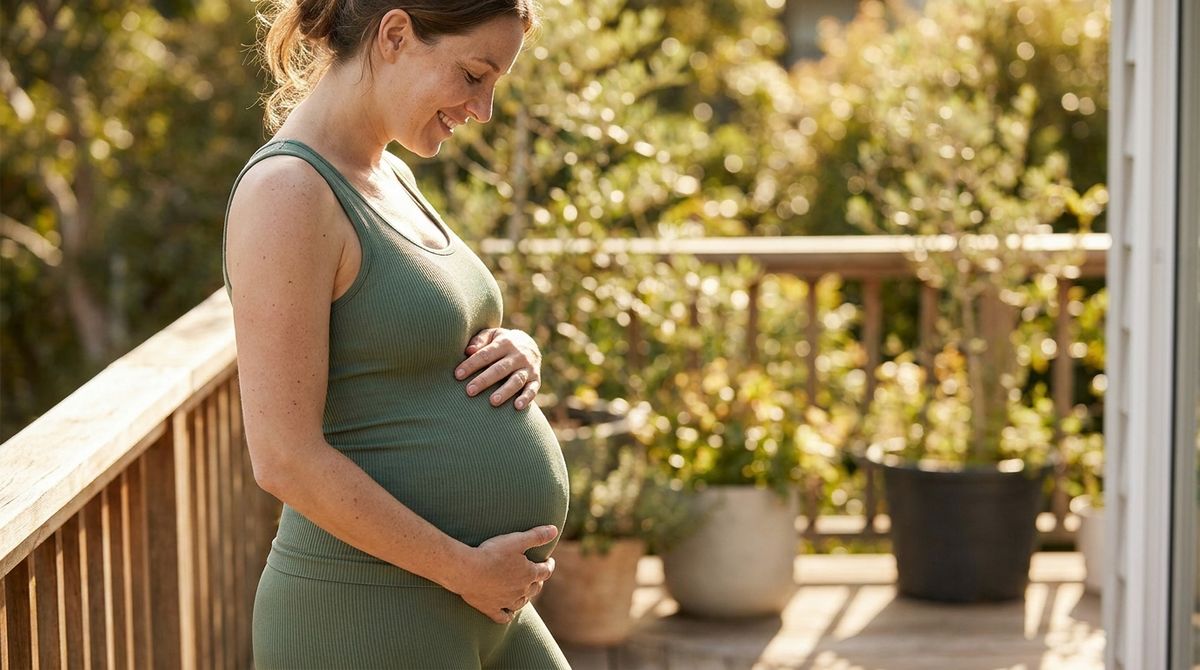
One of the most common questions at a prenatal visit is how much weight you should gain during pregnancy. The good news: there is no single "right" number. Healthy pregnancy weight gain depends first and foremost on the weight you started with — that is, your body mass index (BMI, the ratio of your height to your weight) before you conceived. In this article we'll calmly walk through the official ranges by BMI and trimester, explain where those extra kilos actually go, and why you don't need to stress over every number on the scale.
First, an important reminder: the weight you gain in pregnancy isn't "extra weight" — it's a necessary part of helping your baby grow. The goal isn't "as little as possible" but staying within your own healthy range. There's no room for shame or judgment here: every woman's body changes in its own way.
How much weight should you gain during pregnancy?
Recommendations for pregnancy weight gain around the world are built on the BMI thresholds from the U.S. National Academies guidelines (NASEM, formerly the IOM). The logic is simple: the lower your weight before pregnancy, the more you should aim to gain; the higher it is, the less. This lowers the risks for both you and your baby.
To find your starting point, calculate your pre-pregnancy BMI: divide your weight in kilograms by your height in meters squared (or just use a free online BMI calculator). For example, at 1.65 m (5'5") and 60 kg (132 lb): 60 ÷ (1.65 × 1.65) ≈ 22 — a normal weight.
Pregnancy weight gain by BMI (one baby)
- Underweight (BMI under 18.5): aim to gain roughly 12.5–18 kg (28–40 lb).
- Normal weight (BMI 18.5–24.9): roughly 11.5–16 kg (25–35 lb).
- Overweight (BMI 25–29.9): roughly 7–11.5 kg (15–25 lb).
- Obesity (BMI 30 or higher): roughly 5–9 kg (11–20 lb).
For a twin pregnancy, the recommended gain is higher: with a normal pre-pregnancy weight the target is usually about 16.8–24.5 kg (37–54 lb), with overweight about 14–22.7 kg (31–50 lb), and with obesity about 11.3–19.1 kg (25–42 lb). These are general guideposts only — your provider will set a goal that fits you.
Remember: these are ranges, not a strict gram-by-gram quota. You don't need to land exactly in the middle — what matters is staying within your interval.
Pregnancy weight gain by trimester
Weight doesn't come on evenly, and that's normal. Most of the gain happens in the second half of pregnancy, when your baby is growing fastest.
- First trimester: the gain is usually small — often just about 0.5–2 kg (1–4.5 lb) across all three months. Because of nausea, some women gain almost nothing or even lose a little weight — and that's usually no cause for panic.
- Second and third trimesters: with a normal pre-pregnancy weight, the pace is about 0.3–0.5 kg (roughly 1 lb) per week. If you were overweight or had obesity before pregnancy, the recommended pace is a bit slower — around 0.2–0.3 kg (about 0.5 lb) per week.
Don't weigh yourself every day — fluctuations within a single day mean nothing. It's enough to watch the overall trend once a week, or simply go by the routine weigh-ins at your appointments.
Where does pregnancy weight actually go?
Here's the most reassuring fact: the weight you gain is far from being all fat. Most of it is your baby and everything that supports their life. A rough breakdown by the end of pregnancy looks like this:
- Baby — about 3–3.5 kg (7–8 lb).
- Placenta — about 0.7 kg (1.5 lb).
- Amniotic fluid — about 0.8 kg (2 lb).
- Enlarged uterus — about 1 kg (2 lb).
- Breasts (preparing to feed) — about 0.5–1 kg (1–2 lb).
- Extra blood volume — about 1.2–1.5 kg (3 lb).
- Tissue fluid — about 1.5–2 kg (3–4 lb).
- Fat stores (an energy reserve for birth and breastfeeding) — about 2.5–4 kg (5–9 lb).
As you can see, fat stores are only one part of the total — and they're needed too: they're the "fuel" for labor and breastfeeding. As soon as your baby is born, you'll immediately "lose" the weight of the baby, placenta, and fluid, and the extra fluid will leave over the first few weeks.
Why staying within the healthy range matters
The goal of healthy weight gain isn't a perfect picture — it's the safety of you and your baby. Gaining well outside the range in either direction is linked to certain risks, so it's simply worth paying attention to, without anxiety or self-blame.
If you gain too much
- A higher risk of gestational diabetes (high blood sugar during pregnancy).
- A higher risk of high blood pressure and preeclampsia (a complication affecting blood pressure and kidney function).
- A larger baby — which can make delivery harder and raise the likelihood of a cesarean.
- It can be harder to return to your pre-pregnancy weight afterward.
If you gain too little
- A higher risk of a low birth weight baby.
- A greater chance of preterm birth.
If you notice you're drifting outside your range — up or down — it's not a "failure," just a cue to calmly talk through your nutrition and activity with your provider.
The "eating for two" myth
This may be the most stubborn myth in pregnancy. In reality, your baby doesn't need twice as much food — just a small bump in calories, and mostly in the second half of the pregnancy.
- First trimester: usually almost no extra calories are needed.
- Second trimester: about +340 calories a day.
- Third trimester: about +450 calories a day.
That's the equivalent of a small snack: a Greek yogurt with a handful of nuts, say, or a whole-grain sandwich with cheese. You don't literally need to "eat for two" — the quality of your food matters more than the quantity.
How to gain weight at a healthy pace
Healthy weight gain isn't about dieting or counting every calorie — it's about a calm, balanced diet and sensible movement.
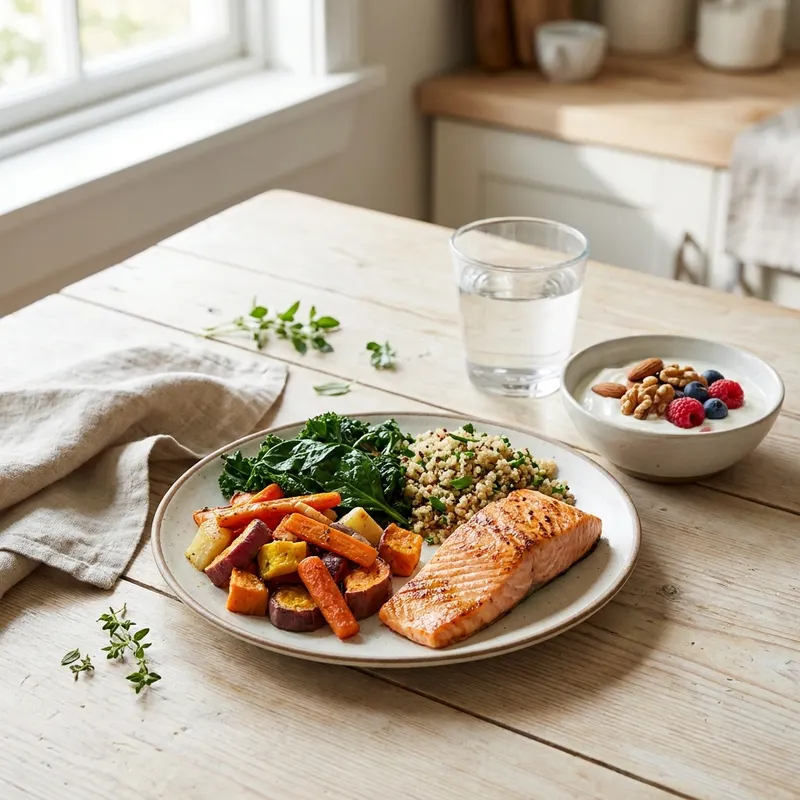
- Focus on quality. Vegetables and fruit, whole grains, protein (fish, poultry, eggs, legumes), dairy, and healthy fats. We cover what to eat and what to skip in detail in our article on foods to avoid during pregnancy.
- Don't skip meals. Smaller, more frequent meals help with nausea and heartburn and smooth out sharp swings.
- Drink enough water and limit sugary drinks and foods high in added sugar.
- Move, if your provider says it's okay. Walking, swimming, and prenatal yoga — gentle activity helps keep weight on track and lifts your mood. Always clear your exercise plan with your provider first.
Don't fixate on the scale
The number on the scale is just one of many measures, and it can be misleading. Your weight shifts throughout the day depending on what you've eaten, the time of day, your digestion, and how much fluid your body is holding.
In the second half of pregnancy, fluid retention adds noticeably to your weight. Mild swelling in the feet and hands is common and usually harmless; we've written separately about when swelling during pregnancy does warrant your provider's attention. Thanks to water, your weight can "jump" over a couple of days and then drop again — it doesn't mean you've "overeaten."
If weigh-ins make you anxious, give yourself permission to do them less often and lean on how you feel, your appetite, and your routine check-ups instead. Your worth isn't measured in kilograms.
When to call your provider
Reasons to calmly discuss your weight with your provider:
- you're consistently gaining noticeably more or less than your recommended range;
- a sudden jump in weight — for example, more than 1 kg (about 2 lb) in a week, especially together with marked swelling of the face and hands, a headache, or vision changes (this can be a sign of preeclampsia and needs prompt evaluation);
- you're not gaining any weight at all in the second or third trimester, or you're losing it;
- severe nausea and vomiting are keeping you from eating and drinking normally.
Your provider will assess the trend in the context of your specific pregnancy — and, if needed, gently adjust your nutrition or look into the cause.
Key takeaways
- There's no single norm: pregnancy weight gain depends on your pre-pregnancy BMI.
- Guideposts (one baby): underweight 12.5–18 kg (28–40 lb), normal 11.5–16 kg (25–35 lb), overweight 7–11.5 kg (15–25 lb), obesity 5–9 kg (11–20 lb); more for twins.
- The first-trimester gain is small (often 0.5–2 kg), then about 0.3–0.5 kg (roughly 1 lb) per week.
- The kilos you gain are mostly your baby, fluid, placenta, blood, and tissue fluid — not just fat.
- You don't need to "eat for two": about +340–450 calories a day in the second half of pregnancy is enough.
- Don't panic over the scale: water and the time of day cause swings. Call your provider with a sudden jump, drifting outside your range, or marked swelling.
This article is general information and is not a substitute for personalized medical advice. For questions about your weight and nutrition during pregnancy, talk to your obstetrician-gynecologist.
Sources
Created with AI and reviewed by the Mama Ai team. Educational information — not a substitute for professional medical advice.
We’re with you every week of the way
Download on the App Store