
Epidural During Labor: How It Works, Side Effects & Risks
An epidural is the most effective labor pain relief: how it works, when you can get one, the procedure, side effects, risks and who shouldn't have it.

Mama Ai Team

Labor pain worries almost every expectant mother, and an epidural is one of the most reliable and widely used ways to manage it. It's the most common method of pain relief during labor in the world, yet plenty of questions and myths still surround it: when it's done, whether it hurts to place, whether you can still push afterward, and whether it's true that an epidural leaves you with a sore back or leads to more C-sections. In this article we'll calmly walk through how an epidural works during labor, what the procedure involves, its benefits, side effects and risks — and who it isn't right for. This will help you come to the conversation with your anesthesiologist prepared and make the decision that's right for you.
What an epidural is and how an epidural works
An epidural means delivering pain-relief medication into the epidural space — the narrow gap around the coverings of the spinal cord in your lower back, at the level of the lumbar spine. A local anesthetic, sometimes combined with a small dose of an opioid, is fed in through a thin, flexible tube called a catheter.
The medication "switches off" the pain signals traveling from the lower half of your body to your brain. You stay fully awake throughout: talking, breathing on your own, feeling touch and pressure — the contractions simply stop being a sharp, exhausting pain. A key advantage of the catheter is that pain relief can be kept up for as long as labor lasts and the dose increased if needed — for example, if a C-section becomes necessary.
When can you get an epidural: dilation and "is it too late?"
It used to be thought that an epidural could only be placed once the cervix had dilated to 4–5 cm. Current guidelines (ACOG, NICE) have moved away from this: there's no fixed dilation threshold. Pain relief can start as soon as labor is active and you ask for it — there's no need to wait for a "certain centimeter."
The question "is it too late?" comes up at the very end. An epidural is only considered late when the baby's head has already descended and pushing is about to begin — placing the catheter and letting the medication take effect takes time (usually 10–20 minutes), and the anesthesiologist may simply not make it in time. So if you're planning on pain relief, it's better to say so once contractions become regular and painful, rather than holding out until the last moment.
To recognize in good time that labor has really started, it helps to tell true contractions from practice ones. We cover this in detail in how to know when labor is starting and Braxton Hicks contractions.
How an epidural is done: the procedure step by step
Preparation and positioning
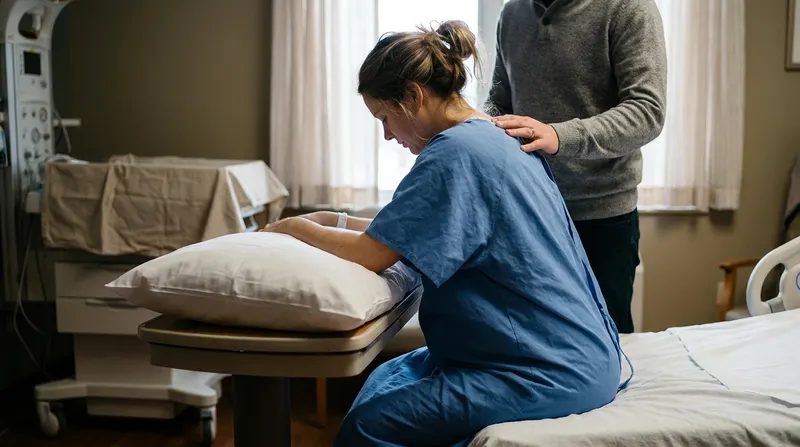
First, an IV line is placed in a vein in your arm and your blood pressure and the baby's heartbeat start being monitored. Then you'll be asked to get into the right position — sitting on the edge of the bed or lying on your side, rounding your back "like a cat" and tucking your chin toward your chest. This pose opens up the spaces between the vertebrae and makes the doctor's job easier. It's important to stay still for a few minutes, even at the peak of a contraction — a midwife or your partner is usually right there to hold on to.
The epidural needle, catheter and what you'll feel
The skin on your lower back is cleaned with antiseptic and numbed with a tiny injection — it feels like a mild stinging. The anesthesiologist then inserts a special epidural needle, through which a soft catheter is threaded into the epidural space. The needle itself is then removed, while the thin catheter stays taped to your back — you can move and lie down with it in place.
Most women feel pressure and a sense of fullness while it's being placed, and sometimes a brief "twinge" down one leg, but not sharp pain. About 10–20 minutes after the medication goes in, contractions become noticeably softer or are barely felt. If the pain relief is uneven (weaker on one side), say so — the doctor will adjust the dose or the position of the catheter.
Can you still move and push?
Your legs usually feel heavy and warm, and there may be mild numbness. Modern "low-dose" regimens and the so-called "walking epidural" preserve more movement — sometimes you can change position in bed or even stand with support. You'll be able to push, too: the urge to push may feel muted, so your midwife will guide you on when and how to push, using your contractions as a cue. Sometimes the dose is lowered a little toward the end of labor so you can feel the urge to push more clearly.
Epidural benefits, side effects and risks
The benefits
- The most effective labor pain relief — it eases the pain while keeping you conscious.
- The effect can be maintained and adjusted throughout labor.
- A chance to rest and gather strength before pushing, especially during a long labor.
- If an emergency C-section is needed, the same catheter can often be used for anesthesia — without general anesthesia.
Common, usually harmless side effects
- A drop in blood pressure — the most common effect, so it's closely watched and treated with fluids or medication if needed.
- Itchy skin — a reaction to the opioid in the mix that goes away on its own.
- Shivering and chills — common and harmless.
- Trouble urinating — a urinary catheter is often placed for the duration of labor.
- A slight rise in temperature, and mild tenderness at the injection site for a couple of days.
Rare but serious risks
Serious complications are rare, but worth knowing about. In roughly 1 in 100–200 women, a headache after a puncture of the dura (the tough membrane around the spinal cord) — a postdural puncture headache — develops; it worsens when you're upright and can be treated. Very rarely there can be lasting numbness or weakness, infection, or an epidural hematoma (a collection of blood pressing on the nerves) — the latter is extremely unlikely in healthy women in labor. Your anesthesiologist will always explain the warning signs that mean you should tell staff right away.
Epidural myths: does it slow labor, cause C-sections or back pain?
There are many fears surrounding the after-effects of an epidural. Here's what current evidence-based medicine says:
- "An epidural slows down labor." The pushing stage can lengthen by tens of minutes on average, but this doesn't harm the baby's health, and doctors account for it.
- "An epidural leads to more C-sections." Large reviews (Cochrane) do not confirm that an epidural raises the risk of a C-section. It may slightly increase the chance of an assisted delivery (vacuum or forceps).
- "An epidural gives you lifelong back pain." Good-quality studies find no link between an epidural and chronic back pain. Back pain after birth is very common and usually relates to pregnancy itself and the strain on your body, not the injection. Tenderness where the catheter went in lasts only a few days.
Contraindications: who can't have an epidural
An epidural suits most women, but in some cases it isn't given, or is given with caution. The decision is always made by the anesthesiologist after an examination. The main contraindications:
- Blood-clotting disorders or taking anticoagulants ("blood-thinning" medications).
- A very low platelet count.
- Infection or inflammation of the skin at the injection site, or a severe body-wide infection (sepsis).
- Certain conditions or previous surgery of the lower spine.
- An allergy to local anesthetics (rare).
That's why it's so important to tell your doctor in advance about all your conditions, surgeries and medications. It's helpful to write this down and bring it with you — along with the rest of your documents and the items on our hospital bag checklist.
Alternatives to an epidural
An epidural isn't the only option. Depending on the situation and the hospital, other methods are available too:
- Spinal anesthesia — a single injection into the spinal fluid. It works faster than an epidural but is time-limited; it's used more often for a planned C-section.
- Combined spinal-epidural (CSE) — combines the fast start of a spinal with the lasting effect of an epidural through a catheter.
- Nitrous oxide ("laughing gas") — breathed in through a mask during a contraction; it makes the pain easier to bear and works and wears off quickly.
- IV opioids — they dull the pain, but relieve it less than an epidural and can cause drowsiness.
- Non-drug methods — breathing techniques, changing position and walking, a warm shower or bath, massage, a birthing ball, and support from your partner. These can be combined with any other method.
Epidural vs spinal anesthesia for a C-section
For a planned C-section, spinal anesthesia is usually chosen: it works quickly and reliably, and the mother stays awake and can see her baby right away. If an epidural catheter was already in place during labor, a stronger dose is often given through it for an emergency operation. General anesthesia for a C-section is used less often — mainly in emergencies or when regional anesthesia is contraindicated. For more on the operation itself and recovery, see our article on the C-section procedure and recovery.
What happens after the birth: recovery
After your baby is born, the catheter is gently removed from your back — this is painless. Feeling and strength in your legs return gradually, usually within a few hours. Until the medication has fully worn off, you should only get up with staff helping you, so you don't fall. The urinary catheter, if there was one, is also removed, and urination returns to normal over time. Mild tenderness in your lower back at the injection site may last a couple of days and goes away on its own. If you develop a severe headache when upright, run a fever, or have growing weakness or numbness in your legs — be sure to tell your doctor.
Key takeaways
- An epidural is the most effective way to relieve labor pain; you stay awake throughout.
- There's no fixed dilation threshold: it's done once labor is active and you ask; "too late" only means just before pushing.
- The procedure is done sitting or lying on your side with a rounded back; you mostly feel pressure rather than sharp pain.
- Common side effects (low blood pressure, itching, shivering) are usually harmless; serious complications are rare.
- Current evidence does not confirm that an epidural raises the risk of a C-section or causes chronic back pain.
- There are contraindications and alternatives — make the final decision together with your anesthesiologist.
This article is for general information only and is not a substitute for personalized medical advice. Make decisions about labor pain relief together with your OB-GYN and anesthesiologist, taking your health and the course of your pregnancy into account.
Sources
Created with AI and reviewed by the Mama Ai team. Educational information — not a substitute for professional medical advice.
We’re with you every week of the way
Download on the App Store