
Folic Acid for Pregnancy: When and How Much
Why folic acid matters for pregnancy, when to start taking it, how many mcg a day, folate vs folic acid, and which other prenatal vitamins matter early on.

Mama Ai Team

If you're planning a pregnancy or have just found out you're expecting, there's one supplement worth starting first — folic acid. It's the synthetic form of vitamin B9 (folate), and it's the one that lowers the risk of serious birth defects in your baby. According to the WHO, CDC, and NHS, taking folic acid regularly before and during the first weeks of pregnancy reduces the chance of neural tube defects (major malformations of the brain and spinal cord, such as spina bifida) by roughly 50–70%.
Below we'll walk through it step by step: why folic acid matters for pregnancy, when to start taking it and how many mcg a day you need, how folate differs from folic acid, which foods are high in folate, and which other prenatal vitamins matter in early pregnancy. This is general information for understanding — always confirm your specific plan with your doctor.
Why folic acid matters for pregnancy
Folate is involved in cell division and building DNA. In the very earliest weeks, when the embryo's neural tube — the foundation of the future brain and spinal cord — is forming, cells divide especially fast and the need for folate rises sharply.
The key thing here is timing. The neural tube fully closes by about day 28 after conception — the end of the 5th–6th week of pregnancy. In other words, at the very moment many women are just seeing two lines on a test, this crucial stage is already nearly complete. That's why your folate stores need to be in place before pregnancy begins, not built up afterward.
Adequate folate is linked not only to a lower risk of neural tube defects, but also to a reduced chance of certain other defects (such as cleft lip and palate) and, in some studies, of preterm birth. It's not a guarantee — no supplement removes the risk entirely — but it's one of the most evidence-backed and simplest preventive steps available.
When to start folic acid
Ideally, start at least 1 month before conception and continue throughout the entire first trimester (the first 12 weeks). Many organizations, including the CDC, advise women of reproductive age who could become pregnant to take folic acid continuously — because about half of pregnancies are unplanned, and the neural tube forms before a woman even knows she's pregnant.
If you're actively preparing to conceive, it makes sense to put folic acid on the same checklist as tracking your cycle. To figure out which days give you the best chance of conceiving, see our article on signs of ovulation and your fertile window, and when you have reason to suspect pregnancy, read about when to take a pregnancy test for an accurate result.
What if I only started folic acid after I found out I was pregnant?
It's never too late to start, and the benefit continues throughout the first trimester — so be sure to begin right away. Yes, the ideal "window" for preventing neural tube defects is those first few weeks, which often pass before a positive test. But that's no reason to beat yourself up — it's a reason to start taking it right now and talk the situation over with your doctor. Early pregnancy symptoms before a missed period vary from person to person, and many people don't find out right away — that's a very common situation, not a mistake.
What should I do if I forget to take a tablet?
One missed day doesn't undo all the benefit. Just keep taking the supplement as usual the next day — there's no need to "double up" the dose to make up for it. Tying it to a daily ritual (brushing your teeth, breakfast) helps you remember.

How much folic acid you need a day
The standard preventive folic acid dosage for most women when planning a pregnancy and during the first trimester is 400 mcg (0.4 mg) a day. This is the recommendation of the WHO, CDC, NHS, and ACOG. This dose is often advised as part of a prenatal vitamin, but it can also be a standalone folic acid tablet.
For certain groups of women, a doctor may prescribe a higher dose — up to 4000 mcg (4–5 mg) a day. This dose is recommended only under medical supervision and usually for those at higher risk of neural tube defects, for example:
- a previous pregnancy affected by a neural tube defect;
- a neural tube defect in the woman herself or in the baby's father;
- diabetes;
- taking certain anticonvulsant medications;
- obesity and a number of other conditions.
Important: do not put yourself on a high dose — 4–5 mg isn't a "just in case" measure, it's a separate medical decision. If you have any of these risk factors, discuss the dosage with your doctor before conception.
Can too much folic acid be harmful?
For most women, the standard 400 mcg is completely safe. The tolerable upper limit for adults set by regulators is around 1000 mcg (1 mg) a day from supplements (folate from ordinary food doesn't count toward this limit). Higher doses are prescribed specifically when indicated and under a doctor's supervision. The main practical risk of excess synthetic folic acid is that it can "mask" a vitamin B12 deficiency, which is why when planning a pregnancy your doctor sometimes checks your B12 level too.
Folate vs folic acid: what's the difference
These words are often used interchangeably, but there's a nuance between them:
- Folate is the natural form of vitamin B9 found in foods (leafy greens, legumes, liver).
- Folic acid is the synthetic, stable form used to fortify foods and supplements. It's well absorbed, and it's the form studied in the large trials on preventing birth defects.
- Methylfolate (5-MTHF) is the "active" form, ready for the body to use; it's found in some supplements.
You may sometimes come across talk about the MTHFR gene: in some people the enzyme that converts folic acid into its active form works a little more slowly. In practice, for the vast majority of women this is no reason to avoid ordinary folic acid — the standard dose is enough, and official recommendations don't support routine MTHFR testing. If you have particular concerns, you can discuss the form of the supplement (folic acid or methylfolate) with your doctor, but there's no need to panic about it.
Foods high in folate
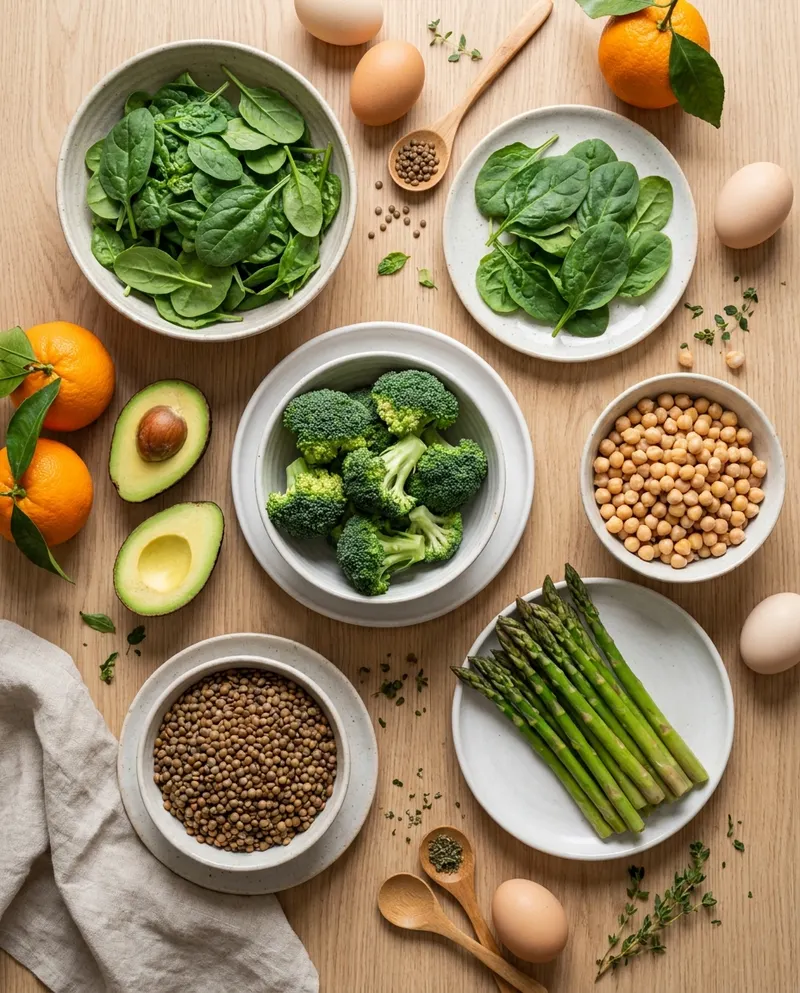
Diet is an important support, but not a replacement for the supplement: getting the right level of folate from food alone within the right timeframe is hard, and synthetic folic acid is absorbed better than dietary folate. So the advice is simple: both a balanced diet and a supplement. Good sources of folate include:
- dark green leafy vegetables: spinach, arugula, leaf lettuce, broccoli;
- legumes: lentils, chickpeas, beans, peas;
- asparagus, Brussels sprouts, avocado;
- citrus fruits (oranges) and their juice;
- eggs, nuts, and seeds;
- fortified foods: some cereals and breads with added folic acid.
To preserve folate, it's best to cook vegetables only briefly — it breaks down with long boiling.
If I eat well, do I still need a supplement?
Yes. Even with an excellent diet, official recommendations advise taking a folic acid supplement when planning a pregnancy and during the first trimester. It comes down to the dose, the absorption, and the timing: you need stores in place early and consistently. Food complements the supplement, but doesn't replace it.
Which other prenatal vitamins matter
Folic acid is the cornerstone of pregnancy preparation, but it's not the only important nutrient. Many women take it as part of a prenatal vitamin. Here's a brief look at the other key elements (choice and doses — only with your doctor):
- Iodine. Needed for your baby's brain and thyroid development. The WHO recommends adequate iodine intake when planning and during pregnancy; many prenatal vitamins already contain it.
- Iron. Supports the growing blood volume and helps prevent anemia. Iron needs rise during pregnancy; whether you need iron supplements for pregnancy is something your doctor determines from blood work, not by guesswork.
- Vitamin D. Important for the bones and immunity of both mother and baby; deficiency is common, especially in winter. The dose is usually tailored individually.
- Omega-3 (DHA). Fatty acids for your baby's brain and vision development. There's a lot of talk about the benefits of omega-3 for women; sources include oily fish or DHA supplements.
- Vitamin B12. Works in tandem with folate; especially important on a vegetarian or vegan diet.
A quick word on a popular search, magnesium with B6 in pregnancy: it's sometimes prescribed, but it isn't a basic "vitamin" supplement for everyone — take it only on your doctor's advice, not on advice from the internet.
What to do if morning sickness makes it hard to keep vitamins down
In the first trimester, nausea can make taking tablets difficult. It sometimes helps to take the supplement with food or before bed rather than on an empty stomach, or to ask your doctor about a different form (a chewable, for example). For more on why nausea happens and how to ease it, see our article on morning sickness in pregnancy. If vomiting is severe and you can't keep down water or food, that's a reason to contact your doctor.
Key takeaways on folic acid for pregnancy
- Folic acid lowers your baby's risk of neural tube defects — one of the most evidence-backed preventive measures there is.
- It's best to start a month before conception and continue through the entire first trimester (up to 12 weeks).
- The standard dose is 400 mcg a day; a higher dose (up to 4000 mcg / 5 mg) is only for risk factors and only on a doctor's prescription.
- Found out about your pregnancy later, or missed a day? Don't beat yourself up — just start and keep taking it.
- A folate-rich diet (greens, legumes, citrus) complements the supplement, but doesn't replace it.
- Besides folic acid, iodine, iron, vitamin D, omega-3 (DHA), and B12 all matter — usually as part of a prenatal vitamin and in consultation with your doctor.
This article is for general informational purposes and is not a substitute for individualized medical advice. Discuss your choice of vitamins, doses, and regimen with your OB-GYN or primary care doctor.
Sources
Created with AI and reviewed by the Mama Ai team. Educational information — not a substitute for professional medical advice.
We’re with you every week of the way
Download on the App Store