When Can Baby Hear in the Womb & What They Sense
By 18 weeks your baby can hear your voice; from week 14 they taste the amniotic fluid. How each sense develops — and how to bond before birth.

Mama Ai Team

As you read this line, your baby is probably asleep — curled up in warm water, in soft half-light. But they aren't cut off from the world. They can hear your heartbeat, the gurgle of your stomach after lunch, the sound of your laugh, and the voice of the person sitting next to you.
A baby's development in the womb is about far more than grams, centimeters and lines on an ultrasound report. Alongside the body, the senses are maturing too, and little by little your baby begins to touch, taste, hear and react. Here's what science actually knows: when each sense switches on — including when baby can hear in the womb — whether they can hear dad's voice, whether a newborn recognizes mom's voice, and which popular tips really work versus which turned out to be a lovely myth.
When each sense switches on: the fetal timeline
If you follow a baby's development month by month in the womb, the senses appear in a fairly consistent order — from the most "bodily" to the most "distant":
- Touch — around 8 weeks. The skin around the mouth is the first to respond to contact.
- Taste — 8–14 weeks. Taste buds start forming by about 8 weeks, your baby begins swallowing amniotic fluid around 12–13 weeks, and can distinguish taste molecules from roughly week 14.
- Hearing — from 18 weeks. The structures of the ear are ready to receive sound; at first that means the internal sounds of your body.
- Response to outside sound — 24–25 weeks, with clear perception of voices from outside by 26–28 weeks.
- Sight — last. The eyelids open at around 26–28 weeks, but it's nearly dark in the womb anyway.
These timings are approximate: like everything else in the second trimester of pregnancy, they describe an average pace, not a schedule your particular baby is obliged to follow.
Touch: the first sense to appear
Touch comes before everything else. From around 8 weeks a fetus responds to a light touch with movement, and in the second half of pregnancy uses its hands quite purposefully: gripping the umbilical cord, touching its own face, sucking a thumb, pushing its feet against the wall of the uterus. On a 4D ultrasound you can clearly see a baby "exploring" itself.
Which leads to a question many expectant parents ask — what does a baby enjoy in the womb? Some babies visibly perk up when mom lies on her side and slowly strokes the bump; others go quiet instead. Both are normal: it's not a verdict on your parenting, just an individual temperament that begins before birth.
Taste and smell: does baby taste what you eat in the womb
By mid-pregnancy a fetus swallows a noticeable amount of amniotic fluid — and its flavor changes with your diet. Molecules of garlic, carrot, vanilla and spices pass into the amniotic fluid; the concentration usually peaks about 45 minutes after a meal. Put simply, your baby really does "taste" mom's dinner — in a very diluted form.
Carrot and kale: what a 4D ultrasound revealed
In 2022, researchers at Durham University (Ustun and colleagues, published in Psychological Science) gave pregnant participants capsules of carrot or kale powder and filmed the fetus's face on a 4D ultrasound. After carrot, babies were more likely to make a smile-like expression; after kale, a cry-like grimace. This doesn't mean the baby "loves carrots", of course: the point is that they can distinguish flavor and respond to it with facial expressions long before birth.
Why this matters after birth
There's evidence that meeting a flavor before birth may make it easier to accept the same foods later, when starting solids. It's one more calm argument for a varied diet during pregnancy — not for the sake of "eating right", but because it introduces your baby to your family's kitchen in advance. Incidentally, the flavors of your diet also reach breast milk, so the introduction continues after birth.
Smell works hand in hand with taste: newborns recognize the smell of their own amniotic fluid and turn toward it — one of the first ways to find mom in an unfamiliar world.
When can baby hear in the womb
The hearing structures are ready to receive sound at around 18 weeks. But the first thing a baby hears isn't music from outside — it's the soundscape of your body: your heartbeat, blood moving through vessels, the workings of your gut, your breathing. And your voice — it reaches your baby not only through the air but also through the tissues and fluids of your body, so it sounds louder and clearer to them than any other. Mom's voice is the most familiar signal in this world, long before your baby ever sees your face.
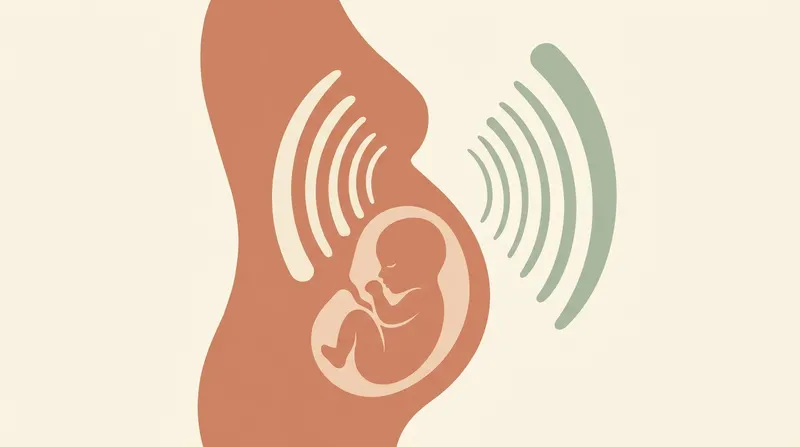
From here the fetal hearing timeline unfolds in stages: a reliable response to outside sounds — movement, a change in heart rate — appears at around 24–25 weeks. This is roughly when a baby first responds to a voice in the womb. By 26–28 weeks they clearly hear voices from outside, and by about 30 weeks start to distinguish frequencies, that is, to tell one voice from another.
Can baby hear dad's voice in the womb
Yes — and this is a case where physics is on the partner's side. The wall of the belly and the amniotic fluid act like a filter: high frequencies are dampened more, low ones pass through better. So a deep male voice reaches the baby especially well. There's no need to shout or press your face to the bump: it's enough to sit close and speak in a normal, calm voice, ideally in the third trimester when hearing has matured.
When does baby recognize mom's voice
This is one of the most beautiful findings in developmental psychology. In a classic experiment by DeCasper and Fifer (1980), newborns were given a pacifier wired to a recording: by changing the rhythm of their sucking, the baby could "choose" whose voice to hear. Babies adjusted their sucking so that their own mother's voice played, rather than a stranger's. In a follow-up (DeCasper and Spence, 1986), expectant mothers read the same story aloud regularly at the end of pregnancy — and after birth the babies preferred that very text over a new one.
So yes: by the time they're born, your baby already knows your voice and, most likely, your favorite lullaby. That's the mother-baby bond in the womb — not mysticism, but a perfectly measurable effect of a familiar sound.
Sight: the last and quietest sense
The eyelids open at around 26–28 weeks, but there's not much to look at in the womb. Late in pregnancy a baby may sense a diffuse glow if a bright light is shone on the belly — a dim reddish haze, no more. Sight won't really kick in until after birth, and for the first few weeks a newborn will only see clearly at about arm's length — roughly the distance from the breast to your face.
Why baby doesn't always respond: they're just asleep
A fetus has its own sleep–wake cycles, including REM sleep, and spends a large part of the day asleep. So "I put on music and got no reaction at all" usually doesn't mean "can't hear" — it means "was asleep" or "had turned the other way".
Many expectant moms look for ways to get baby moving in the belly. Usually it's enough to have a snack, drink some cool water, change position or lie on your left side and wait — often the baby wakes up on its own. Just keep an important distinction in mind: no response to a sound is normal, but a noticeable, persistent change in your baby's usual pattern of movement is a reason to contact your provider without delay. There's more on this in our separate article on fetal movement and what's normal week by week.
Two popular myths worth knowing about
Do babies in the womb need Mozart?
There's no convincing evidence for the "Mozart effect": the research doesn't support the idea that classical music or "prenatal intelligence" programs make a baby smarter. That doesn't mean you should switch the music off. The reason is just different: listen to whatever calms and delights you. Your baby "reads" your calm far more reliably than any list of composers.
Headphones and speakers on the belly
It's best not to press headphones or a speaker against the bump, and certainly not to turn up the volume. A fetus's ear is still forming, and loud sound isn't harmless to it. Ordinary conversation, singing and background music in the room are more than enough — all of it reaches your baby just fine. If you really want to use a device "for the bump", keep the volume minimal and the sessions short — and when in doubt, calmly do without it.
"The baby didn't startle at a loud noise — what if they can't hear?"
At-home hearing checks during pregnancy prove nothing: a lack of reaction is usually explained by the baby being asleep or by their position. The real test is the newborn hearing screening done at the hospital in the first days of life. If something worries you, ask about it at your appointment — it's a normal question, and your provider is used to it.
Bonding with your baby during pregnancy
The good news: you don't need to buy anything special. Everything that works is free and takes just minutes.
- Narrate your day. "We're going to the store", "it's about to get loud, that's the hairdryer" — it only feels odd the first three times.
- Sing. Off-key is perfectly fine too: what matters to your baby is the rhythm and a familiar intonation, not hitting the note.
- Read the same thing aloud. In the third trimester, reading stories to your baby in the womb isn't about early education — it's practice at recognition: the same rhythm and the same words after birth often work as a familiar "all is well" signal. It pairs nicely with resting in the third trimester of pregnancy, when you tend to lie down more often.
- Give your partner a turn. Have them sit close to the bump and speak softly in their normal low voice — those frequencies travel best.
- Stroke the bump and answer the kicks. When your baby kicks, place your palm on the spot. Sometimes the baby "answers", sometimes not; both are normal.
- Call them by name — a real one or a nickname.
- Eat a varied diet. This is a form of introduction too — through the flavor of the amniotic fluid.

If you don't feel a bond yet — that's normal
Not everyone feels a bond with their baby during pregnancy, and quietly feeling awkward in front of your own bump is a very common story. For many parents attachment doesn't switch on to a schedule: for some it comes after the first movements, for some at an ultrasound, for some only days or weeks after birth. It's not a diagnosis, not a sign of a "bad mom", and not something you have to fake. But if, instead of joy, you feel anxious, low or empty almost all the time, it's worth talking to your provider: emotional wellbeing in pregnancy is handled just as calmly and practically as blood pressure or lab results.
Key takeaways
- Touch appears first (from around 8 weeks), then taste (around 14 weeks), then hearing (from 18 weeks), and sight last.
- At first a baby hears the internal sounds of your body and your voice; they reliably respond to outside sounds by 24–25 weeks and make out voices from outside by 26–28 weeks.
- Low frequencies travel through tissue better — which is why a baby hears dad and partner especially well.
- Newborns prefer their own mother's voice and a text that was read aloud to them before birth.
- The flavor of your food passes into the amniotic fluid; meeting different flavors before birth may make starting solids easier later.
- There's no "Mozart effect" — listen to music for your own enjoyment, and don't press speakers against the bump.
- No reaction to a sound is almost always sleep. But a persistent change in the pattern of movement is a reason to contact your provider.
This article is general information and not a substitute for personalized medical advice. For questions about your pregnancy and your baby's health, talk to your OB-GYN.
Sources
Created with AI and reviewed by the Mama Ai team. Educational information — not a substitute for professional medical advice.
We’re with you every week of the way
Download on the App Store