
Bonding With Baby Before Birth: A Guide for Dads
Does baby hear dad's voice in the womb, and when can you feel the first kicks from outside? A practical, evidence-based guide to bonding with baby before birth.

Mama Ai Team
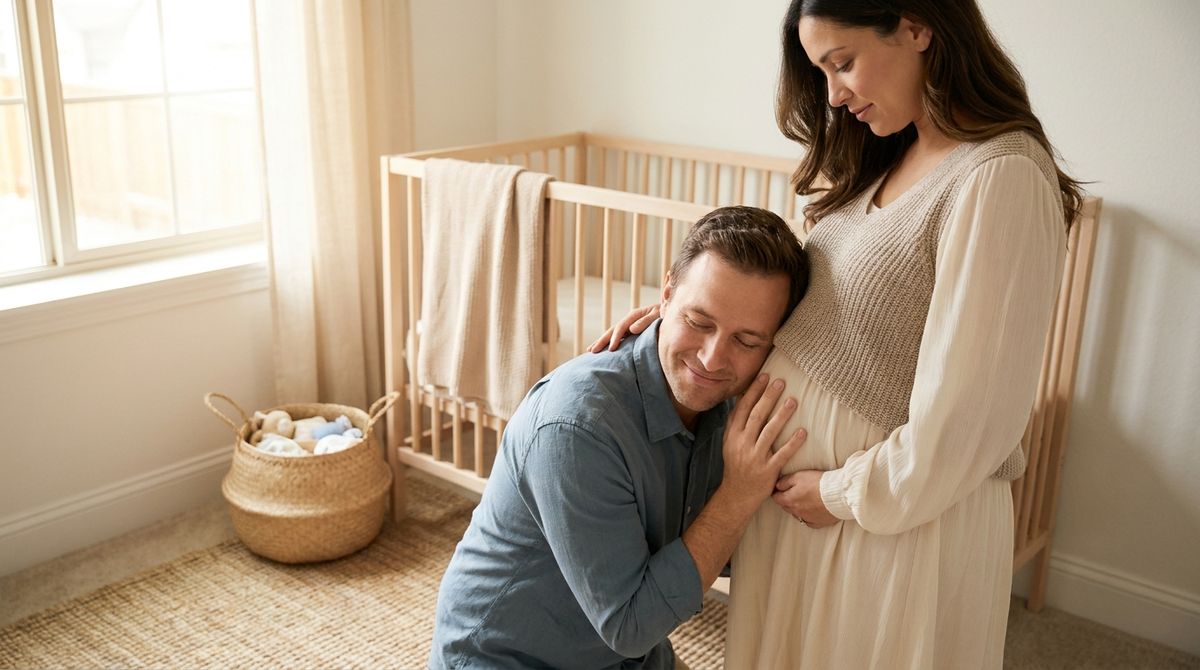
Plenty of expectant dads admit it honestly: while your partner's belly grows, pregnancy can feel abstract — ultrasounds, blood tests, a due date counted out in weeks, and a baby who doesn't quite feel real yet. That feeling is incredibly common, and there's nothing to be ashamed of. But bonding with your baby before birth isn't just a nice phrase — around the midpoint of pregnancy, your baby genuinely starts picking up sounds from outside, responding to touch on the belly, and getting used to the voices that show up every day.
Here's what's actually known about whether baby can hear dad's voice in the womb, what you can start doing this week, when you'll likely feel those first kicks with your own hand, and what helps if the bond just isn't there yet.
When Can Baby Hear Dad's Voice in the Womb? A Week-by-Week Look
Hearing develops gradually. The inner ear's structures are largely formed by around week 18, consistent reactions to outside sound (a change in heart rate, movement in response) are documented by researchers from around 24–25 weeks, and by 26–28 weeks those reactions become noticeably clearer and more repeatable.
It helps to understand how sound reaches your baby at all. The womb isn't silent — baby constantly hears mom's heartbeat, the whoosh of blood flow, digestive sounds, and her own voice. External sounds travel through the abdominal wall and amniotic fluid in muffled form, and low frequencies travel better than high ones. That's exactly why a deeper male voice reaches your baby reasonably well — though still more faintly than mom's, since her voice also reaches baby "from the inside," carried through tissue and bone.
What that means practically: newborns show recognition of and preference for sounds that were repeated often in the final months of pregnancy. The research is strongest on recognizing mom's voice; there's less data specifically on dad's voice, so it wouldn't be honest to promise your baby will "definitely recognize you the second you speak." What is realistic, though: if you talk near the belly every day, your voice becomes part of baby's familiar soundscape — not something heard for the first time in the delivery room. For more on what babies pick up in the womb, see what your baby can hear and sense in the womb.
Talking to Baby in the Womb: Building an Evening Ritual
The simplest way to bond with your baby during pregnancy is just to talk. There's no special technique and no "right" words.
- Normal speaking volume. No need to shout, lean in close, or "aim" your voice at the belly. Just sit nearby, about 20–30 cm (8–12 inches) away, and talk the way you normally would.
- Content can be anything. How your day went, what's happening outside, weekend plans, what you picked up for the nursery today. What matters isn't the information — it's how regularly baby hears your voice.
- Reading and singing work great. The same couple of pages or the same tune every evening gives baby exactly the kind of repetition it gets used to.
- Turn it into a ritual. One repeated phrase at the same time each day — like "Hi, it's Dad" before bed — works better than long but random conversations. Five to ten minutes daily beats an hour once a week.
You can start at any point — even if baby can't hear yet, you're building the habit for yourself. A reasonable marker for "now baby can really hear you" is the second trimester, closer to 24–28 weeks.

What to Skip When It Comes to Sound
Plain conversation nearby has been studied and is considered safe. Here's what's better to avoid:
- pressing headphones or a speaker against the belly and playing music at high volume;
- using "prenatal learning" gadgets that promise to boost baby's intelligence: there's no evidence that these devices make babies smarter, and uncontrolled volume right against the belly is an unnecessary risk;
- spending long stretches in very loud places (concerts, noisy job sites) — that's a matter of both your comfort and what your partner's body is dealing with.
Touch and Kicks: When Dad Can Feel the Baby Move
Mom usually starts feeling the first movements at 18–22 weeks (sometimes closer to 24 weeks in a first pregnancy). From outside, with a hand on the belly, partners can most often feel kicks around 24–28 weeks — later than mom does, and that's completely normal. Timing depends on where the placenta sits (an anterior placenta makes kicks feel weaker and later), how much amniotic fluid there is, and body type.
How to improve your odds of catching the moment:
- pick the evening — many babies get more active once mom has finally lain down and stopped moving;
- rest a warm hand on the belly and give it 5–10 calm minutes, without repositioning your hand every thirty seconds;
- when you feel a kick, respond gently: a light press with your palm and a few words. Sometimes baby "answers" with movement, sometimes not — it's a game, not a bonding test.
Over time you'll start noticing a rhythm — active hours, a favorite side of the belly. This is often the single moment an abstract pregnancy suddenly becomes a specific, real person. For how movement changes by week, see fetal movement: when it starts and what's normal.
When to Call the Doctor — Without Waiting
One thing is worth remembering on its own: movement isn't only about tenderness — it's about safety, too. If baby starts moving less or more weakly than usual, or the usual movement pattern changes, that's a reason to contact your doctor or the maternity unit right away, at any hour, not "wait until morning." Don't try cold water, something sweet, or a home fetal doppler first — a heartbeat heard at home doesn't rule out a problem, and it often gives false reassurance.
Other situations that call for contacting your doctor without delay:
- bleeding or any spotting;
- leaking or a gush of amniotic fluid;
- a severe or persistent headache, flashing lights or vision changes, sudden swelling of the face and hands;
- severe abdominal pain, regular contractions before 37 weeks;
- fever, chills, or feeling notably unwell.
Being the person who calmly says "let's call and ask" is part of being a dad too. Bothering the doctor "over nothing" doesn't count as a mistake here.
Being Inside the Pregnancy, Not Just Nearby: Appointments, Ultrasounds, and Daily Life
A partner's involvement during pregnancy is linked to better wellbeing for the pregnant partner and to an easier time bonding for dad himself after birth. It's a correlation, not a guarantee, but the direction is clear: the more involved you are now, the less catching up you'll be doing later.
What actually works:
- Go to appointments and ultrasounds when you can. Seeing the profile and hearing the heartbeat on screen is a turning point for a lot of dads. For what gets checked and when, see the first pregnancy ultrasound.
- Prepare two or three questions before appointments and write down the answers. It's easy to forget half of what's said in the room — you can keep the list and fill in details afterward.
- Know the current week. Not "somewhere around month seven," but specifically: what's developing this week, roughly how big baby is, what's changing for your partner. A pregnancy calendar turns a due date into a story you can actually follow.
- Take on daily life — that's bonding work too. Nausea and exhaustion in the first trimester, back pain, heartburn, and insomnia closer to birth are all very real. Cooking, cleaning, logistics, and older kids aren't "helping her out" — they're your share of the parenting load, and it starts before birth.
- Ask, don't decide for both of you. Some partners want dad at every single appointment; others just want him waiting downstairs. It's her body and her call — your role is support, not control.
Getting Ready for Birth Together: The Name, the Bag, and Your Role as Partner
Preparing together has real practical value — and it's also what makes "we're waiting for this baby together" actually feel true.
- The name. Talking through options, debating, keeping a shared list — it's one of the most enjoyable ways to make your baby feel real before birth.
- The hospital bag. Pack it together, and definitely know where it is and what's in it — when the moment comes, you'll likely be the one digging for the paperwork. There's a full packing list in what to pack in the hospital bag for mom and baby.
- Logistics. The route, a car or a cab at night, who to call, who watches older kids and pets, where the insurance card and medical records are.
- Birth preferences. Find out ahead of time what matters to your partner: her feelings about pain relief, who cuts the cord, skin-to-skin contact right after birth. During labor, you can be the one telling staff, when she doesn't have the bandwidth to explain.
- Your role during labor. Breathing with her, counting out loud, pressing on her lower back, bringing water, wiping her forehead, timing contractions. It's worth practicing the technique ahead of time — for instance, walk through how to breathe through contractions so you're not reading it for the first time in the delivery room.
- Childbirth classes for couples. Also check your hospital's own rules — whether partners are allowed in the delivery room, and what paperwork or tests are needed.

Plan the first few hours after birth, too. Skin-to-skin contact works with dad as well — if mom had a C-section or needs medical attention, baby can be kept warm and calmed against your chest instead. For a lot of dads, that's the moment the bond finally becomes physical.
If You Don't Feel the Bond Yet — That's Normal
This is the part of the topic that gets talked about the least. A significant share of dads honestly don't feel any bond with their baby during pregnancy — sometimes not until birth, sometimes not for a few weeks after. Pregnancy happens in someone else's body; you don't feel the movements from inside, you're not nauseous, your day-to-day life hasn't visibly changed much. Not feeling instant emotion doesn't make you a bad father, and it says nothing about what kind of parent you'll turn out to be.
What usually helps:
- don't wait for the feeling — start with actions instead: a hand on the belly, an evening phrase, going to an ultrasound. For a lot of people, attachment follows behavior, not the other way around;
- find "your" area of responsibility — the nursery, the car seat, the paperwork, the route to the hospital. Concrete tasks ground you more than talking about feelings does;
- talk to other dads. Almost every one of them will admit he "didn't feel much either," and just hearing that lifts a good chunk of the shame;
- be honest with your partner. Silent distance is felt far more painfully than a simple "I don't fully understand my own feelings yet, but I'm here."
Anxiety and Low Mood in Expectant Dads
The perinatal period is a vulnerable time for more than just moms. By some estimates, roughly one in ten dads experiences an anxiety disorder or depression during their partner's pregnancy and in the first year after birth. It often doesn't look like sadness — more like irritability, emotional distance, burying yourself in work, sleep trouble, losing interest in things you used to enjoy, or drinking more.
If any of this lasts more than two weeks, it's worth talking to a doctor or therapist — it's treatable, and getting help now benefits your whole family. If you have thoughts of harming yourself or the baby, get help urgently, the same day. It's worth knowing the signs for your partner too: postpartum depression can affect either parent, and having one attentive person nearby often determines how quickly a family gets to a specialist.
Key Takeaways
- Baby starts reacting to outside sound around 24–25 weeks, more clearly from 26–28 weeks; dad's lower voice travels through the abdominal wall reasonably well, though more faintly than mom's.
- Consistency beats volume: 5–10 minutes of talking, reading, or singing each evening at normal volume, with no speakers or headphones on the belly.
- Partners can usually feel kicks from outside starting around 24–28 weeks; with an anterior placenta, it tends to happen later and feel weaker.
- Any decrease or change in baby's usual movement pattern is a reason to call your doctor right away, not wait it out. A home doppler can't answer that question for you.
- Appointments, ultrasounds, knowing the current week, and taking on daily tasks are all linked to better wellbeing for your partner and easier bonding for dad.
- Not feeling bonded before birth is common and normal. Action, honest conversation, and — if the feeling doesn't lift — professional support all help.
This article is for general information only and doesn't replace individual medical advice. If you have any questions about how the pregnancy is progressing, your partner's wellbeing, or your baby's movements, contact your OB/GYN or the maternity unit.
Sources
Created with AI and reviewed by the Mama Ai team. Educational information — not a substitute for professional medical advice.
We’re with you every week of the way
Download on the App Store