
What Contractions Feel Like & How to Ease Labor Pain
What do contractions feel like, and how do you ease labor pain without medication? Breathing, positions, water, massage, and continuous support that truly help.

Mama Ai Team

The thought "what if I can't handle it" crosses almost everyone's mind. Questions like "does labor hurt," "what do contractions feel like," and "how do I breathe through contractions" are among the most common in the days before birth. Let's walk through it calmly: what determines how hard contractions are to cope with, which drug-free ways to ease labor pain are actually backed by research, and which ones simply work for some people. And one caveat that matters more than anything else: everything below pairs beautifully with medical pain relief and cancels out none of it.
What contractions feel like and what shapes how you cope
In the first stage of labor, the uterus tightens in rhythmic waves while the cervix gradually shortens and opens. Hence the sensations: most people feel a pulling low in the belly and lower back, the pain builds, peaks around the middle of the contraction, and then eases off. Many describe it as very intense menstrual cramps. If the baby is facing your spine (occiput posterior), the pain often "settles" into the sacrum and barely lets up between contractions — this is what's known as back labor.
There's a fundamental difference from injury pain: a contraction damages nothing. It's a muscle doing a job that has a purpose, a beginning, and an end — and it always comes with a pause. Those pauses are when you recover. That doesn't mean "it doesn't hurt" — it means what's happening has a clear explanation, and the body responds to it differently than it does to a threat.
How well you tolerate it depends on things you can genuinely influence:
- Fear and tension. Anxiety ramps up adrenaline, and adrenaline interferes with oxytocin: labor progresses less smoothly and pain feels stronger. The "fear – tension – pain" cycle is broken by a calm setting, information, and the presence of someone close.
- The environment. Dim light, quiet, your own clothes, and the freedom not to be on display work better than a bright lamp and a stream of strangers.
- Freedom to move. Being able to stand up, walk, sway, and change position.
- Fatigue and dehydration. A long early phase without sleep, food, or drink makes the pain harder.
- Medical factors. Oxytocin augmentation, the baby's position, the need for continuous monitoring — some of this is beyond your control, and that's okay.
If you're not yet sure this is really labor, first take a look at the signs that labor has started and how they differ from Braxton Hicks contractions.
Continuous labor support: what works best
If you had to pick a single drug-free "method" with the strongest evidence base, it isn't breathing or a birth ball. It's a person who stays with you the whole time.
A Cochrane systematic review pooling 26 studies and around 15,000 women found that with continuous labor support, women were more likely to have a spontaneous vaginal birth, less likely to use pain medication, less likely to end up with a cesarean or an assisted (vacuum/forceps) delivery, had slightly shorter labors on average, and were less likely to look back on the birth negatively. The effect was strongest when the support came not from hospital staff or a family member, but from a trained companion — a doula.
Support isn't "sitting nearby and worrying." In practice it's made up of very concrete things: physical help (massage, something to lean on, water, a towel), emotional help (a voice, eye contact, "you're doing this," no panic), informational help ("they're checking dilation now," "this contraction is ending"), and advocacy — voicing your wishes to the staff when you're in no state to talk.
If your partner can't be with you or is very anxious themselves, it's not a lost cause: talk to your birth facility ahead of time about having a doula, or ask how the midwife's support is organized.
How to breathe through contractions
Breathing doesn't "remove" the pain. It does two things: it keeps you in the rhythm of the contraction instead of panic, and it stops your muscles from clenching. It's a simple tool that's always with you and works from the very first minute.
Slow, deep breathing — the foundation
The moment you feel a contraction start, take one "welcoming" breath in and a long, slow breath out — as if exhaling through a straw or blowing out a candle from a distance. Then breathe calmly and deeply from the belly: in through the nose, out through slightly parted lips. The key principle is that the out-breath is longer than the in-breath: for example, breathe in for 4 counts, out for 6–8. Keep your shoulders and jaw loose; if your teeth are clenched, soften your face — the pelvic floor usually relaxes right after it.
Lighter breathing at the peak
When contractions get stronger and slow breathing can no longer "keep up" with the sensations, switch at the peak to lighter, faster breathing — shallow, high in the chest, roughly twice as fast as usual, in and out through the mouth. As soon as the wave starts to fade, return to slow breathing. Many people find counting or a rhythm helpful: "one-two-three-out," or repeating a short phrase to yourself on each exhale. Breaking the contraction into parts ("a third done, halfway, coming down") is another technique that works: it turns endless pain into a finite stretch.
Between contractions
The pause isn't the time to "get ready for the next one." It's the time to go limp: sink onto something, unclench your hands, take a couple of slow exhales, sip some water. The quality of your pauses is what determines whether you'll have the strength left by the end of the first stage of labor.
What's best to avoid
- Hyperventilating. If you breathe too fast and too deeply at the same time, you get dizziness, ringing in the ears, and tingling in your fingers and around your mouth. It's not dangerous, but it's unpleasant: slow your breathing down, exhale into cupped hands, breathe along with your partner "at their pace."
- Holding your breath to push "just in case." Long breath-holding while pushing makes sense only when your midwife tells you to. The rest of the time it's better to follow your body and keep breathing.
- Screaming on the exhale "into your throat." Making sound is fine and even helpful, but low, open sounds ("aaah," "ooo") relax you, while a high, tight scream adds tension.
It's worth practicing the technique in advance — even a few times for 60–90 seconds, which is how long a contraction lasts. The point of practice isn't perfection, it's not having to invent it from scratch during labor.
Labor positions and movement
A Cochrane review on maternal position in the first stage of labor found that women who were upright and free to move had a first stage roughly an hour shorter on average, and were less likely to use an epidural. The World Health Organization recommends encouraging mobility and an upright position during labor for women at low risk.
There's no universal "best position": the right position is whichever one feels a little easier right now. Change it every 20–30 minutes if nothing gets in the way.
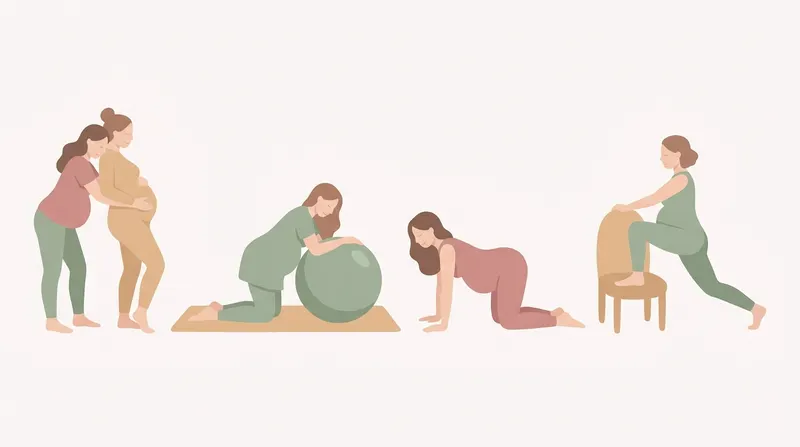
- Walking and swaying. A slow "dance" with your partner: you drape your arms around their neck, they hold your lower back, and you sway from side to side.
- Leaning on your partner, a wall, or the head of the bed. Leaning forward takes the load off your lower back and helps the baby turn into a better position.
- On all fours. One of the most-loved positions for back pain; you can drop your chest lower than your hips and rock your pelvis.
- Lunge. One foot up on a sturdy chair, gently rocking toward that leg — it helps open the pelvis asymmetrically.
- Birth ball. Sitting with your knees wide and rocking in circles or figure-eights; or kneeling and hugging the ball from above, resting your head and chest on it.
- Sitting on the toilet. It sounds odd, but it's a familiar position for relaxing the pelvic floor.
- Lying on your side with a pillow between your knees. An option for resting, if you need to lie down or you have an epidural catheter in place.
Preparing your body ahead of time helps too — regular, moderate activity during pregnancy; more on that in our piece on safe exercise during pregnancy.
Water: a warm shower and a bath
Water is one of the most underrated helpers. A warm shower aimed at your lower back and sacrum releases tension and, at the same time, creates a "different signal" that overrides the pain. You can stand leaning against the wall or your partner, or sit on a chair in the shower if there is one.
According to a Cochrane review, immersion in a bath during the first stage of labor reduces the need for epidural or spinal anesthesia, with no increase in adverse outcomes for mother or baby. The water should be comfortably warm but not hot; immersion is usually recommended once regular labor is well established.
Giving birth in the water itself is a separate matter. ACOG notes that water immersion during the first stage may be offered, but there isn't enough evidence on the benefits and safety of actually delivering the baby underwater, so that option is considered only at facilities with an established protocol. Check ahead of time what your birth facility practices, and discuss it with your provider.
Touch: massage, sacral counter-pressure, heat and cold
Touch works for two reasons at once: it overrides the pain signal at the level of the nervous system, and it reduces the feeling of being alone.
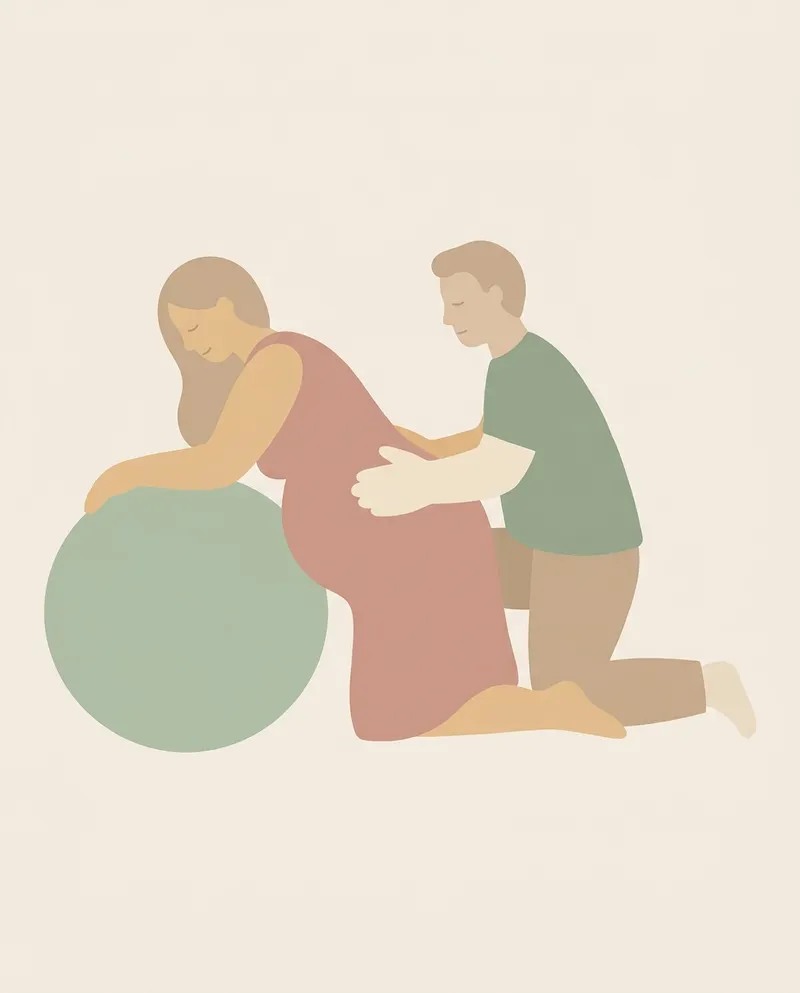
- Sacral counter-pressure. Your partner places the heel of one hand (or both hands, one over the other) on the sacrum — the flat bone just above the tailbone — and during the contraction presses hard and evenly, leaning in with their body weight rather than their arm muscles. This is the most effective technique for back labor. Ask them to shift the spot by a centimeter or two until you find "the one."
- Double hip squeeze. You're on all fours or leaning forward, and your partner places their palms on the upper outer part of the buttocks on both sides and, during the contraction, squeezes the pelvis inward and upward. Many people find this brings real relief.
- Massage. Slow stroking of the back, shoulders, and feet between contractions; during the contraction itself many people don't want to be touched — that's normal, just say so directly.
- Heat. A warm heating pad or towel on the lower back and lower belly between contractions.
- Cold. A cold compress on the forehead and neck if you're "flushing hot"; a cooling cloth on the face helps you regain clarity.
Relaxation and shifting your focus
Cochrane reviews of relaxation techniques (breathing-and-muscle relaxation, yoga, music) suggest a possible reduction in pain intensity and greater satisfaction with birth, but the quality of the evidence is low: the studies are small and very varied. Put simply, these are "might help, won't hurt" methods.
- Progressive muscle relaxation: between contractions, release your jaw, shoulders, hands, buttocks, and feet one by one.
- Visualization: an opening flower, a wave, walking down a staircase — an image you return to with each contraction.
- Music and headphones: your own playlist changes the feel of the room dramatically.
- Light and privacy: dim the lamp, draw the curtains, ask extra people to step out.
- Hypnobirthing: according to Cochrane, it doesn't reduce the need for pain medication on average, but it noticeably helps some women feel calmer. If the technique appeals to you, learn it ahead of time, not in the delivery room.
TENS, acupressure, aromatherapy: what's known
These methods are often offered in childbirth classes, and the honest way to describe them is this: the evidence is limited, but so are the risks.
- TENS (transcutaneous electrical nerve stimulation) — skin electrodes on the lower back. There's little convincing evidence that it reduces pain, but women often say they feel better with the device, and adverse effects are barely reported. It can't be used in the bath.
- Acupuncture and acupressure — there's some evidence of a reduction in pain and in the need for pain relief, but the confidence in it is low. Acupressure should be done by someone who knows how.
- Aromatherapy — there isn't enough data on its effect on pain, though a scent may aid relaxation. Check whether it's allowed at your birth facility, and keep in mind that your sense of smell often sharpens during labor and a favorite scent can suddenly become unbearable.
Myths that only get in the way
- "Toughing it out to the very end is the right thing." No. An exhausted, frightened woman has a harder labor. Pain relief isn't a prize for weakness — it's a tool.
- "Asking for an epidural means I failed." Birth isn't an exam, and there's no medal for going without anesthesia. Only one thing is being assessed: the health of you and your baby.
- "You mustn't scream, you have to be quiet." Making sound is fine. What matters isn't the volume but the tone: low, open sounds relax you.
- "You should pick one method in advance and stick to it strictly." In labor, switching techniques almost always works better: what helped at 4 cm of dilation may stop working at 8 cm.
- "Natural birth at any cost." The cost can be high and isn't always obvious in advance; a birth plan is a list of preferences, not a commitment.
Drug-free methods and the epidural aren't an "either/or"
Breathing, movement, water, and support don't compete with medical pain relief. More often they complement it: they help you get through the early phase and reach the point where anesthesia is appropriate, and after it's placed — help you keep your rhythm, shift onto your side, breathe, and stay connected to the process. If you'd like to understand in advance how it's done and what the limits and risks are, read our separate breakdown of the epidural during labor.
And most importantly: asking for pain relief is an ordinary medical decision that you have the right to make at any moment, with no explanations and no guilt. No one hands out penalty points for it.
What to prepare in advance
- A short birth plan — one page: what matters to you (movement, water, dim light, who's with you) and what you leave to the providers' judgment. Go over it with your provider before the birth and check what's technically possible at your facility.
- Rehearsed breathing — a few sessions of 60–90 seconds together with your partner.
- Your bag: a ball (if you're allowed to bring your own), comfortable shower flip-flops, a massage roller or a simple wooden massager, headphones and a charged phone with a playlist, a hair tie, water and light snacks, warm socks. The full list is in our piece on what to pack in your hospital bag for mom and baby.
A checklist for your partner
- Don't disappear for long, and say where you're going and for how long.
- Breathe together: your rhythm is her anchor.
- Offer a change of position every 20–30 minutes: "want to try the ball?", "shall we go to the shower?"
- Keep up sacral counter-pressure for the whole contraction — until it ends, without letting go early.
- Offer water after every contraction and remind her about the bathroom roughly once an hour.
- Watch the environment: light, noise, extra people, temperature.
- Speak in short phrases: "this one's ending," "you're doing this" — not "calm down."
- Voice her wishes to the staff and ask questions when she's in no state to.
- Eat and drink yourself — a drained partner can't help.
When to call the doctor or midwife
Drug-free methods are about comfort, not about monitoring the labor. Tell the staff right away if:
- your waters break, especially if they're green, brown, or blood-tinged;
- you have bright red bleeding (not to be confused with the mucus plug streaked with blood);
- you stop feeling the baby move or the movements change noticeably;
- the pain becomes constant and doesn't let up between contractions, and your belly is hard and tender outside a contraction;
- you develop a fever, chills, a severe headache, vision changes, or pain in the upper right abdomen;
- you feel strong pressure and an urge to push;
- the pain has become unbearable and you want to discuss pain relief — that, too, is a perfectly valid reason to call the midwife.
If the birth ends in a cesarean — planned or decided along the way — it takes nothing away from your preparation or your effort; there's a separate detailed piece on how the operation and recovery go.
Key takeaways
- Labor pain is rhythmic, comes with pauses, and isn't a signal of damage — and that changes how you can live through it.
- The strongest evidence base belongs to continuous labor support: less pain medication, fewer interventions, shorter labor, better memories.
- How to breathe through contractions: slow and deep at the start and between contractions, lighter and faster at the peak, out-breath longer than the in-breath, without hyperventilating and without holding your breath "just in case."
- Upright positions and freedom to move shorten the first stage of labor by about an hour and reduce the need for an epidural.
- A shower and immersion in a bath genuinely work; birth in the water is a separate conversation with your provider and facility.
- Sacral counter-pressure and the double hip squeeze are especially helpful for back labor.
- Relaxation, music, TENS, acupressure — "might help, won't hurt": try whatever appeals to you.
- Drug-free methods and the epidural go together beautifully. Asking for pain relief is normal and is not a failure.
This material is general information and does not replace a personal consultation with your provider. Discuss your birth plan and pain-relief options with the provider managing your pregnancy and with the facility where you plan to give birth.
Sources
Created with AI and reviewed by the Mama Ai team. Educational information — not a substitute for professional medical advice.
We’re with you every week of the way
Download on the App Store