Exercise During Pregnancy: Safe Workouts & What to Avoid
Can you exercise during pregnancy? For most moms-to-be, yes — and it's encouraged. Here are safe prenatal exercises, how much to move and warning signs.

Mama Ai Team

Whether you're used to an active lifestyle or you're only just thinking about getting moving, the question "is it safe to exercise while pregnant?" comes up for almost every mom-to-be. The good news: for most women with a normally progressing pregnancy, moderate exercise during pregnancy isn't just safe — it's beneficial, and it's recommended by leading medical organizations. In this article we'll calmly walk through which prenatal exercises work best, how much to move, how to adjust your routine by trimester, and when it's better to put workouts on hold and talk to your doctor first.
Is it safe to exercise while pregnant?
Yes — for an uncomplicated pregnancy, regular physical activity is recommended, not merely allowed. Mothers-to-be used to be told to rest more, but modern evidence says the opposite: movement helps you feel better and lowers the risk of several complications. Of course, there are conditions that call for limiting activity, so the first step is to discuss your plans with the doctor managing your pregnancy.
How exercise during pregnancy helps:
- Mood and sleep. Activity helps you gently cope with anxiety and fatigue, and improves sleep quality.
- Less back pain. Strengthening your back and abdominal muscles eases the load on your spine — we covered this in more detail in our article on back pain during pregnancy.
- Weight management. Regular movement helps you stay within the recommended range of pregnancy weight gain.
- Lower risk of complications. Physical activity reduces the likelihood of gestational diabetes, as well as high blood pressure and preeclampsia.
- Less constipation and swelling. Movement gently stimulates the bowel (which helps with constipation) and improves circulation in the legs.
- Easier labor and recovery. Good fitness and strong pelvic floor muscles can make labor easier and help you bounce back faster afterward.
How much to move: 150 minutes a week
Most pregnant women are advised to aim for about 150 minutes of moderate physical activity a week — roughly 30 minutes on five days a week. You can break those 150 minutes into short bouts: three 10-minute sessions through the day work just as well as one long workout. If you trained regularly and intensely before pregnancy, in many cases you can keep going — but check the pace with your doctor.
How to tell the intensity is moderate: the talk test
A simple guide is the "talk test." If you can comfortably hold a conversation during your workout but find it hard to sing, the intensity is moderate and appropriate. If you're out of breath and can't get a sentence out, ease off. Listen to your body: pregnancy is no time for personal records or pushing to your limit.
Safe exercises during pregnancy
The best options are activities with a low risk of falls and blows to the belly, with smooth, controlled movement. Here are the prenatal exercises generally considered the safest:
- Walking. The simplest, most accessible option: no preparation or gear required, and easy to dose.
- Swimming and water aerobics. Water supports your body weight and takes pressure off your joints and back — many moms-to-be feel real relief in the pool.
- Stationary cycling. Unlike cycling outdoors, there's no risk of falling, and the load is easy to adjust.
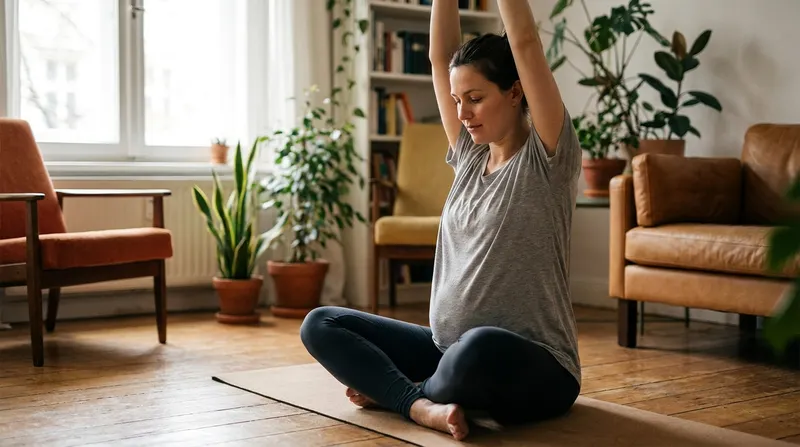
- Prenatal yoga and Pilates. Programs designed for pregnancy (prenatal yoga) strengthen muscles, improve posture and teach breathing. It's important to choose classes made specifically for pregnant women and to avoid lying on your back in the second half of pregnancy and deep twists.
- Light strength training. With small weights or a resistance band, focusing on form and without holding your breath.
- Stretching and prenatal gymnastics. Gentle routines help release tension in the back, hips and shoulders.
Kegel (pelvic floor) exercises
Kegel exercises — pelvic floor muscle training — deserve a special mention. These muscles support the uterus, bladder and bowel, and they're under extra strain during pregnancy. Regular Kegel exercises help lower the risk of urine leakage (which often shows up toward the end of pregnancy and after birth) and may ease recovery.
How to do them: tighten the muscles as if you're trying to stop the flow of urine, hold the squeeze for a few seconds, then fully relax. Try not to hold your breath or tense your belly, buttocks and thighs. A few short sets through the day — and you can do them almost anywhere, with no one noticing.
How to adjust your workouts by trimester
First trimester
In the first trimester, many women are held back by nausea and heavy fatigue — that's normal, and on days like these a walk is a better choice than an intense workout. If you feel up to it, you can keep your usual routine. Drink plenty of water and don't let yourself overheat.
Second trimester
This is often the most comfortable time to exercise. The key rule for this stage: after roughly the midpoint of pregnancy, avoid lying flat on your back for long — in this position the growing uterus can press on a major blood vessel and cause dizziness. Swap exercises done lying on your back for versions on your side, seated or standing. As your belly grows your center of gravity shifts, so pay extra attention to your balance.
Third trimester
In the third trimester you usually scale back and focus on comfort: walking, swimming, breathing exercises and stretching. Listen to your body and don't hesitate to rest more often. A balanced pregnancy diet and enough water will help keep your energy up for workouts.
Which activities and sports to avoid
Some activities raise the risk of falls, abdominal injury or overheating, so they're best put on hold during pregnancy:
- Contact sports — soccer, basketball, martial arts, where a blow to the belly is possible.
- High fall-risk activities — downhill and water skiing, horseback riding, outdoor cycling later in pregnancy, ice skating.
- Scuba diving. Diving with a tank is off-limits because of the risk to the baby.
- Overheating. Hot yoga, working out in the heat, saunas and hot baths — overheating and dehydration are best avoided.
- Heavy weights with breath-holding (straining) — this sharply raises blood pressure.
- Training at high altitude (above about 2,000 m / 6,000 ft above sea level) if you're not used to it.
- Long stretches lying flat on your back in the second half of pregnancy.
What to do if you didn't exercise before
Pregnancy is a perfectly good time to start moving, even if sport was barely part of your life before. The key is to start gently and build up gradually. Try 10–15 minutes of walking a day and slowly increase the time and pace, guided by how you feel and the talk test. There's no need to chase 150 minutes right away — that's a goal you can work toward over weeks. Before you start, be sure to discuss your plan with your doctor, especially if you have chronic conditions or anything unusual about your pregnancy.
When to stop immediately and call your doctor
Stop and contact your doctor or seek emergency care if any of these warning signs appear during or after exercise:
- vaginal bleeding or spotting;
- regular painful contractions or pain low in the belly;
- fluid leaking from the vagina (your waters);
- dizziness, weakness or feeling faint;
- chest pain or pressure;
- a severe headache;
- pain, redness or swelling in one calf (this can be a sign of a blood clot);
- shortness of breath that comes on even before you exert yourself;
- a rapid heartbeat that doesn't settle with rest.
When exercise during pregnancy is not recommended
There are conditions in which physical activity is limited or stopped. The decision is always made by your doctor on an individual basis. Caution is needed, for example, with:
- certain heart and lung conditions;
- cervical insufficiency (a weak cervix);
- placenta previa after a certain point in pregnancy;
- preeclampsia or pregnancy-induced high blood pressure;
- a threat of preterm labor or bleeding;
- certain multiple pregnancies with a risk of preterm birth.
If any of these apply to you, it doesn't always mean a complete ban on movement — sometimes your doctor will clear you for light activity. That's exactly why it's so important to discuss your specific situation with a specialist rather than relying on general recommendations alone.
Key takeaways
- For an uncomplicated pregnancy, moderate exercise is safe and beneficial — but start with a conversation with your doctor.
- Aim for about 150 minutes of moderate activity a week; the talk test helps you avoid overdoing it.
- Walking, swimming, stationary cycling, prenatal yoga, Pilates, light strength training and Kegel exercises are all safe.
- Avoid contact sports, fall risks, overheating, scuba diving and long stretches lying on your back in the second half of pregnancy.
- If you didn't train before, start with 10–15 minutes and build up gradually.
- With bleeding, contractions, leaking fluid, dizziness, chest pain or calf pain, stop exercising immediately and call your doctor.
This article is general information and is not a substitute for individualized medical advice. Before starting or changing your physical activity, discuss your plan with the specialist managing your pregnancy, especially if you have any complications or chronic conditions.
Created with AI and reviewed by the Mama Ai team. Educational information — not a substitute for professional medical advice.
We’re with you every week of the way
Download on the App Store