
Kegel Exercises After Birth: How to Do Them Correctly
Leaking urine when you sneeze or feeling heaviness down below? Here's what happens to the pelvic floor postpartum and how to do Kegel exercises correctly.

Mama Ai Team

You sneezed, laughed, or lifted the stroller — and felt urine leak. Or maybe you noticed a sense of heaviness and pressure low in your belly, as though something is "dropping down." A great many women deal with this after childbirth, yet for some reason it's not something people talk about. The good news: it isn't the price of motherhood and it isn't something you have to put up with. The pelvic floor is muscle, and muscle can be trained — and Kegel exercises remain the most accessible recovery tool there is.
Let's go through it in order: what happens to the pelvic muscles during pregnancy and birth, why urinary incontinence appears, how to do Kegel exercises correctly (it's harder than it looks), when you should not do them, and when you need a doctor or a pelvic floor physical therapist.
What the pelvic floor is, and what pregnancy and birth do to it
The pelvic floor is several layers of muscle and connective tissue stretched between the pubic bone, the sitting bones, and the tailbone, like a hammock. This "hammock" supports the bladder, uterus, and rectum from below, controls the sphincters (the ring-shaped muscles that hold in urine and stool), plays a role in sexual sensation, and — together with the diaphragm, the deep abdominal muscles, and the back — forms a single muscular "cylinder": what trainers call the core.
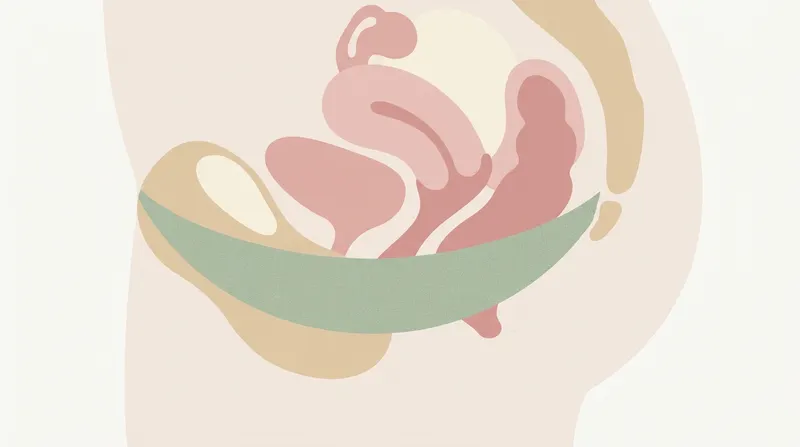
Over pregnancy this hammock takes on a serious load. The uterus, along with the baby, placenta, and amniotic fluid, weighs several kilograms, and all of it presses down day after day. At the same time, hormones (progesterone, relaxin) make connective tissue softer and more stretchy — that's needed for birth, but it temporarily reduces support. Posture changes too: the center of gravity shifts forward, the lower back curves more, and the way load is distributed across the pelvic muscles changes. That's why many women develop leaking with a cough and back pain even before giving birth.
In a vaginal birth, the muscles and tissues of the perineum stretch many times more than usual. Sometimes tears occur or an episiotomy is done, and the nerves that control these muscles can be affected. The risk is higher with a long second stage of labor, a large baby, the use of forceps or vacuum, or third- to fourth-degree tears. How stitches heal and what counts as normal in the first weeks we covered in detail in the article on postpartum recovery: lochia, stitches, and warning signs.
Why a C-section doesn't fully protect you
The common belief that "after a C-section the pelvic floor is intact" is only partly true. The stretching of tissues during delivery is indeed avoided, and the risk of some problems is lower. But the pelvic floor still lived through nine months of vertical load and hormonal change — and those contribute a great deal. On top of that comes surgery on the abdominal wall, after which the deep abdominal muscles switch on less effectively, which means the whole support system works less in sync. So urine leakage and a feeling of heaviness happen after a C-section too, and training the pelvic muscles is worthwhile in that case as well.
Postpartum urinary incontinence: how common is it, and will it go away on its own?
Most often this is stress urinary incontinence — "stress" here means physical effort, not emotion. Urine leaks at the moment intra-abdominal pressure suddenly rises: with a sneeze, cough, laugh, jump, or lifting the baby or a bag. A weakened or poorly responsive pelvic floor doesn't manage to squeeze in time and keep the sphincter closed.
By various estimates, roughly one in three women deals with urine leakage in the first months after birth, and it's one of the most common yet most hushed-up problems of the postpartum period. Here an honest distinction matters: common doesn't mean normal forever. For many women, symptoms ease noticeably within the first three to six months, while tissues heal and muscles regain tone. But if nothing changes after 6–12 weeks, waiting for it to "sort itself out" isn't the way to go — it may not.
And one more thought worth reading to the end for: incontinence can be treated at any point, not only in the first months. If your child is three, eight, or twenty, and you're still dashing to the toilet and putting a pad in before a run — pelvic muscle exercises and a specialist's help work now too. A trainable muscle stays trainable.
Other symptoms worth mentioning to your doctor
Incontinence isn't the only thing that can happen to the pelvic floor after birth. It's worth knowing the other signs so you can call them by their proper names:
- Urge incontinence — a sudden, almost overwhelming urge where you don't always make it in time. The mechanism is different (an overactive bladder), and so is the treatment approach.
- A feeling of heaviness, fullness, or a "ball" in the vagina — especially toward evening or after a long day on your feet. This can be how prolapse shows up (the descent of the vaginal walls, uterus, or bladder). Many women search for "exercises for a prolapsed uterus," but an exam comes first: the degree of prolapse determines what will actually help.
- Pain during sex — pain that lasts longer than a few months after birth shouldn't be written off as "you'll get used to it." The causes vary: a scar from a tear or episiotomy, dryness related to breastfeeding, or excessive muscle tension.
- Leaking gas or stool — even occasionally. This is not a symptom to train away on your own from articles online. It can point to damage to the anal sphincter during birth and calls for an in-person visit to the doctor: the sooner, the more options for help.
Kegel exercises: how to do them correctly
This is the key section. Research shows that pelvic floor muscle training helps with postpartum incontinence — but only when you contract those particular muscles. By specialists' observations, a large share of women trying Kegel exercises from a written description for the first time do them wrong: they tense the abdomen, the glutes, or, worst of all, bear down.
Step 1. Find the right muscles
Lie on your back, knees bent, feet on the floor — in this position it's easiest to feel the movement. Imagine you need to hold in gas and at the same time draw something small up into the vagina. The movement should be inward and upward, as if you're gently lifting the perineum toward your navel. The sensation is a squeeze around the vaginal opening and the anus, plus a slight lift inside.
How to check yourself:
- Place one palm on your belly: it should stay soft, with no sharp tensing of the abs.
- Place your other hand on your glutes or inner thigh: they shouldn't switch on.
- You can put your fingers to the perineum — with a correct contraction the tissue moves inward, rather than bulging outward.
- Keep breathing. If you're holding your breath, that's already a hint something is off.

Step 2. Learn what a correct contraction feels like
A correct Kegel is two equally important actions: a lift and a full release. Relaxation matters no less than the squeeze: a muscle that can't let go can't work properly either. After each contraction, give yourself just as much time for everything down there to "settle" back and go soft.
Common mistakes that cancel out your effort:
- Holding your breath. Breathe evenly: it's easier to exhale on the lift and inhale on the release.
- Working the glutes, abs, and thighs. If during a "Kegel" you lift your pelvis or squeeze your knees together, the big muscles have switched on instead of the pelvic floor.
- Bearing down. The most harmful mistake: instead of lifting up, you push down as if pushing in labor. This adds load to the ligaments and can worsen prolapse symptoms. If you're not sure which way the movement is going, that's a reason to see a specialist, not to train blindly.
- Training "on the stream." Stopping the flow of urine can be used once to figure out where the right muscles are, but not as an exercise: regularly stopping the flow interferes with fully emptying the bladder.
Step 3. The protocol: how much, how often, and when to expect results
A working scheme combines two types of contractions — slow ones (for endurance) and fast ones (for reacting to a sneeze or cough):
- Slow holds: squeeze and hold for 3–5 seconds, then relax for the same length of time. Gradually, over a few weeks, build the hold up to 8–10 seconds. Do 8–12 reps.
- Fast contractions: 10 short one-second squeezes, with a full release between each.
- Frequency: about three sets a day, every day. Three short sets of 3–5 minutes do more than one heroic session a week.
- Progressing positions: start lying down, then after a week or two move to doing them sitting, and then standing — standing is harder because of gravity.
- The "knack": learn to squeeze the pelvic floor before a sneeze, cough, or lifting the baby. It's a simple skill that often reduces leakage before your muscle strength has even grown.
You can usually begin gentle contractions in the first days after birth if it isn't painful — even with stitches, light muscle work improves blood flow. The first changes are more often noticeable after 6–12 weeks of regular practice, not after a few days; a full course is at least three months, and it's best to keep the exercises as a habit for years to come.
The main challenge here isn't strength but consistency and counting: it's easy to lose track, get distracted by the baby, and forget which rep you're on. The Mama Ai app has a Kegel workout with a timer for exactly this: it cues you when to squeeze and when to relax, so you keep the rhythm without counting in your head, and the workout's progress shows right on your lock screen. It's not a substitute for correct technique — first make sure you're contracting the right muscles, and then the timer helps you do it consistently.
When Kegel exercises aren't the answer
An important nuance that rarely makes it into popular articles: not every pelvic floor needs strengthening. The opposite situation happens too — hypertonicity, when the muscles are already overly tense and don't know how to relax. In that case, extra squeezing makes the problem worse.
You can suspect this if you have:
- pain in the vagina, perineum, or lower belly, or pain during sex or when using tampons;
- trouble starting to urinate, a weak or interrupted stream, or a feeling of incomplete emptying;
- constipation that requires a lot of straining, or pain during bowel movements;
- a constant feeling of being "clenched" down below.
Separately — the symptoms of prolapse (bulging, heaviness, a "ball"). Here exercises can help too, but an exam comes first, to gauge the degree of descent and to avoid training in positions and at loads that would make things worse. The rule is simple: pain, bulging, and trouble emptying — a specialist's assessment first, then a program.
Diastasis recti: how to check, and its link to the pelvic floor
Diastasis recti after birth is a separation of the rectus abdominis muscles along the midline: over pregnancy the connective tissue between them stretches. To some degree almost everyone has it by the end of pregnancy, and in many women it closes on its own in the first months.
A simple self-check: lie on your back, knees bent, feet on the floor. Place your fingers across your belly just above the navel and lift your head and shoulders as if starting a crunch. With your fingers you'll feel a gap between the muscles. Assess how many fingers fit across it and how firm the "floor" of the gap is. Repeat at the level of the navel and below it. A gap wider than about two fingers, a soft-pit feeling, or a "dome" that bulges along the midline when you tense are reasons to see a specialist.
The pelvic floor and the abdominal wall work as one system: the diaphragm on top, the deep abdominal muscles in front, the pelvic floor below. If the front wall doesn't hold pressure, that pressure goes down — onto the pelvic floor. That's why classic crunches and planks in the first months are often not the best idea: you start with breathing, gentle activation of the transverse abdominal muscle, and Kegels, and only then add load.
When to see a doctor or a pelvic floor physical therapist
Book an appointment if:
- urine leakage persists 3 months after birth or doesn't ease at all;
- there's any leaking of gas or stool — in any amount and at any time;
- you feel or see a bulge at the vaginal opening, or heaviness that gets worse toward evening;
- sex stays painful for longer than a few months;
- you can't feel the muscles contract, or you're not sure you're doing the exercises correctly;
- you develop burning, stinging, frequent urges, cloudy urine, or a fever — this can be how a urinary tract infection presents, similar to cystitis, and a doctor treats it;
- there's pelvic or lower-back pain that interferes with everyday tasks;
- heavy bleeding suddenly returns, or you notice discharge with an unpleasant smell.
A pelvic floor physical therapist can assess how the muscles work, catch a faulty pattern, tailor an individual program, and use methods like biofeedback. This isn't a "last resort" but a routine stage of recovery — in many countries this kind of consultation is part of standard postpartum care.
Everyday habits that help the pelvic floor
- Don't train "on the stream." Stopping mid-urination is a way to check, not an exercise.
- Don't hold it, and don't run to the toilet "just in case." Both extremes throw off the bladder's rhythm. Drink enough water: concentrated urine irritates the bladder more.
- Keep stools soft. Regular straining is a direct load on the pelvic floor and a common cause of hemorrhoids. Fiber, water, movement, and a footstool at the toilet all help; the principles are the same as with constipation during pregnancy.
- Lift on the exhale. Breathing out at the moment of effort and pre-tensing the pelvic floor reduce downward pressure. In the first weeks, don't lift anything heavier than the car seat with the baby in it.
- Return to exercise gradually. Walking, breathing exercises, and Kegels from the first weeks; strength work and running with jumping later, usually not before 3 months and only once there's no leakage or heaviness. The logic is the same as with exercise during pregnancy: listen to your body and build up the load in steps. Leaking on a run is a signal to take a step back, not to push through.
- Treat a lingering cough and allergies. A cough that lasts many weeks is a serious mechanical load on the pelvic floor.
- Give yourself time and support. The body's recovery goes hand in hand with the mind's; if you have no energy at all and your mood isn't leveling out, look at the signs of postpartum depression — that's treatable too.
Key takeaways
- The pelvic floor is a muscular "hammock" that supports the pelvic organs; pregnancy and birth put a big load on it, and a C-section doesn't fully protect against this.
- Leaking urine with a sneeze or laugh in the first months after birth is common, but common ≠ normal forever: this condition can be treated a year out and even ten years out.
- A correct Kegel is a lift inward and upward with a full release afterward, with a soft belly, calm glutes, and even breathing. Bearing down makes it worse.
- A working scheme: slow holds up to 8–10 seconds for 8–12 reps, plus 10 fast contractions, about three times a day; the first changes come after 6–12 weeks.
- With pain, bulging, trouble urinating, or leaking of gas or stool, you see a doctor first rather than training on your own.
- Diastasis recti is checked with a simple lying-down test; the abdominal wall and pelvic floor recover together, so crunches and planks are put off for later.
This material is general information and does not replace an individual consultation with a doctor. If you're troubled by pelvic floor symptoms, discuss them with your OB-GYN, urologist, or pelvic floor physical therapist.
Sources
Created with AI and reviewed by the Mama Ai team. Educational information — not a substitute for professional medical advice.
We’re with you every week of the way
Download on the App Store