
Prenatal Screening: What It Is and When It's Done
What prenatal screening is, when first- and second-trimester screening happen, what NIPT, NT, PAPP-A and hCG show — and why a "risk" is not a diagnosis.

Mama Ai Team

The word "screening" on a lab order often sounds scarier than it needs to. In reality, prenatal screening is a calm, routine part of pregnancy care that helps estimate how likely it is that your baby has certain chromosomal differences or birth defects. It is not a verdict and not a diagnosis — just an assessment of probability. In this article we'll walk through what first- and second-trimester screening are, what NIPT is, when they're done, what numbers like "1:300" mean, and what to do if your result comes back as "high risk."
The most important thing to remember up front: even a "high risk" result most often means the baby is perfectly fine. Screening simply flags who might benefit from additional, more precise testing.
What prenatal screening is — and how it differs from a diagnosis
Prenatal screening is a set of safe tests (an ultrasound and a blood test) that a program uses to calculate your individual probability that the fetus has certain chromosomal conditions. The key word here is "probability."
The difference between screening and diagnosis is fundamental:
- Screening answers the question "how likely is this?" It sorts expectant parents into lower- and higher-risk groups, but it doesn't diagnose anyone.
- Diagnostic testing (for example, amniocentesis or chorionic villus sampling) answers the question "is it present or not?" — it examines the baby's chromosomes directly and gives a definitive answer.
So a "bad screening result" is not a diagnosis — it's a signal that it may be worth talking to your provider about more precise methods. Many people with a high calculated risk go on to have completely healthy babies.
First trimester screening (11–14 weeks): ultrasound + bloodwork
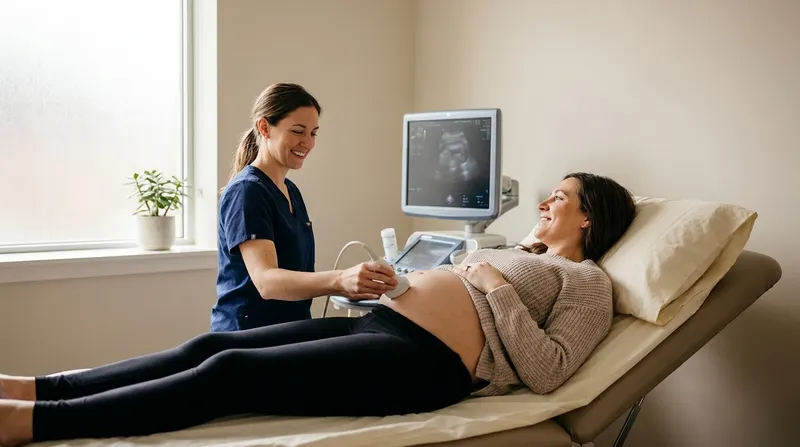
First trimester screening, also called the combined test, is done between 11 and 14 weeks (ideally 11 weeks to 13 weeks and 6 days). It brings together two tests: an ultrasound and a blood test. The program combines their results with your age, weight, and gestational age to produce a single risk estimate. For more on what's happening at this stage, see our guide to the first trimester of pregnancy.
Ultrasound: nuchal translucency (NT) and nasal bone
During the ultrasound, the sonographer measures the nuchal translucency (NT) — a thin pocket of fluid under the skin at the back of the baby's neck. At this stage NT is typically no more than about 2.5–3 mm; an increased measurement doesn't mean a problem on its own, but it raises the calculated risk and warrants a closer look. The sonographer also assesses the presence and appearance of the nasal bone, along with blood flow and other markers. This same scan confirms your due date, the number of babies, and the heartbeat — read about how the first pregnancy ultrasound works.
Bloodwork: PAPP-A and free β-hCG
The blood test measures two proteins: PAPP-A (pregnancy-associated plasma protein A) and free β-hCG. With some chromosomal conditions these markers drift away from typical levels — for example, in Down syndrome PAPP-A is often lower and β-hCG may be higher. What matters is not the raw numbers but how far they deviate from the norm for your gestational age. If you're curious how this hormone changes overall, take a look at typical hCG levels by week.
Second trimester screening (16–18 weeks): the triple and quad test
If first trimester screening wasn't done in time for some reason, or additional assessment is needed, a biochemical screen is offered in the second trimester — usually between 15 and 20 weeks (most often 16–18). This is a blood test known as the triple or quad screen:
- Triple test: AFP (alpha-fetoprotein), hCG, and unconjugated estriol.
- Quad test: the same three markers plus inhibin A, which slightly improves accuracy.
On its own, the AFP level helps assess the risk of neural tube defects. Second trimester screening is usually paired with a detailed anatomy ultrasound (around 18–22 weeks), where the sonographer examines the baby's organs. We've gathered what else matters during these weeks in our article on the second trimester of pregnancy.
NIPT — the noninvasive prenatal test
NIPT (noninvasive prenatal test, an analysis of cell-free fetal DNA) is the most modern screening method. During pregnancy, small fragments of DNA from the placenta — genetically linked to the baby — cross into the mother's bloodstream. NIPT analyzes this cell-free DNA from an ordinary blood draw from a vein.
What's worth knowing about NIPT:
- It can be done early — from about 10 weeks of pregnancy.
- It has very high sensitivity for trisomies 21, 18, and 13 — for Down syndrome, detection exceeds 99%.
- It can also determine the baby's sex and Rh factor.
- It is still a screening test, not a diagnosis: a positive (high-probability) result must be confirmed with invasive testing, because false positives are possible.
- In many countries and clinics NIPT is paid and optional rather than part of the standard free program.
What screening looks for: which conditions it assesses
Prenatal screening calculates the risk primarily of three chromosomal conditions and estimates the likelihood of birth defects:
- Down syndrome (trisomy 21) — the most common chromosomal difference, and the one every type of screening estimates.
- Edwards syndrome (trisomy 18) and Patau syndrome (trisomy 13) — rarer and more serious conditions.
- Neural tube defects (such as spina bifida) — suggested by the AFP level and a detailed ultrasound.
In addition, first trimester combined screening at many clinics can estimate the risk of preeclampsia — using PAPP-A, PlGF, blood pressure, and blood flow in the uterine arteries. This helps start prevention in time. To learn what this condition is and what to watch for, read our article on preeclampsia in pregnancy.
How to read your result: a 1:300 risk, MoM, and "high risk"
A screening result isn't a "yes/no" — it's an individual risk, written as a fraction, for example 1:300. That means: out of 300 people with exactly the same measurements, on average one baby has the condition and 299 do not. The larger the second number, the lower the risk: 1:1500 is a very low risk, while 1:50 is high.
The lab usually sets a cutoff (for example, 1:150 or 1:250). Results above the cutoff fall into the low-risk group, and those below it into the high-risk group. Individual markers are often expressed in MoM (multiples of the median): a value around 1.0 MoM is typical for your gestational age, while notable deviations up or down affect the final calculation.
Your result is strongly influenced by age: the baseline risk of chromosomal differences naturally rises over the years, so even with reassuring markers an older parent may see a higher calculated number. That's a normal feature of the method, not a reason to panic — more on this in our piece about pregnancy after 35.
What to do if your result is "high risk"
A high-risk screening result is a reason to calmly discuss the next step with your provider — not to diagnose yourself. Usually you'll be offered:
- A genetics consultation — a specialist will explain the numbers, factor in your history, and walk you through the options.
- NIPT as a more accurate follow-up screen, if it hasn't been done yet.
- Invasive diagnostic testing for a definitive answer: chorionic villus sampling (CVS) — usually at 11–14 weeks — or amniocentesis (drawing a small amount of amniotic fluid), typically from 15–16 weeks.

Invasive procedures give a definitive result but carry a very small risk of complications, so they're always your voluntary choice. No one can make you go through them; you have every right to pause, ask questions, and decide what information you need.
Is screening safe, and is it mandatory?
Screening itself — the ultrasound and blood test — is completely safe for both mother and baby: it's noninvasive and doesn't affect the course of the pregnancy. The tests are offered and recommended, but the final decision is always yours. You can do the full screening, choose only some of the tests, or decline entirely — and none of that makes you a "bad parent." Your provider's job is to give you information, not to pressure you.
How to prepare for screening
No complicated preparation is needed, but a few things help you get an accurate result:
- An accurate due date. The combined test is calculated by gestational age, so blood is usually drawn after the ultrasound that measures the baby (crown-rump length, CRL). Ideally, have the ultrasound and the blood test within a day or two of each other.
- Ask about eating. Most biochemical tests don't require strict fasting, but it's best to check with the lab ahead of time on exactly how to give your sample.
- Bring your records. Your maternity notes and previous test results will help your provider with the calculation.
- Share the important details: your exact weight, smoking, a multiple pregnancy, an IVF pregnancy, diabetes — all of these are factored into the program.
Screening is one part of the larger plan of tests during pregnancy, which will later include others, such as the glucose tolerance test. Together they help you and your provider navigate the pregnancy with confidence.
Key takeaways
- Screening is a risk assessment, not a diagnosis. "High risk" most often still means a healthy baby.
- First trimester screening (11–14 weeks) is an ultrasound (NT, nasal bone) plus a blood test for PAPP-A and β-hCG.
- Second trimester screening (16–18 weeks) is a triple or quad blood test, often alongside an anatomy ultrasound.
- NIPT from 10 weeks, using the mother's blood, is highly accurate — but a positive result is still confirmed.
- Results are read as a fraction (for example, 1:300) and in MoM; the number is affected by age.
- With a high risk you'll be offered genetics and definitive diagnostics (CVS, amniocentesis) — and it's your choice.
- Screening is safe and entirely voluntary; it doesn't affect the pregnancy.
This article is general information and does not replace individualized medical advice. Make decisions about screening and diagnostic testing together with your OB-GYN or genetic counselor, taking your own situation into account.
Sources
Created with AI and reviewed by the Mama Ai team. Educational information — not a substitute for professional medical advice.
We’re with you every week of the way
Download on the App Store