
Can You Fly While Pregnant? Safety, Weeks & Tips
In a healthy pregnancy, flying is usually safe. Here's how late you can fly while pregnant, the best trimester to travel, and how to lower the real risks.

Mama Ai Team

You're expecting a baby and dreaming of a trip-to the beach, to see family, or for work. And right away the worry creeps in: is it safe to fly while pregnant, could the flight harm the baby, and how late can you even fly? Here's the good news: in a calm, uncomplicated pregnancy, air travel is usually safe for both you and your baby.
In this article we'll cover the essentials-how late you can fly while pregnant, which trimester is the most comfortable, which risks are real (and which are wildly overstated), and how to make your flight as comfortable as possible. This is general information: the final call is always one you make together with your doctor.
Can you fly while pregnant?
For most moms-to-be, the answer is yes. If your pregnancy is progressing without complications and both you and your baby are doing well, a short or medium-length flight generally poses no danger. Major medical organizations-the American College of Obstetricians and Gynecologists (ACOG), the UK's NHS, and the RCOG-agree that flying is safe in a low-risk pregnancy.
The flight itself doesn't trigger labor or harm the baby. Fears that turbulence, takeoff, or landing will "hurt" your little one aren't borne out. What matters far more than the fact of flying is how your pregnancy is going and whether there are any specific contraindications-we'll get to those below.

The best time to fly is the second trimester
If you can plan your trip, the most comfortable window is the second trimester, roughly weeks 14 to 27. By then the nausea and heavy fatigue of the early weeks have usually eased, while the heaviness and approaching labor of the third trimester are still a way off. The risk of complications like miscarriage or preterm labor is also lower during this period.
Flying in the first trimester isn't off-limits, but many moms-to-be are dealing with nausea and fatigue-which can make a flight harder to bear. The third trimester brings its own challenges: sitting for long stretches is tougher, you need the restroom more often, and your legs swell more. On top of that, it's toward the end of pregnancy that airline restrictions kick in.
How late can you fly while pregnant?
There's no medical reason to stop flying at any specific week, but airlines have their own rules-and they vary. Most carriers let you fly with a single pregnancy until about 36 weeks, and with a multiple pregnancy (twins, triplets) usually until about 32 weeks.
From roughly 28 weeks, many airlines ask for a medical certificate from your doctor. It typically states your estimated due date and confirms that the pregnancy is progressing normally with no contraindications to flying. Closer to your due date the certificate needs to be recent-it's often required to be dated no more than 7 days before departure.
Every carrier has its own policy, so be sure to check the specific airline's rules in advance-for both the outbound and return flights. Confirm the cutoff week, whether a certificate is needed, and in which language. That saves you unpleasant surprises at the check-in desk.
The real risks of flying and how to lower them
Air travel during pregnancy comes with a few genuine considerations, but nearly all of them are manageable. Let's go through them one by one.
Deep vein thrombosis (DVT)
Long stretches of sitting still slow the blood flow in your leg veins, and pregnancy itself makes blood a little more prone to clotting. Because of this, long flights raise the risk of deep vein thrombosis (DVT)-a clot that most often forms in the lower leg. This is the main, but very manageable, risk of long-haul flights.
Lowering it isn't hard:
- get up and walk around the cabin every 30-60 minutes when it's safe to do so;
- right in your seat, do some foot exercises: rotate your ankles, flex your toes toward you and away, and raise and lower your heels;
- drink plenty of water and skip alcohol and extra coffee;
- talk to your doctor about compression stockings-they help a lot on long flights;
- if you can, choose an aisle seat so it's easier to get up.
The same steps ease swelling and leg cramps, which often come with pregnancy anyway. One warning sign, though: if after a flight one leg becomes noticeably swollen, red, warm, and painful-don't wait, seek medical care.
Radiation
At altitude, cosmic radiation levels are slightly higher than on the ground. But for occasional flights this dose is negligibly small and isn't considered dangerous for pregnancy. It's a different story for pilots and flight attendants, who spend a great many hours in the air-separate guidelines apply to them. For the average passenger, this isn't something to worry about.
Cabin pressure, motion sickness, and your ears
The pressure and oxygen levels in the cabin are comfortable for a healthy pregnancy-your baby is well protected. Sometimes other little things bother you: mild queasiness, blocked ears, dry air. Here's what helps:
- for motion sickness, pick a seat closer to the wing, look at the horizon, and eat light snacks;
- for blocked ears, swallowing, yawning, and sipping water help;
- bring water and lip balm-the cabin air is dry;
- keep your seatbelt on and try to rest as much as you can.
When it's better not to fly and to ask your doctor first
In some situations it's better to hold off on flying, or at least talk it over with your doctor beforehand. This isn't a reason to panic-it's just that with certain conditions a flight adds unnecessary risk. Extra caution is warranted if you have:
- preeclampsia or pregnancy-related high blood pressure;
- placenta previa or bleeding;
- a threat of preterm labor or your water breaking early;
- severe anemia;
- a previous blood clot or a high risk of DVT;
- certain cases of multiple pregnancy.
This isn't a complete list. If your pregnancy has particular features, you have chronic conditions, or you're simply unsure-a quick chat with your doctor before you buy tickets will clear everything up.
How to prepare for your flight: a checklist
A little preparation, and your flight will go smoothly. Here's what's worth doing ahead of time.
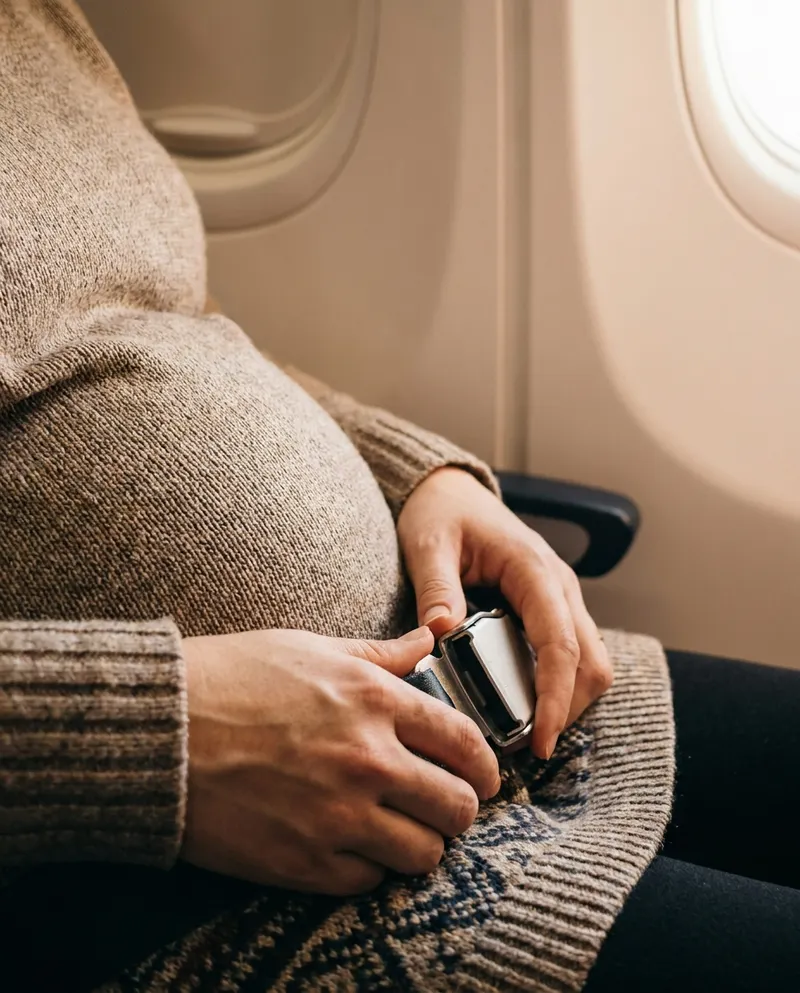
- Check the airline's rules on the cutoff week and certificate-well in advance and for both flights.
- Bring your documents: your maternity records, test results, and your doctor's contact details.
- Get insurance that covers pregnancy, and find out where you can get care at your destination.
- Buckle up correctly: the lap belt should sit under your belly, across your hips-not across your bump.
- Move every 30-60 minutes and do foot exercises.
- Drink water, wear loose clothing and comfortable shoes, and use compression stockings if you'd like.
- Pack snacks and whatever helps you with nausea.
- Consider the region's health situation: some countries carry a risk of, for example, the Zika virus-check ahead of time whether it's safe to travel there while pregnant.
A quick word on security: the archway detectors and scanners at the airport are harmless for pregnant travelers, so you can walk through them without worry. And if it puts your mind more at ease, you can always ask for a manual pat-down.
Key takeaways
- In an uncomplicated pregnancy, flying is usually safe-for both you and your baby.
- The most comfortable window for flying is the second trimester, roughly weeks 14-27.
- Most airlines allow flying until about 36 weeks in a single pregnancy and until about 32 weeks in a multiple pregnancy; from about 28 weeks a doctor's certificate is often required.
- Always check the specific airline's rules in advance-for both flights.
- The main manageable risk of long-haul flights is blood clots: keep moving, drink water, and ask your doctor about compression stockings.
- If you have pregnancy complications (preeclampsia, placenta previa, threatened labor, and so on), check with your doctor first.
This article is general information and does not replace a consultation with your doctor. Make the decision about flying and its timing together with your ob-gyn, taking your individual pregnancy into account.
Sources
Created with AI and reviewed by the Mama Ai team. Educational information — not a substitute for professional medical advice.
We’re with you every week of the way
Download on the App Store